


Last updated: October 13, 2026
Introduction: Ingredients Matter
You wouldn’t eat food without reading the label. Why do it with hair care?
Your scalp absorbs chemicals. Some are beneficial. Others are toxic, drying, or environmental pollutants.
Shampoo bars can contain:
– Natural plant oils (good)
– Biodegradable surfactants (good)
– Harsh sulfates (bad)
– Palm oil (environmental concern)
– Synthetic fragrances (allergenic)
– Microplastics (environmental disaster)
This guide decodes shampoo bar ingredient lists so you can make informed choices for your health, hair, and planet.
The Two Types of Shampoo Bars
Before diving into ingredients, understand the fundamental difference:
Soap-Based Bars
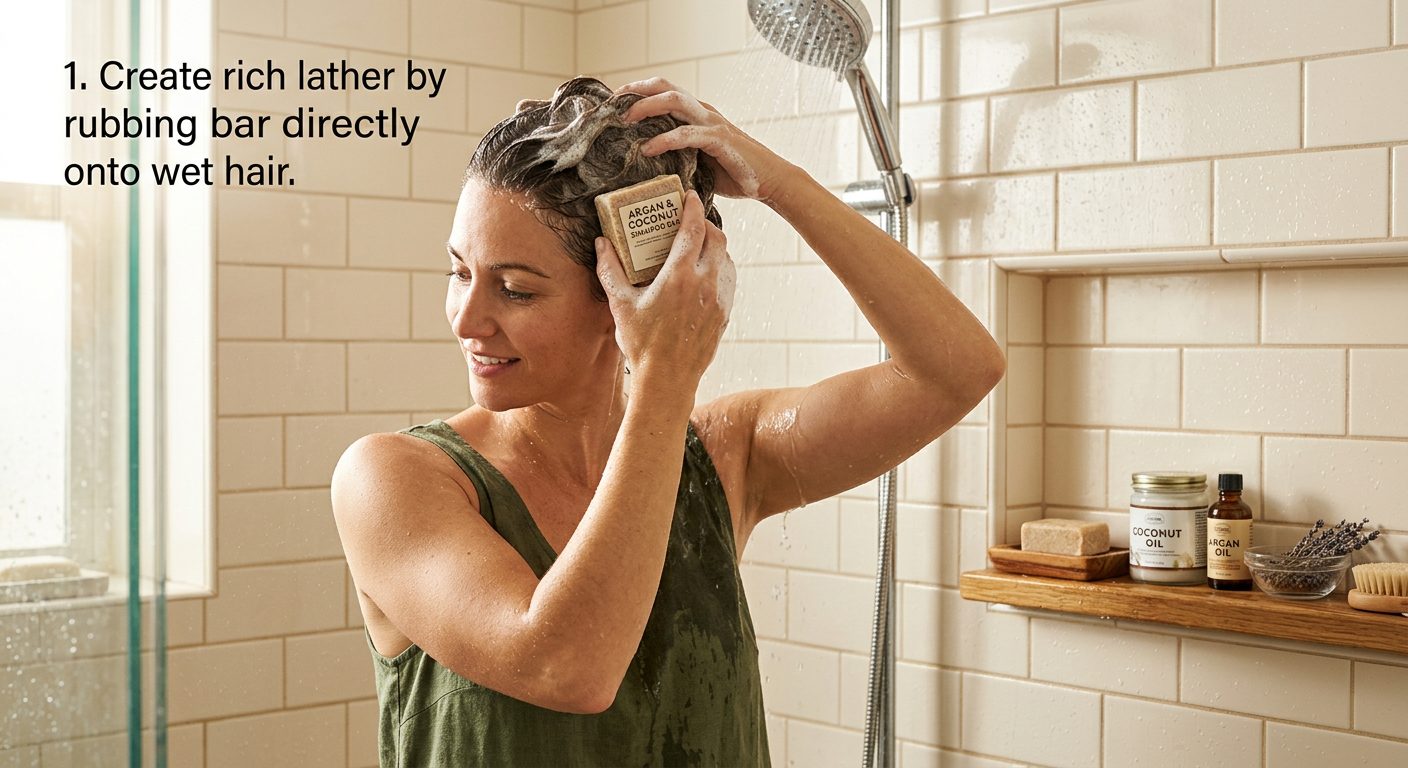
Chemical process: Saponification (oils + lye → soap)
Typical ingredients:
– Coconut oil
– Olive oil
– Castor oil
– Sodium hydroxide (lye)
– Essential oils (fragrance)
pH level: 8-10 (alkaline)
Best for: Soft water areas (<60 ppm), or any water hardness when followed by an ACV rinse
Syndet Shampoo Bars (Synthetic Detergent)
Chemical process: Surfactants formulated for pH balance
Typical ingredients:
– Sodium Cocoyl Isethionate (SCI)
– Cocamidopropyl Betaine
– BTMS-25 (conditioning agent)
– citric acid (pH adjuster)
– Natural oils (nourishment)
pH level: 5-6 (same as hair)
Best for: Hard water areas (120+ ppm), color-treated hair, gentle cleansing
The 5 Core Ingredient Categories
Every shampoo bar contains some combination of:
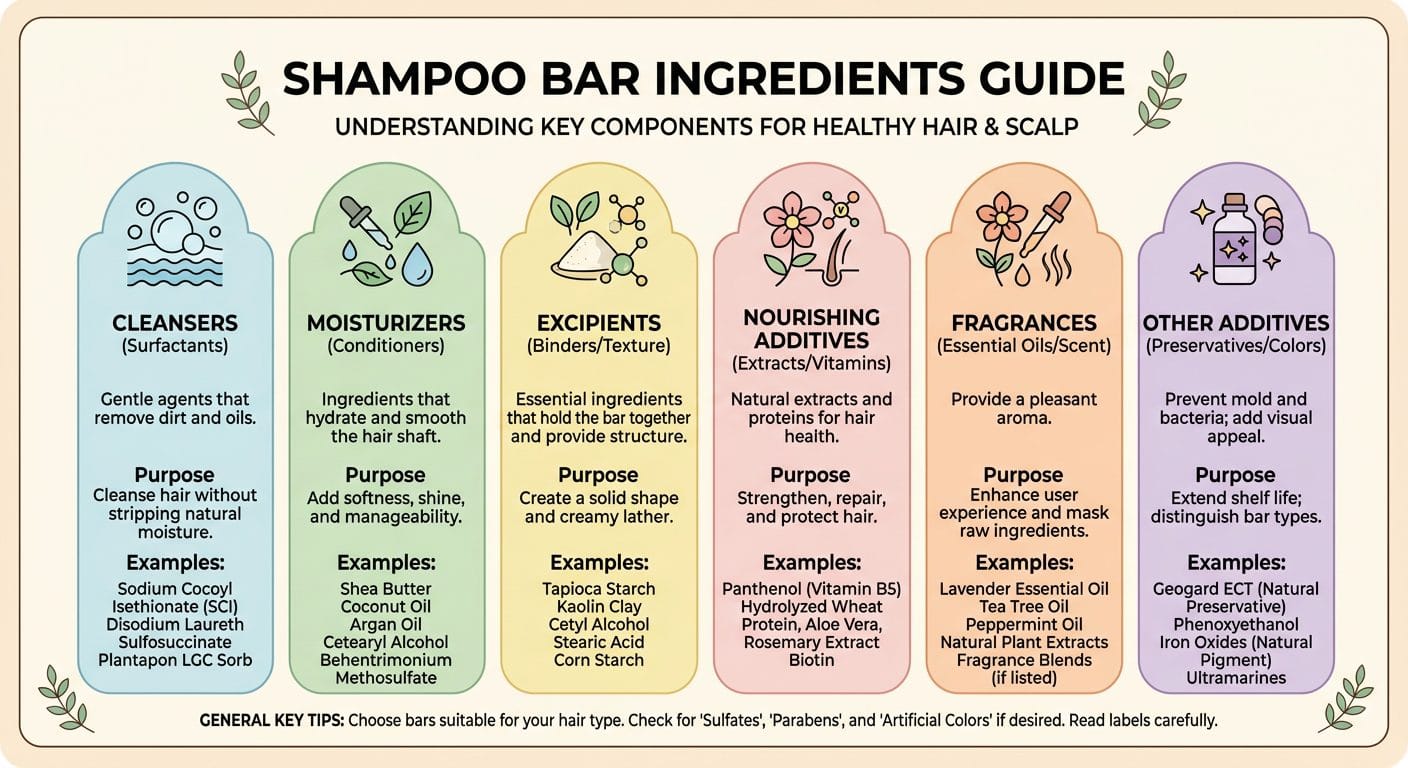
- Cleansers (remove oil, dirt)
- Conditioners (soften, detangle)
- pH Adjusters (balance formula)
- Preservatives (prevent bacteria)
- Extras (fragrance, color, specialty actives)
Let’s break down each category.
Category 1: Cleansers (Surfactants)
What They Do
Surfactants = Surface Active Agents
How they work:
– One end attracts water (hydrophilic)
– Other end attracts oil (lipophilic)
– Bridge between water and oil = wash away sebum, dirt
The Good: Gentle, Effective Cleansers
✅ Sodium Cocoyl Isethionate (SCI)
– Source: Coconut oil
– What it is: Mild surfactant, basis of most natural shampoo bars
– Pros: Gentle, doesn’t strip hair, great lather, pH-balanced
– Cons: None (ideal cleanser)
– Verdict: 🌟 Excellent choice
✅ Cocamidopropyl Betaine
– Source: Coconut oil
– What it is: Amphoteric surfactant (works in all pH levels)
– Pros: Ultra-gentle, boosts lather, conditions while cleansing
– Cons: Derived from coconuts (allergen for rare coconut allergies)
– Verdict: 🌟 Excellent for sensitive scalps
✅ Coco Glucoside
– Source: Coconut + glucose (sugar)
– What it is: Non-ionic surfactant
– Pros: Extremely gentle, biodegradable, suitable for babies
– Cons: Lower lather than SCI
– Verdict: 🌟 Great for ultra-sensitive skin
✅ Decyl Glucoside
– Source: Coconut + corn glucose
– What it is: Ultra-mild non-ionic surfactant
– Pros: Hypoallergenic, biodegradable, Ecocert approved
– Cons: More expensive, harder to find
– Verdict: 🌟 Premium gentle cleanser
The Okay: Moderate Cleansers
⚠️ Sodium Lauryl Sulfoacetate (SLSa)
– NOT the same as SLS (Sodium Lauryl Sulfate)
– What it is: Mild sulfate derivative
– Pros: Good lather, rinses clean, less drying than SLS
– Cons: Can be drying for very dry hair
– Verdict: ✅ Fine for most people, avoid if sensitive
⚠️ Disodium Lauryl Sulfosuccinate
– What it is: Mild surfactant derived from sulfosuccinic acid
– Pros: Gentle, good for sensitive skin
– Cons: Contains sulfate structure (though milder)
– Verdict: ✅ Acceptable, not ideal
The Bad: Harsh, Stripping Cleansers
❌ Sodium Lauryl Sulfate (SLS)
– What it is: Harsh sulfate surfactant
– Problems:
– Strips natural oils (causes dryness, frizz)
– Irritates scalp
– Fades hair color faster
– Harsh on damaged hair
– Verdict: ❌ AVOID — especially in bars (concentrated formula)
❌ Sodium Laureth Sulfate (SLES)
– What it is: Slightly gentler than SLS, but still harsh
– Problems:
– Still strips hair
– Can contain 1,4-dioxane (carcinogenic contaminant from ethoxylation process)
– Not much better than SLS
– Verdict: ❌ AVOID
❌ Ammonium Lauryl Sulfate
– What it is: Ammonia-based sulfate
– Problems: Even harsher than SLS, scalp irritant
– Verdict: ❌ AVOID COMPLETELY
Category 2: Conditioning Agents
What They Do
Conditioners in shampoo bars:
– Coat hair shaft for smoothness
– Prevent tangles
– Add shine
– Reduce frizz
– Protect from damage
The Good: Natural Oils
✅ Coconut Oil (Cocos Nucifera)
– Pros: Penetrates hair shaft, strengthens, prevents protein loss
– Best for: All hair types (low-porosity hair especially)
– Note: Use in moderation (too much = greasy)
✅ Argan Oil (Argania Spinosa)
– Pros: Rich in vitamin E, antioxidants, adds shine without grease
– Best for: Dry, frizzy, color-treated hair
– Sustainability: Labor-intensive harvest (expensive but ethical if sourced properly)
✅ Jojoba Oil (Simmondsia Chinensis)
– Pros: Mimics natural scalp sebum, balances oil production
– Best for: Oily scalp, combination hair
– Unique property: Not technically an oil (liquid wax ester)
✅ Shea Butter (Butyrospermum Parkii)
– Pros: Deeply moisturizing, rich in fatty acids
– Best for: Dry, coarse, curly, or damaged hair
– Cons: Can weigh down fine hair
✅ Cocoa Butter (Theobroma Cacao)
– Pros: Moisturizing, adds slip for detangling
– Best for: Thick, coarse, dry hair
– Cons: Heavy (skip if fine/thin hair)
✅ Castor Oil (Ricinus Communis)
– Pros: Thick, coating oil that seals moisture, promotes shine
– Best for: Damaged hair, split ends
– Unique property: High ricinoleic acid content (anti-inflammatory)
The Good: Synthetic Conditioners
✅ BTMS-25 (Behentrimonium Methosulfate)
– What it is: Quaternary ammonium compound (cationic surfactant)
– NOT a sulfate (despite “methosulfate” in name)
– Pros: Excellent detangling, reduces static, biodegradable
– Best for: All hair types
– Verdict: 🌟 Gold standard conditioning agent
✅ BTMS-50
– Similar to BTMS-25 but with added Cetearyl Alcohol (see below)
– Slightly richer formula
The Okay: Fatty Alcohols
⚠️ Cetyl Alcohol
– NOT drying (despite “alcohol” in name — it’s a fatty alcohol, not rubbing alcohol)
– What it does: Thickens formula, adds smoothness
– Verdict: ✅ Fine for most hair
⚠️ Cetearyl Alcohol
– Blend of cetyl + stearyl alcohols
– Pros: Moisturizing, non-drying
– Cons: Can build up on fine hair over time
– Verdict: ✅ Good for dry/thick hair, use cautiously on fine hair
⚠️ Stearyl Alcohol
– Similar to cetyl alcohol, slightly heavier
– Verdict: ✅ Good for thick/coarse hair
The Bad: Silicones
❌ Dimethicone
– What it is: Synthetic silicone polymer
– Problems:
– Coats hair with waterproof layer (creates “slip” and shine)
– Buildup over time (hair feels heavy, limp, greasy)
– Requires sulfates to remove (harsh cycle)
– Not biodegradable (environmental pollutant)
– Masks damage instead of repairing
– Verdict: ❌ AVOID in bars (you switched to bars to escape this!)
❌ Cyclomethicone
– Lighter silicone than dimethicone, but same problems
– Verdict: ❌ AVOID
❌ Amodimethicone
– “Conditioning” silicone (cationic charge)
– Still causes buildup
– Verdict: ❌ AVOID
Category 3: pH Adjusters
Why pH Matters
Hair’s natural pH: 4.5-5.5 (slightly acidic)
What happens with wrong pH:
– Too alkaline (8+): Cuticle opens, hair becomes rough, tangles, breaks, color fades
– Too acidic (<3): Cuticle closes too tightly, brittle hair, breakage
Goal: pH 5-6 for syndet bars; cold-process soap (pH 9-10) works with an ACV rinse to bring post-wash pH down
The Good: Natural pH Adjusters
✅ Citric Acid
– Source: Citrus fruits (usually corn-derived commercially)
– What it does: Lowers pH to 5-6, removes hard water buildup, adds shine
– Bonus: natural chelator (binds to minerals, prevents buildup)
– Best for: Hard water areas (120+ ppm)
– Verdict: 🌟 Essential in natural shampoo bars
✅ Lactic Acid
– Source: Fermented sugars (vegan) or milk (non-vegan — check source)
– What it does: Lowers pH, gently exfoliates scalp
– Verdict: ✅ Good, but check if vegan matters to you
The Okay: Alkalis (Soap Bars Only)
⚠️ Sodium Hydroxide (Lye)
– Required for soap-making (saponification process)
– What it does: Converts oils into soap
– Safety: Fully reacted in finished product (no free lye remains)
– Result: Alkaline pH (9-10) = why soap bars struggle in hard water
– Verdict: ✅ Safe, but results in higher pH (hard water issues)
⚠️ Potassium Hydroxide
– Similar to sodium hydroxide, creates softer soap
– Verdict: ✅ Safe in soap bars
Category 4: Preservatives & Stabilizers
Why Needed
Shampoo bars contain water? Not typically (solid = long shelf life).
But natural shampoo bars may contain:
– Minimal water in formula
– Oils (can go rancid)
– Exposure to shower moisture
Preservatives prevent:
– Bacterial growth
– Mold
– Oxidation (oils going rancid)
The Good: Natural Preservatives
✅ Vitamin E (Tocopherol)
– What it does: Antioxidant, prevents oil oxidation
– Pros: Natural, beneficial for skin/hair
– Cons: Not antimicrobial (doesn’t kill bacteria)
– Verdict: 🌟 Great for extending oil freshness
✅ Rosemary Extract (Rosmarinus Officinalis)
– What it does: Natural antioxidant
– Pros: Plant-based, gentle
– Cons: Weaker than synthetic preservatives
– Verdict: ✅ Good for low-water formulas
The Okay: Synthetic Preservatives
⚠️ Phenoxyethanol
– What it is: Synthetic preservative (replaces parabens)
– Pros: Effective antimicrobial, considered safe (EU approved up to 1%)
– Cons: Can irritate sensitive skin at high concentrations
– Verdict: ✅ Acceptable, avoid if very sensitive
⚠️ Benzyl Alcohol
– Source: Can be natural (jasmine, ylang-ylang) or synthetic
– What it does: Preservative, solvent, fragrance component
– Pros: Generally safe
– Cons: Can dry out scalp in high concentrations
– Verdict: ✅ Fine in small amounts
The Bad: Parabens
❌ Methylparaben
❌ Propylparaben
❌ Butylparaben
❌ Ethylparaben
- What they are: Widely-used preservatives
- Problems:
- Endocrine disruptors (mimic estrogen)
- Linked to hormone disruption (controversial studies)
- Accumulate in body tissue
- Found in breast cancer tumors (correlation, not proven causation)
- Verdict: ❌ AVOID — easy to find paraben-free alternatives
Category 5: Extras (Fragrance, Color, Specialty Ingredients)
Fragrance
🌸 Essential Oils (Natural Fragrance)
– Examples: Lavender, peppermint, rosemary, tea tree, eucalyptus
– Pros: Natural, aromatherapy benefits, biodegradable
– Cons: Can be allergenic (especially citrus oils), oxidize over time
– Verdict: ✅ Good choice, but check for allergens
❌ Synthetic Fragrance (“Parfum” or “Fragrance”)
– What it is: Trade secret blend (can contain 200+ undisclosed chemicals)
– Problems:
– Allergens (common cause of scalp irritation)
– Phthalates (endocrine disruptors, often hidden in “fragrance”)
– Headache/asthma triggers
– Environmental pollutants (not biodegradable)
– Verdict: ❌ AVOID — opt for essential oils or fragrance-free
Colorants
✅ Natural Colorants
– Examples: Turmeric (yellow), spirulina (green), activated charcoal (black), beetroot powder (pink)
– Pros: Plant-based, safe, biodegradable
– Cons: May stain shower temporarily (rinses off)
– Verdict: 🌟 Great for aesthetics without harm
⚠️ Mica
– What it is: Mineral powder (shimmer/pearlescent effect)
– Ethical concern: Often mined by child labor (India, Madagascar)
– Solution: Look for “ethical mica” or “synthetic mica” certification
– Verdict: ⚠️ Check sourcing
❌ Synthetic Dyes (FD&C, D&C colorants)
– Examples: Yellow 5, Red 40, Blue 1
– Problems:
– Derived from petroleum
– Potential allergens
– Environmental pollutants
– Unnecessary (purely cosmetic)
– Verdict: ❌ AVOID
Specialty Active Ingredients
✅ Panthenol (Pro-Vitamin B5)
– What it does: Moisturizes, strengthens hair, adds shine
– Pros: Penetrates hair shaft, water-soluble (no buildup)
– Verdict: 🌟 Excellent addition
✅ Keratin (Hydrolyzed Keratin)
– What it is: Protein that makes up hair structure
– Pros: Strengthens damaged hair, fills in gaps in cuticle
– Cons: Usually animal-derived (check if vegan matters)
– Verdict: ✅ Effective for damaged hair
✅ Aloe Vera (Aloe Barbadensis)
– What it does: Soothes scalp, moisturizes, reduces inflammation
– Pros: Gentle, beneficial for sensitive scalps
– Verdict: 🌟 Great addition
✅ Activated Charcoal
– What it does: Deep cleanses, removes buildup, detoxifies
– Best for: Oily scalp, product buildup, clarifying washes
– Cons: Can be drying (use 1x/week max)
– Verdict: ✅ Good for occasional use
✅ Clay (Kaolin, Rhassoul, Bentonite)
– What it does: Absorbs excess oil, gentle exfoliation, minerals for hair
– Best for: Oily scalp, fine hair
– Verdict: ✅ Good for oil control
⚠️ Tea Tree Oil (Melaleuca Alternifolia)
– What it does: Antifungal, antibacterial, treats dandruff
– Pros: Effective for scalp issues
– Cons: Can be drying, strong scent, potential allergen
– Verdict: ✅ Good for dandruff, avoid if dry scalp
The Controversial Ingredient: Palm Oil
Why It Matters
Environmental impact:
– 90% of palm production destroys rainforest (Indonesia, Malaysia)
– Orangutan habitat loss (critically endangered species)
– Biodiversity collapse
– Carbon emissions from deforestation
Why it’s used:
– Cheap (€800/ton vs €2,000+ for alternatives)
– Effective (creates hard bars, good lather)
– Versatile (many derivatives: SCI can be palm-based)
The Options
❌ Conventional Palm Oil
– Verdict: AVOID (deforestation)
⚠️ RSPO-Certified Palm Oil
– What it is: “Sustainable” palm certification
– Problems:
– Loopholes (certified plantations still linked to deforestation)
– Greenwashing concerns
– Better than conventional, but not truly sustainable
– Verdict: ⚠️ Less bad, not ideal
✅ Palm-Free Alternatives
– What brands use: Coconut oil, rice bran oil, sunflower oil, shea butter
– Trade-off: Slightly softer bars, but formula science has improved
– Verdict: 🌟 Best choice — palm-free bars now work great
How to spot hidden palm:
Many ingredients are palm-derived but not labeled “palm oil”:
– Sodium Cocoyl Isethionate (SCI) — can be coconut or palm, ASK BRAND
– Stearic acid — often palm, sometimes plant-blend
– Cetyl/Cetearyl Alcohol — often palm-derived
– Glycerin — by-product of soap-making (palm or other oils)
Solution: Look for brands that explicitly state “palm-free” or “coconut-derived SCI.”
Hard Water Ingredients: Essential for Most People
Why Hard Water Ruins Shampoo Bars
Hard water contains:
– Calcium
– Magnesium
– Other minerals (120-300+ ppm)
What happens with soap bars + hard water:
1. Soap (alkaline) reacts with minerals
2. Creates “soap scum” (calcium stearate)
3. Deposits on hair = waxy, dull, tangles
Result: “Shampoo bars don’t work for me!”
Ingredients That Combat Hard Water
✅ Citric Acid
– How it works: Binds to minerals, prevents buildup
– Bonus: Lowers pH (makes bar gentler)
– Verdict: 🌟 ESSENTIAL for hard water areas
✅ EDTA (Ethylenediaminetetraacetic Acid)
– What it is: Synthetic chelating agent
– How it works: Binds to calcium/magnesium, prevents scum
– Pros: Extremely effective
– Cons: Synthetic (not natural), poor biodegradability
– Verdict: ✅ Effective but not eco-friendly
✅ Sodium Citrate
– What it is: Salt of EDTA
– How it works: Water softener, improves lather
– Pros: Natural, biodegradable
– Verdict: ✅ Good addition
✅ Mild Surfactants (SCI, Cocamidopropyl Betaine)
– Why they work: Don’t react with calcium/magnesium ions — no soap scum, even in very hard water
– Result: Clean hair when paired with ACV rinse after every wash
– Verdict: 🌟 Use cold-process soap bars (like Natural Answer) with ACV rinse in hard water
Reading an Ingredient List
Example Shampoo Bar Label
“Natural Cleansing Bar”
Ingredients: Sodium Cocoyl Isethionate, Cocamidopropyl Betaine, Coconut Oil, Shea Butter, Cetyl Alcohol, Citric acid, Panthenol, Essential Oil Blend (Lavender, Peppermint), Vitamin E.
Decoding This Label
✅ Sodium Cocoyl Isethionate — Gentle cleanser (natural shampoo bar)
✅ Cocamidopropyl Betaine — Mild co-surfactant, boosts lather
✅ Coconut Oil — Moisturizing, strengthens hair
✅ Shea Butter — Deep conditioning
✅ Cetyl Alcohol — Fatty alcohol (smooths, not drying)
✅ Citric Acid — pH adjuster, hard water helper
✅ Panthenol — Pro-Vitamin B5, strengthens
✅ Essential Oil Blend — Natural fragrance
✅ Vitamin E — Antioxidant, preserves oils
Verdict: 🌟 Excellent formula — gentle, effective, hard water-friendly, no nasties.
Example 2: “Organic Soap Bar”
Ingredients: Saponified Oils (Olive, Coconut, Palm, Castor), Fragrance, Mica, FD&C Yellow 5.
Decoding This Label
✅ Saponified Oils — True soap (alkaline pH)
❌ Palm Oil — Environmental concern (conventional palm)
❌ Fragrance — Synthetic (undisclosed chemicals, potential allergens)
⚠️ Mica — Check if ethical sourcing
❌ FD&C Yellow 5 — Synthetic dye (petroleum-derived)
Verdict: ❌ Avoid — contains palm oil, synthetic fragrance, unnecessary dyes. “Organic” claim is misleading (palm oil isn’t organic in environmental sense).
Building Your Ideal Ingredient Profile
Based on Hair Type
Fine/Thin Hair:
✅ Lightweight oils (jojoba, argan)
✅ Panthenol (strengthens without weight)
❌ Avoid: Heavy butters (shea, cocoa), too much conditioning
Thick/Coarse Hair:
✅ Rich butters (shea, cocoa)
✅ Deep conditioning agents (BTMS-25)
✅ Oils (coconut, argan, castor)
Curly/Textured Hair:
✅ Moisturizing oils (shea, coconut, argan)
✅ Gentle cleansers (avoid sulfates!)
✅ Conditioning agents (BTMS, fatty alcohols)
Color-Treated Hair:
✅ An acidic finish (an ACV rinse with soap, or a pH 5-6 syndet formula)
✅ Gentle surfactants (SCI, Cocamidopropyl Betaine)
⚠️ Soap bars without ACV rinse (alkaline pH 9–10 can open cuticle) — always follow cold-process soap with ACV rinse to seal cuticle; harsh sulfates ❌
Oily Scalp:
✅ Balancing oils (jojoba, tea tree)
✅ Clay or charcoal (absorbs excess oil)
❌ Avoid: Heavy butters, too much conditioning
Dry/Damaged Hair:
✅ Nourishing oils (argan, coconut, castor)
✅ Panthenol, keratin (repair)
✅ BTMS-25 (detangling)
Based on Water Hardness
Soft Water (<60 ppm):
✅ Soap bars OR natural shampoo bars (both work)
✅ Simple formulas (fewer ingredients)
Hard Water (120+ ppm):
✅ Cold-process soap with an ACV rinse, or a syndet bar (SCI-based)
✅ MUST HAVE: citric acid or an ACV rinse
Very Hard Water (180+ ppm):
✅ Cold-process soap with an ACV rinse, or a syndet bar with citric acid
✅ Consider: Vinegar rinse (1 tbsp ACV in 1 cup water)
✅ OR: Install shower filter
Based on Values
Vegan:
✅ Check: No honey, beeswax, lanolin, milk proteins, keratin (unless plant-based)
✅ Look for: Vegan Society certification
Palm-Free:
✅ Look for: “Palm-free” or “coconut-derived SCI” label
✅ Ask brand: If SCI source isn’t clear
Plastic-Free:
✅ Packaging: Paper/cardboard only
✅ Ingredients: No microplastics (polyethylene beads)
Cruelty-Free:
✅ Certification: Leaping Bunny (strictest)
✅ Check parent company (some indie brands owned by testing companies)
Red Flags: When to Walk Away
❌ “Fragrance” or “Parfum” without specifying essential oils
❌ Sulfates (SLS, SLES) in first 5 ingredients
❌ Parabens (methylparaben, propylparaben, etc.)
❌ Silicones (dimethicone, cyclomethicone)
❌ Conventional palm oil (not RSPO or palm-free)
❌ Synthetic dyes (FD&C, D&C colors)
❌ Microplastics (polyethylene, polypropylene beads)
❌ “Natural” claims without ingredient transparency
⚠️ Soap bar in a hard water area with no ACV rinse (setup for failure)
Green Flags: Quality Indicators
✅ Short ingredient list (10-15 ingredients = focused formula)
✅ Recognizable ingredients (coconut oil, shea butter, citric acid)
✅ pH disclosed (soap is pH 9-10, so look for ACV-rinse guidance; syndet bars are pH 5-6)
✅ Palm-free clearly stated
✅ Essential oils for fragrance (instead of “fragrance”)
✅ Certifications (Leaping Bunny, Vegan Society, EcoCert)
✅ Brand transparency (source of ingredients disclosed)
✅ Plastic-free packaging (paper only)
✅ Citric acid or ACV-rinse guidance (if targeting hard water areas)
Related reading: the 6 plant oils saponified in our bars, and why each one is there.
Frequently Asked Questions
Are “natural” ingredients always better?
No. Natural ≠ automatically safe or effective.
Counterexamples:
– Poison ivy = natural, but toxic
– Arsenic = natural, but deadly
– Soap bars with palm oil = “natural” but environmentally destructive
Synthetic ingredients that are good:
– Sodium Cocoyl Isethionate (gentle, coconut-derived surfactant)
– BTMS-25 (biodegradable conditioning agent)
– Citric acid (technically synthesized from corn fermentation)
The rule: Judge ingredients individually, not by “natural vs synthetic” label.
How do I know if a brand is lying about ingredients?
Red flags for greenwashing:
1. Vague claims (“eco-friendly” without specifics)
2. No ingredient list on website
3. “Natural fragrance” (could still be synthetic)
4. “Organic” without certification
5. Avoidance when you ask about palm oil sourcing
How to verify:
– Check ingredient list against this guide
– Ask specific questions (“Is your SCI coconut or palm-derived?”)
– Look for third-party certifications (Leaping Bunny, Vegan Society)
– Check reviews (honest users will mention issues)
Can I be allergic to shampoo bar ingredients?
Yes. Common allergens:
Essential oils:
– Lavender (common allergen)
– Citrus oils (photosensitivity)
– Tea tree (irritant in high concentrations)
– Peppermint (too strong for some)
Coconut-derived ingredients:
– Rare, but possible (SCI, Cocamidopropyl Betaine)
Synthetic fragrance:
– Major allergen (one reason to avoid)
What to do:
– Patch test new bars (rub on inner elbow, wait 24h)
– Start with fragrance-free if sensitive
– Check ingredient list against known allergens
Do shampoo bars need preservatives?
Depends on formula:
True soap bars: No (no water = bacteria can’t grow)
natural shampoo bars:
– Minimal water content = long shelf life without preservatives
– Some use Vitamin E (prevents oil oxidation)
– A few use phenoxyethanol (low concentration)
Liquid shampoo (for comparison): YES, requires strong preservatives (70-80% water = bacteria heaven)
Verdict: Bars need fewer/gentler preservatives than liquid shampoo.
What if I can’t pronounce an ingredient?
Complex names ≠ always bad.
Examples of hard-to-pronounce but GOOD ingredients:
– Cocamidopropyl Betaine (gentle surfactant)
– Behentrimonium Methosulfate (BTMS — excellent conditioner)
– Tocopherol (Vitamin E)
How to research:
1. Google “[ingredient name] shampoo bar”
2. Check EWG Skin Deep database (rates safety)
3. Look for function (cleanser, conditioner, preservative)
4. Cross-reference this guide
Don’t judge by syllable count — judge by function and safety.
The Bottom Line
Great shampoo bar ingredients:
– Saponified plant oils (cold-process soap) or gentle syndet surfactants (SCI, Cocamidopropyl Betaine)
– Natural oils (coconut, argan, jojoba)
– pH adjusters (citric acid — essential for hard water!)
– Conditioning agents (BTMS-25)
– Essential oils (fragrance)
– Vitamin E (preserves oils)
Ingredients to avoid:
– Harsh sulfates (SLS, SLES)
– Silicones (dimethicone)
– Parabens
– Synthetic fragrance
– Conventional palm oil
– Synthetic dyes
The most important factor? Match formula to your water hardness.
– Hard water = cold-process soap with an ACV rinse, or a syndet bar with citric acid
– Soft water = soap OR natural shampoo bar (both work)
Your move: Read that ingredient list. You’re now equipped to make an informed choice.
Want a shampoo bar with clean ingredients, hard water protection, and zero palm oil? [Browse our transparent formulas →]
Questions about a specific ingredient? Drop a comment — we’ll decode it.
Last updated: March 2026
Sources: Cosmetic Ingredient Review (CIR), EWG Skin Deep Database, biodegradability studies
Start Your Natural Hair Care Journey
Understanding ingredients is the first step. The next? Trying a high-quality shampoo bar yourself. Our complete starter kit takes the guesswork out – we’ve curated the best ingredients in one convenient package, along with all the accessories you need for success.