


Last updated: October 7, 2026
Introduction

You bought a shampoo bar. You tried it. Your hair feels waxy, greasy, or coated.
“These bars don’t work!”
But here’s the truth: It’s not the bar. It’s the silicones.
If you’ve been using conventional shampoo, conditioner, or styling products, your hair is likely coated in silicones — synthetic polymers that create a waterproof seal around each strand. This coating prevents shampoo bars from cleaning effectively, causes buildup, and creates the frustrating “transition period” most people experience.
The good news? You can remove silicones completely and reset your hair for successful shampoo bar use. This guide shows you exactly how.
What Are Silicones and Why Do They Matter?
Common Silicones in Hair Products
Silicones are synthetic ingredients added to shampoos, conditioners, and styling products to create:
– Instant shine (light reflection off the coating)
– Smoothness (slippery surface reduces friction)
– Frizz control (seals cuticle gaps)
– Heat protection (waterproof barrier)
Common silicone names on ingredient labels:
– Dimethicone (most common)
– Amodimethicone (bonds to damaged areas)
– Cyclomethicone (lightweight, evaporates)
– Cyclopentasiloxane (volatile silicone)
– Dimethiconol (heavier, harder to remove)
– Phenyl trimethicone (adds shine)
– Anything ending in “-cone” or “-siloxane”
Why Silicones Cause Problems with Shampoo Bars
The coating effect:
1. Silicones create a waterproof layer on your hair
2. Shampoo bars clean the hair shaft itself — not synthetic coatings
3. The silicone layer blocks the bar’s cleansing agents
4. Result: Hair feels greasy, waxy, or heavy (the bar can’t reach the hair underneath)
The buildup cycle:
– Conventional shampoos use sulfates (SLS, SLES) to strip silicones
– Shampoo bars don’t contain sulfates (gentler, but can’t remove silicones)
– Without sulfates, silicones accumulate layer by layer
– After 1-2 weeks, buildup becomes obvious (dull, lifeless, greasy-looking hair)
Why natural bars struggle:
– Natural ingredients (coconut oil surfactants, olive oil, shea butter) work on natural hair oils — not synthetic polymers
– Silicones require aggressive detergents (sulfates) or clarifying agents to remove
– Your shampoo bar is doing its job — it’s just cleaning on top of the silicone layer, not the hair itself
How to Tell If You Have Silicone Buildup
Visual Signs
✅ You have silicone buildup if:
– Hair looks shiny when wet, dull when dry
– Roots get greasy fast, ends stay dry
– Hair feels slippery but lifeless
– Products don’t absorb (they sit on top)
– Hair tangles easily despite using conditioner
– Flat, limp roots with no volume
– “Coated” feeling (hair doesn’t feel like hair)
✅ You probably have silicones if you use:
– Drugstore shampoo/conditioner (TRESemmé, Pantene, Herbal Essences, Dove)
– Anti-frizz serums (John Frieda, Garnier)
– Heat protectants (most contain dimethicone)
– Leave-in conditioners (silicones create “slip”)
– 2-in-1 shampoo/conditioner (always contains silicones)
The Water Test
Try this:
1. Wet your hair thoroughly
2. Squeeze a section between your fingers
3. Does water bead up and slide off? Silicones.
4. Does water absorb into the hair? No silicone coating.
Healthy hair absorbs water like a sponge. Silicone-coated hair repels it.
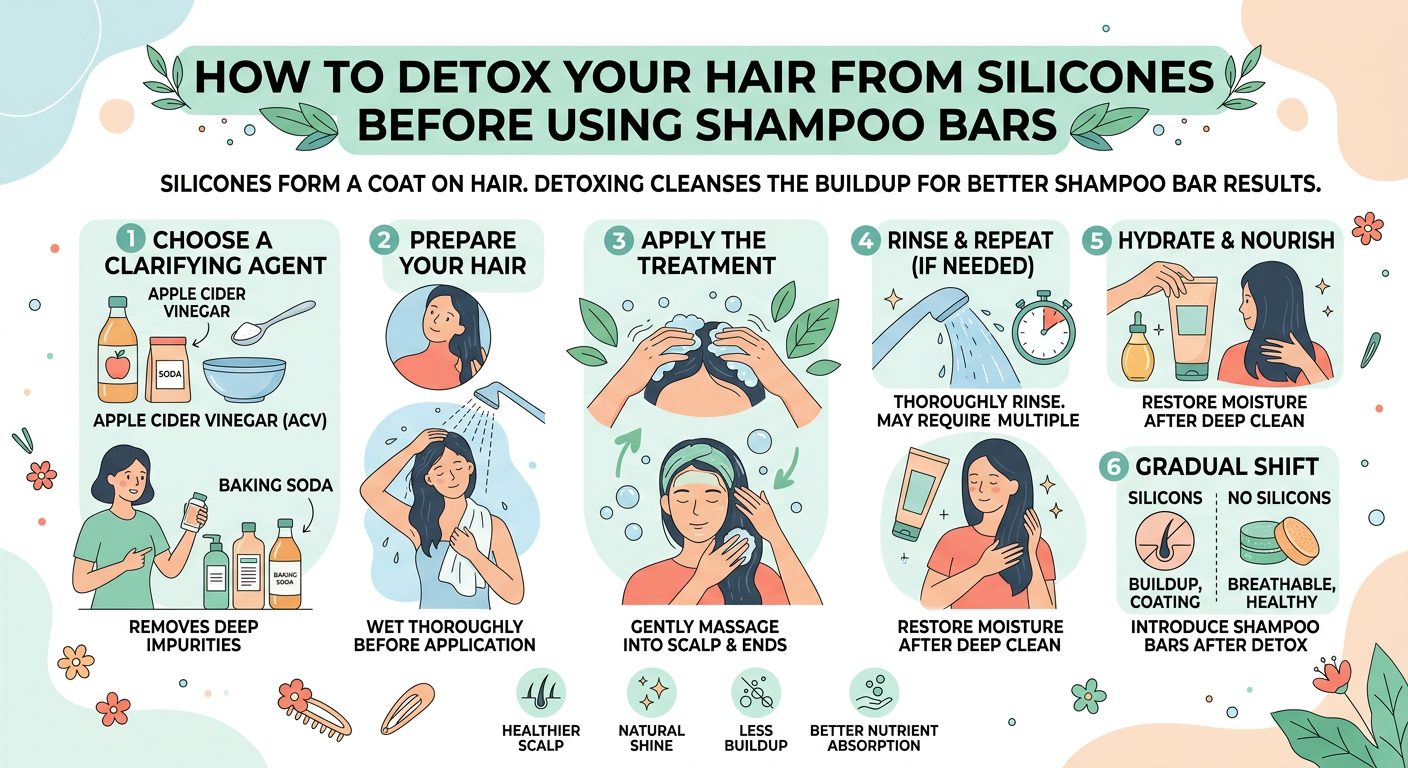
The Complete Silicone Detox Process
Step 1: Final Clarifying Wash (Day 1)
What you need:
– Clarifying shampoo (sulfate-based, just for this one wash)
– Recommended: Neutrogena Anti-Residue Shampoo, Suave Daily Clarifying Shampoo, or any “build-up removing” shampoo
– Check ingredients: Must contain sulfates (Sodium Lauryl Sulfate or Sodium Laureth Sulfate)
Why sulfates just once:
– Sulfates are aggressive detergents that strip everything — including silicones
– You’re using them strategically to remove buildup, not as a regular cleaner
– One clarifying wash removes 80-90% of silicone coating
– After this, you won’t need sulfates again (shampoo bars maintain clean hair)
How to clarify:
1. Wet hair thoroughly (hot water opens cuticles, helps removal)
2. Apply clarifying shampoo (focus on roots, mid-lengths, ends)
3. Massage for 3-5 minutes (mechanical action helps break down silicones)
4. Rinse completely (no residue left)
5. Repeat (yes, shampoo twice — first wash breaks down, second wash removes)
6. Skip conditioner (silicone-free hair doesn’t need it immediately)
What to expect:
– Hair feels squeaky, even slightly rough (that’s clean hair — you’ve never felt it before!)
– Tangles more than usual (cuticles are open, no silicone “slip”)
– Looks matte, not shiny (natural hair isn’t plastic-shiny — that was the silicones)
– Feels lighter, bouncier (no coating weighing it down)
Important: If you have hard water (120+ ppm), add an apple cider vinegar rinse after clarifying:
– Mix 1 tbsp ACV + 1 cup water
– Pour over hair after final rinse
– Leave 1-2 minutes, rinse with cool water
– Why? Hard water minerals can create their own buildup — ACV prevents this
Step 2: First Shampoo Bar Wash (Day 2-3)
Give your scalp 1-2 days to rebalance:
– Clarifying strips natural oils too (not just silicones)
– Your scalp needs 24-48 hours to produce sebum (natural oil)
– Washing too soon = dry, irritated scalp
First shampoo bar wash:
1. Wet hair thoroughly (1-2 minutes under warm water)
2. Rub bar directly on hair (root to tip, 5-10 strokes per section)
3. Lather and massage (focus on scalp, not ends)
4. Rinse completely (2-3 minutes — longer than you think!)
5. Optional: ACV rinse (if hard water, or if hair feels tangled)
6. Air dry or low heat (no heat styling for first week if possible)
What to expect:
– First wash: Hair feels clean but may look dull (this is normal — no silicone shine)
– Days 2-4: Scalp adjusts oil production (may feel slightly greasy — resist washing daily!)
– Days 5-7: Hair starts looking healthier (natural shine returns, not fake gloss)
– Week 2+: Hair feels soft, bouncy, clean (transition complete!)
Step 3: The Transition Period (Weeks 1-3)
Your scalp is relearning how much oil to produce:
– Silicones tricked your scalp into overproducing (coating blocked oil absorption)
– Sulfates stripped everything (scalp panicked and made more oil)
– Now: Your scalp needs 2-4 weeks to find its natural balance
Common transition symptoms:
| Symptom | Why It Happens | Solution |
|---|---|---|
| Greasy roots, dry ends | Scalp overproducing (still adjusting) | Focus shampoo bar on roots only; ACV rinse on ends |
| Hair looks dull/matte | No silicone shine (this is healthy hair!) | Wait 2 weeks — natural shine returns |
| Tangling/roughness | Cuticles open (no silicone seal) | ACV rinse (closes cuticles), boar bristle brush |
| Waxy feeling | Hard water reaction OR incomplete rinsing | Use softer water, rinse 3+ minutes, ACV rinse |
| Itchy scalp | Adjustment period OR product sensitivity | Space out washes (every 2-3 days), try different bar |
Timeline expectations:
– Week 1: Adjustment (hair feels different, not “bad” — just new)
– Week 2: Improvement (scalp oil production normalizing)
– Week 3: Balance (hair looks and feels great)
– Week 4+: New normal (you’ll never go back to silicones!)
Hard Water + Silicone Detox: Double Challenge
If you live in a hard water area (120+ ppm calcium/magnesium), you face TWO types of buildup:
1. Silicone coating (from old products)
2. Mineral deposits (from hard water)
Why Hard Water Makes Detox Harder
The double-layer effect:
– Clarifying shampoo removes silicones ✅
– But hard water minerals bond to hair immediately ❌
– Result: You swap silicone buildup for mineral buildup (still waxy, dull hair)
Solution: Chelating + Clarifying
Option 1: Chelating shampoo (if available)
– Malibu C Hard Water Wellness Shampoo
– Ion Hard Water Shampoo
– Ingredients: EDTA, citric acid, or phytic acid (chelators = mineral removers)
– Use instead of regular clarifying shampoo (chelates minerals + removes silicones)
Option 2: DIY chelating treatment
1. Mix 2 tbsp citric acid powder + 1 cup warm water
2. Apply to wet hair after clarifying shampoo (before rinsing)
3. Leave 5-10 minutes (chelates calcium/magnesium)
4. Rinse thoroughly
5. Follow with ACV rinse (restores pH)
Option 3: Ongoing ACV rinses
– After every shampoo bar wash, use ACV rinse (1 tbsp ACV + 1 cup water)
– Citric acid in ACV prevents mineral buildup
– Makes transition 10x easier in hard water areas
Hard water test:
– Check your local water report (Google “[your city] water hardness”)
– 0-60 ppm = soft (no extra steps needed)
– 60-120 ppm = moderately hard (ACV rinse recommended)
– 120-180 ppm = hard (ACV rinse mandatory)
– 180+ ppm = very hard (chelating treatment + ACV rinse)
Pro tip: If you have very hard water (180+ ppm), consider a shower filter (removes 50-70% of minerals, makes shampoo bars work 10x better).
Products to Avoid During Detox (And Forever)
Read Your Labels!
Silicones to avoid:
– Dimethicone
– Amodimethicone
– Cyclomethicone
– Cyclopentasiloxane
– Dimethiconol
– Any ingredient ending in “-cone” or “-siloxane”
Hidden silicones in:
– ❌ Heat protectant sprays (almost all contain dimethicone)
– ❌ Anti-frizz serums (silicones create “smoothness”)
– ❌ Leave-in conditioners (dimethicone = slip)
– ❌ Hair masks (amodimethicone bonds to damage)
– ❌ Styling creams (cyclomethicone = lightweight hold)
– ❌ Dry shampoos (some use silicones for texture)
Sulfates (avoid after detox):
– Sodium Lauryl Sulfate (SLS)
– Sodium Laureth Sulfate (SLES)
– Ammonium Lauryl Sulfate
– Why? You don’t need harsh stripping anymore — shampoo bars maintain clean hair gently
Parabens, synthetic fragrances, phthalates:
– Not directly related to silicone detox
– But if you’re switching to natural hair care, avoid these too (hormone disruptors, allergens)
Maintaining Silicone-Free Hair
Your New Routine (Post-Detox)
Shampoo bar washing (every 2-3 days):
1. Wet hair 1-2 minutes (warm water)
2. Rub bar on hair (5-10 strokes per section)
3. Lather and massage scalp (1-2 minutes)
4. Rinse thoroughly (3+ minutes)
5. ACV rinse (if hard water, or weekly as treatment)
6. Air dry or low heat
Conditioner bars (optional):
– Apply mid-lengths to ends only (not roots!)
– Leave 1-2 minutes
– Rinse thoroughly
– Choose silicone-free conditioner bars (check ingredients!)
Styling products:
– ✅ Natural oils (argan, jojoba, coconut — small amounts!)
– ✅ Aloe vera gel (frizz control, no buildup)
– ✅ Sea salt spray (texture, no coating)
– ❌ Conventional serums (back to silicone trap!)
How often to wash:
– Fine/oily hair: Every 2 days
– Normal hair: Every 2-3 days
– Dry/curly hair: Every 3-4 days
– Goal: Train your scalp to produce less oil (washing daily = more grease!)
Troubleshooting: “I Detoxed But Still Have Issues”
Problem: Hair still feels waxy/coated
– Cause: Incomplete silicone removal OR hard water minerals
– Solution: Repeat clarifying wash + chelating treatment (citric acid soak)
Problem: Hair looks dull, no shine
– Cause: This is normal! Natural hair isn’t plastic-shiny
– Solution: Wait 3-4 weeks (natural shine returns), use boar bristle brush (distributes oils)
Problem: Scalp is greasy, ends are dry
– Cause: Scalp still adjusting oil production
– Solution: Focus shampoo bar on roots only, ACV rinse on ends, wait 1-2 more weeks
Problem: Hair feels dry/brittle
– Cause: Over-washing OR hard water damage
– Solution: Wash less often (every 3 days), deep condition once/week, ACV rinse every wash
Problem: Shampoo bar doesn’t lather
– Cause: Hard water OR bar formula doesn’t match water type
– Solution: Switch to detergent bar (works in hard water), use warm water, rub bar longer
Why Natural Answer Shampoo Bars Work After Detox
The Cold-Process Soap Advantage
What makes our bars different:
– Cold-process soap formula: 6 organic plant oils saponified with lye — real soap, pH 9–10
– Acidic rinse (ACV): A diluted apple cider vinegar rinse after washing closes the cuticle and clears hard-water minerals
– Palm oil-free: Ethical, sustainable, no waxy residue
– No synthetic detergents, no SCI: Pure saponified plant oils — nothing synthetic
Why this matters post-detox:
– You removed silicones ✅
– You removed hard water minerals ✅
– Now: Our bars maintain clean hair without harsh chemicals
– No sulfates needed — saponified plant oils clean effectively without harsh sulfates
– No silicones needed — plant-oil soap plus an ACV rinse keeps hair manageable
The hard water guarantee:
– Tested in Dutch water (120-180 ppm) — works beautifully
– Works in European hard water regions (Belgium, Germany, UK, Croatia)
– If you have hard water, our bars are designed for you
What customers say after detox:
“I clarified once, switched to Natural Answer bars, and never looked back. My hair has NEVER been this soft!” — Emma, Netherlands
“The first week was weird (no fake shine), but now my hair is healthier than it’s been in years. Real shine, not plastic coating!” — Sophie, Belgium
“I live in a very hard water area. After detoxing and using these bars with ACV rinses, my hair is finally clean. No more waxy buildup!” — James, UK
The Science Behind Silicone-Free Hair
Why Silicones Are Marketing, Not Haircare
The illusion of “healthy” hair:
– Silicones create instant shine, smoothness, softness
– But: They coat hair, don’t repair it
– Underneath the coating: Hair is still dry, damaged, dull
– Silicones mask problems, don’t solve them
What actually repairs hair:
– Moisture: Water, humectants (glycerin, aloe), natural oils
– Protein: Keratin, wheat protein, silk (rebuilds structure)
– pH balance: 4.5-5.5 (closes cuticles, prevents damage)
– Protection: Avoiding heat, harsh chemicals, over-processing
Silicone-free hair timeline:
– Week 1: Adjustment (hair feels “naked” — this is normal!)
– Week 2-4: Improvement (natural oils coat hair, real shine emerges)
– Month 2+: Transformation (hair is stronger, bouncier, healthier)
– Month 6+: New normal (you’ll never recognize your old silicone-coated hair)
Long-term benefits:
– ✅ Stronger hair (no coating = better nutrient absorption)
– ✅ Faster growth (healthy scalp = better follicle health)
– ✅ Less breakage (hair isn’t dried out by sulfate/silicone cycle)
– ✅ Better color retention (if dyed — silicones fade color faster)
– ✅ Environmental impact (silicones don’t biodegrade, pollute waterways)
FAQs: Silicone Detox
How long does silicone detox take?
1 clarifying wash removes 80-90% of silicones. Full detox (scalp adjustment) = 2-4 weeks.
Can I skip the clarifying shampoo?
Not recommended. Shampoo bars can’t remove existing silicones (no sulfates). You’ll struggle with buildup for months. One clarifying wash = clean slate.
Will my hair feel “squeaky clean” after clarifying?
Yes! That’s what clean hair feels like (no silicone coating). It may feel slightly rough — this is normal. ACV rinse smooths cuticles.
What if I accidentally use a silicone product during detox?
Start over. One silicone application = back to buildup. Check ALL products (conditioner, leave-ins, styling creams). Read ingredients carefully!
Do I need to detox if I’ve always used natural products?
Probably not. If you’ve never used conventional shampoo/conditioner (silicones), you can skip clarifying. Just switch directly to shampoo bars.
Can I use coconut oil during detox?
Yes, but sparingly. Natural oils (coconut, argan, jojoba) don’t coat like silicones. Apply only to ends, tiny amounts (pea-sized). Too much = greasy hair.
What if my hair still feels waxy after clarifying?
Two possibilities:
1. Hard water minerals (not silicones) — use chelating treatment + ACV rinse
2. Shampoo bar formula doesn’t match your water — try detergent bar instead
How do I know if a product contains silicones?
Check ingredients: Anything ending in “-cone” or “-siloxane” = silicone. Common culprits: dimethicone, cyclomethicone, amodimethicone.
Can I use heat styling after detox?
Yes, but use heat protectant WITHOUT silicones. Try argan oil or aloe-based sprays. Most conventional heat protectants = dimethicone (back to silicone trap!).
Will my hair be less shiny without silicones?
Different shine. Silicones = plastic-gloss (artificial). Natural hair = soft-glow (real). Give it 3-4 weeks — your natural shine will emerge (and it’s better!).
Final Thoughts
Detoxing your hair from silicones is the single most important step for successful shampoo bar use.
Without detox:
– Shampoo bars can’t clean effectively (silicone coating blocks them)
– You’ll experience waxy buildup, greasiness, frustration
– You’ll give up and think “shampoo bars don’t work”
With detox:
– Clean slate = shampoo bars work beautifully
– Hair feels light, bouncy, naturally soft
– You’ll wonder why you ever used silicones in the first place
The process:
1. One clarifying wash (removes 80-90% of silicones)
2. First shampoo bar wash (24-48 hours later)
3. 2-4 week transition (scalp rebalances oil production)
4. Silicone-free life (healthier hair, forever!)
Your hair deserves to breathe. Give it the chance — detox the silicones, switch to Natural Answer bars, and experience what real hair health feels like.
Ready to make the switch? Browse our palm-free, silicone-free shampoo bars designed for hard water at naturalanswerproducts.com.
Written by Natural Answer Products | Last updated: March 2026
Make the Transition Easier
Detoxing your hair and switching to natural shampoo bars is easier with the right tools. Our transition starter kit includes a sulfate-free, silicone-free shampoo bar specifically formulated to help your hair adjust, plus proper storage to keep it lasting longer.