


Last updated: October 7, 2026
Introduction
If you live in Europe and you’ve struggled with shampoo bars leaving your hair feeling waxy, greasy, or heavy, you’re not alone. The problem isn’t the bars—it’s your water.
Most of Europe has hard to very hard water. Cities like London, Paris, Amsterdam, Berlin, Barcelona, and Rome have calcium and magnesium levels that wreak havoc on natural hair care products. Any true soap forms “soap scum” in hard water, leaving a filmy residue on your hair. Even synthetic detergent bars leave minerals behind, they just do it without the scum.
But here’s the good news: once you understand your local water hardness and know the one habit that fixes it formulation, you can have beautiful, healthy hair—no compromises.
This guide breaks down water hardness across Europe by country and city, explains which shampoo bar ingredients work best in different water types, and gives you actionable recommendations for every major European market.
What You’ll Learn: – How hard is the water in your European country/city? – Why European water causes unique challenges for shampoo bars – Which shampoo bar ingredients (chelators) work best in hard water – Country-by-country recommendations and tips – How to test your water and adjust your hair routine
Whether you’re in Germany, France, the Netherlands, Spain, Italy, or anywhere else in Europe, this guide will help you find shampoo bars that actually work for your water.
Understanding Hard Water When Choosing Shampoo Bars for Europe
Water hardness is measured in parts per million (ppm) of dissolved calcium and magnesium minerals, or in German degrees of hardness (°dH), French degrees (°f), or English degrees (°e).
Quick conversion: – 1 °dH (German degrees) = 17.8 ppm – 1 °f (French degrees) = 10 ppm – 1 °e (English degrees) = 14.3 ppm
European Water Hardness Scale
| Classification | ppm (CaCO₃) | °dH | °f | Hair Impact |
|---|---|---|---|---|
| Soft | 0-60 | 0-3.4 | 0-6 | No issues with any shampoo bars |
| Moderately soft | 61-120 | 3.4-6.7 | 6-12 | True soap works well; an occasional vinegar rinse keeps it clear |
| Moderately hard | 121-180 | 6.7-10 | 12-18 | True soap needs a vinegar rinse after most washes |
| Hard | 181-250 | 10-14 | 18-25 | True soap needs a vinegar rinse every wash; detergent bars need none |
| Very hard | 251-350 | 14-20 | 25-35 | Vinegar rinse every wash, or switch to a detergent bar for zero maintenance |
| Extremely hard | 350+ | 20+ | 35+ | Requires aggressive chelation + ACV rinses |
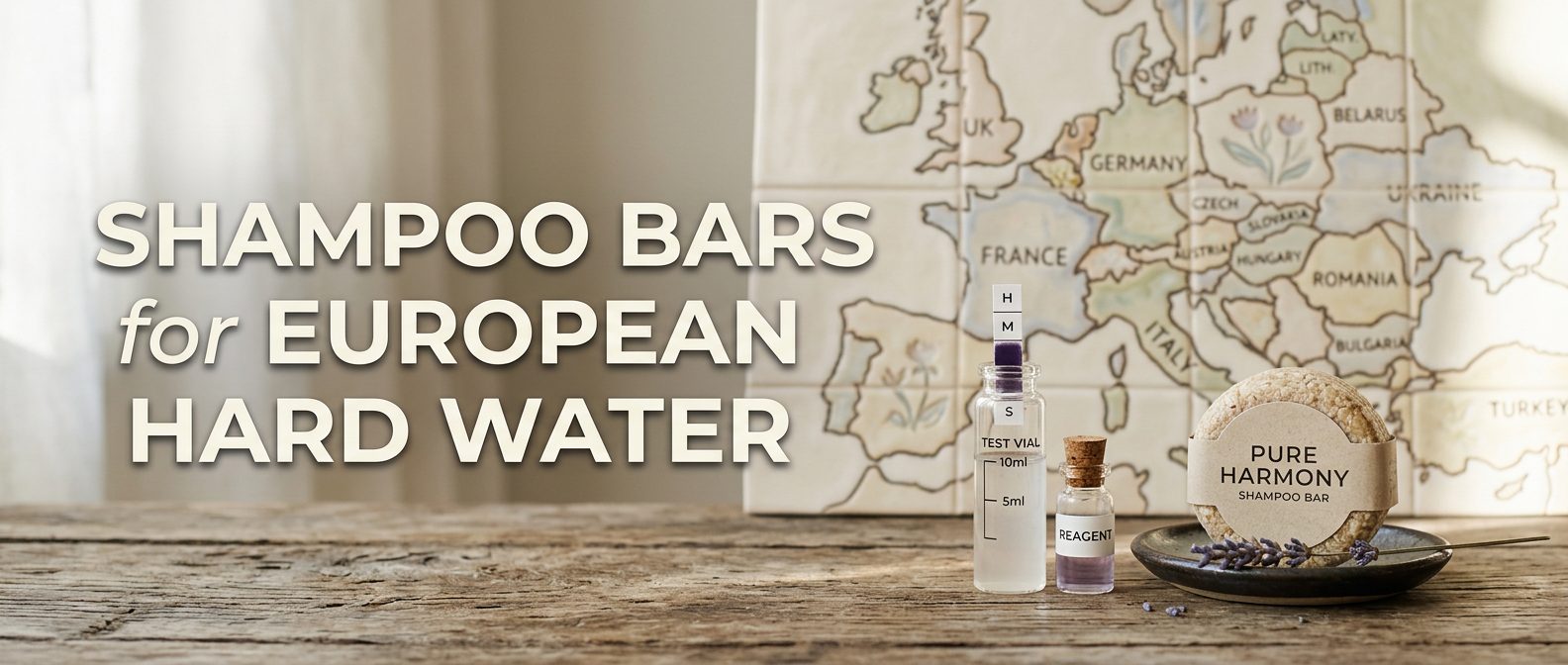
Most of Western and Central Europe falls into the moderately hard to very hard categories (120-350 ppm). Some cities exceed 400 ppm.
Why European Water Is So Hard
Europe’s geology creates naturally hard water:
Limestone and chalk regions: England (chalk downs), northern France (Paris Basin), southern Germany (Swabian Jura), northern Spain (Pyrenees foothills) all sit on limestone-rich geology. Rainfall dissolves calcium carbonate from the rock and carries it into groundwater.
Alpine regions: Switzerland, Austria, southern Germany, northern Italy draw water from limestone-rich Alpine aquifers.
Ancient seabeds: The Netherlands, Belgium, parts of Denmark were underwater millions of years ago. Their geology is rich in calcium and magnesium deposits.
Agricultural runoff: Intensive agriculture in countries like the Netherlands and Belgium leaches additional minerals into groundwater.
Unlike many other regions (e.g., Scandinavia, Scotland), Europe doesn’t have widespread granite bedrock that produces soft water. The result: most Europeans wash their hair in mineral-rich water.
European Water Hardness by Country
Here’s a breakdown of average water hardness across major European countries, with specific cities included.
🇩🇪 Germany (Deutschland)
Average hardness: 150-300 ppm (moderately hard to very hard)
Why Germany has hard water: Southern and central Germany sit on limestone geology (Swabian Jura, Franconian Jura). Northern Germany has softer water due to glacial sand/gravel deposits.
City-by-City:
| City | Hardness (ppm) | Hardness (°dH) | Classification |
|---|---|---|---|
| Berlin | 140-180 | 8-10 | Moderately hard |
| Munich (München) | 270-300 | 15-17 | Very hard |
| Hamburg | 90-120 | 5-7 | Moderately soft |
| Cologne (Köln) | 250-280 | 14-16 | Very hard |
| Frankfurt | 200-240 | 11-13 | Hard |
| Stuttgart | 180-220 | 10-12 | Hard |
| Düsseldorf | 180-200 | 10-11 | Hard |
| Leipzig | 200-230 | 11-13 | Hard |
| Nuremberg (Nürnberg) | 250-290 | 14-16 | Very hard |
German water hardness categories (official): – Weich (soft): <8.4 °dH (<150 ppm) – Mittel (medium): 8.4-14 °dH (150-250 ppm) – Hart (hard): >14 °dH (>250 ppm)
Best shampoo bars for Germany: True soap works anywhere in Germany with a vinegar rinse; in Hamburg and the northern coast you will barely need it. If you would rather not rinse, choose a detergent bar.
🇫🇷 France
Average hardness: 100-300 ppm (moderately soft to very hard)
Why France has hard water: The Paris Basin sits on chalk and limestone. Southwestern France (near Pyrenees) has very hard water. Brittany and parts of the Atlantic coast have softer water (granite bedrock).
City-by-City:
| City | Hardness (ppm) | Hardness (°f) | Classification |
|---|---|---|---|
| Paris | 200-250 | 20-25 | Hard |
| Lyon | 250-300 | 25-30 | Very hard |
| Marseille | 300-350 | 30-35 | Very hard |
| Toulouse | 280-320 | 28-32 | Very hard |
| Nice | 300-350 | 30-35 | Very hard |
| Bordeaux | 180-220 | 18-22 | Hard |
| Strasbourg | 250-290 | 25-29 | Very hard |
| Nantes | 100-140 | 10-14 | Moderately soft |
| Lille | 200-240 | 20-24 | Hard |
Regional variation: Brittany (Rennes, Brest) = soft water. Mediterranean coast (Marseille, Nice) = very hard water due to limestone geology and low rainfall.
Best shampoo bars for France: Brittany and Normandy are easy going — any bar is fine. In the south and east, keep a vinegar rinse next to the shower if you use true soap.
🇳🇱 Netherlands
Average hardness: 120-200 ppm (moderately hard to hard)
Why the Netherlands has hard water: Built on ancient seabed deposits rich in calcium. Groundwater extraction from deep aquifers brings up mineral-rich water.
City-by-City:
| City | Hardness (ppm) | Hardness (°dH) | Classification |
|---|---|---|---|
| Amsterdam | 140-180 | 8-10 | Moderately hard |
| Rotterdam | 150-190 | 8-11 | Moderately hard |
| The Hague (Den Haag) | 160-200 | 9-11 | Hard |
| Utrecht | 170-210 | 10-12 | Hard |
| Eindhoven | 180-220 | 10-12 | Hard |
| Groningen | 140-180 | 8-10 | Moderately hard |
| Maastricht | 200-240 | 11-13 | Hard |
Regional variation: Northern provinces (Friesland, Groningen) slightly softer than southern provinces (Limburg, Noord-Brabant).
Best shampoo bars for Netherlands: Dutch water is moderately hard, so a true soap bar wants a vinegar rinse after most washes. Do that and it behaves perfectly.
🇧🇪 Belgium (België/Belgique)
Average hardness: 150-250 ppm (moderately hard to very hard)
Why Belgium has hard water: Limestone and chalk geology, especially in Flanders and Wallonia. Brussels gets water from multiple sources with varying hardness.
City-by-City:
| City | Hardness (ppm) | Hardness (°f) | Classification |
|---|---|---|---|
| Brussels (Bruxelles) | 180-220 | 18-22 | Hard |
| Antwerp (Antwerpen) | 200-240 | 20-24 | Hard |
| Ghent (Gent) | 180-220 | 18-22 | Hard |
| Bruges (Brugge) | 200-250 | 20-25 | Very hard |
| Liège (Luik) | 220-260 | 22-26 | Very hard |
| Leuven | 200-240 | 20-24 | Hard |
Best shampoo bars for Belgium: Hard water nationwide, so a vinegar rinse is part of the routine with true soap — or pick a detergent bar and skip it.
🇬🇧 United Kingdom
Average hardness: 100-350 ppm (moderately soft to extremely hard)
Why the UK has hard water: Southern and eastern England sit on chalk and limestone. Scotland, Wales, and northern England have granite bedrock (soft water).
City-by-City:
| City | Hardness (ppm) | Hardness (°e) | Classification |
|---|---|---|---|
| London | 280-320 | 20-22 | Very hard |
| Birmingham | 200-240 | 14-17 | Hard |
| Manchester | 90-120 | 6-8 | Moderately soft |
| Liverpool | 80-110 | 6-8 | Moderately soft |
| Edinburgh | 50-80 | 3-6 | Soft |
| Glasgow | 40-70 | 3-5 | Soft |
| Bristol | 240-280 | 17-20 | Very hard |
| Oxford | 300-340 | 21-24 | Very hard |
| Cambridge | 290-330 | 20-23 | Very hard |
Regional variation: Scotland and northern England are soft — perfect for true soap, no rinse needed. Southern and eastern England are very hard, so a vinegar rinse every wash, or a detergent bar.
Best shampoo bars for UK: Depends entirely on region. Scotland/northwest England can use any bar. London/southeast England need aggressive chelation.
🇪🇸 Spain (España)
Average hardness: 120-400 ppm (moderately hard to extremely hard)
Why Spain has hard water: Mediterranean coast has limestone geology + low rainfall = concentrated minerals. Northern Spain (Basque Country, Galicia) has granite bedrock (softer water).
City-by-City:
| City | Hardness (ppm) | Hardness (°f) | Classification |
|---|---|---|---|
| Madrid | 140-180 | 14-18 | Moderately hard |
| Barcelona | 300-350 | 30-35 | Very hard |
| Valencia | 320-380 | 32-38 | Extremely hard |
| Seville (Sevilla) | 180-220 | 18-22 | Hard |
| Bilbao | 90-130 | 9-13 | Moderately soft |
| Málaga | 280-320 | 28-32 | Very hard |
| Zaragoza | 200-250 | 20-25 | Very hard |
| Palma de Mallorca | 350-400 | 35-40 | Extremely hard |
Regional variation: Northern Spain (Galicia, Asturias, Basque Country) = soft to moderately hard. Mediterranean coast and islands = very to extremely hard.
Best shampoo bars for Spain: Northern Spain is comfortable for any bar. On the Mediterranean coast the water is extreme — rinse every wash with true soap, and a shower filter is a genuine upgrade.
🇮🇹 Italy (Italia)
Average hardness: 150-350 ppm (moderately hard to very hard)
Why Italy has hard water: Limestone-rich geology across the Apennines and Alps. Coastal cities have additional mineral concentration from seawater intrusion.
City-by-City:
| City | Hardness (ppm) | Hardness (°f) | Classification |
|---|---|---|---|
| Rome (Roma) | 240-280 | 24-28 | Very hard |
| Milan (Milano) | 180-220 | 18-22 | Hard |
| Naples (Napoli) | 200-250 | 20-25 | Very hard |
| Turin (Torino) | 160-200 | 16-20 | Hard |
| Florence (Firenze) | 220-260 | 22-26 | Very hard |
| Venice (Venezia) | 250-300 | 25-30 | Very hard |
| Bologna | 200-240 | 20-24 | Hard |
| Verona | 220-260 | 22-26 | Very hard |
Best shampoo bars for Italy: Hard water almost everywhere, Rome and Venice especially. True soap plus a vinegar rinse every wash, or a detergent bar if you want it effortless.
🇨🇭 Switzerland (Schweiz/Suisse/Svizzera)
Average hardness: 150-300 ppm (moderately hard to very hard)
Why Switzerland has hard water: Alpine limestone geology. Groundwater dissolves calcium from the mountains.
City-by-City:
| City | Hardness (ppm) | Hardness (°f) | Classification |
|---|---|---|---|
| Zurich | 180-220 | 18-22 | Hard |
| Geneva (Genève) | 200-240 | 20-24 | Hard |
| Basel | 220-260 | 22-26 | Very hard |
| Bern | 200-240 | 20-24 | Hard |
| Lausanne | 210-250 | 21-25 | Very hard |
Best shampoo bars for Switzerland: Hard water in most cantons — true soap with a vinegar rinse, or a detergent bar.
Other European Countries (Quick Reference)
| Country | Average Hardness | Notes |
|---|---|---|
| 🇦🇹 Austria | 200-300 ppm | Vienna 250-300 ppm (very hard), Alpine cities hard |
| 🇵🇹 Portugal | 80-180 ppm | Lisbon 120-160 ppm, northern Portugal softer |
| 🇵🇱 Poland | 150-250 ppm | Warsaw 180-220 ppm, Kraków 200-240 ppm |
| 🇨🇿 Czechia | 150-250 ppm | Prague 200-240 ppm (hard) |
| 🇸🇪 Sweden | 50-150 ppm | Stockholm 80-120 ppm (soft to moderately hard) |
| 🇩🇰 Denmark | 150-250 ppm | Copenhagen 180-220 ppm (hard) |
| 🇫🇮 Finland | 40-120 ppm | Helsinki 60-100 ppm (soft to moderately soft) |
| 🇳🇴 Norway | 40-100 ppm | Oslo 50-80 ppm (soft) |
| 🇮🇪 Ireland | 80-200 ppm | Dublin 120-180 ppm (moderately hard) |
| 🇬🇷 Greece | 200-350 ppm | Athens 250-300 ppm (very hard) |
Scandinavian advantage: Norway, Finland, and Sweden have the softest water in Europe due to granite bedrock. Any shampoo bar type works.
Mediterranean challenge: Greece, southern Spain, southern Italy, and islands (Balearics, Sicily, Sardinia, Cyprus) have the hardest water. Aggressive chelation required.
How Hard Water Ruins Shampoo Bars (The Chemistry)
To understand why European water is so problematic, you need to understand the chemistry.
Soap Bars + Hard Water = Soap Scum
Traditional cold-process shampoo bars are made from saponified oils (soap). When soap reacts with calcium and magnesium in hard water, an insoluble compound forms:
2 C₁₈H₃₅O₂Na (soap) + Ca²⁺ (hard water) → (C₁₈H₃₅O₂)₂Ca (soap scum) + 2 Na⁺
This “soap scum” is the white film you see in your shower. When it forms on your hair, it creates: – Waxy, heavy feeling – Dull, lifeless appearance – Tangles and rough texture – Greasy roots (looks like your hair isn’t clean)
Soap does react with hard water — that is chemistry, not a bad bar. The film it leaves is removed by an acidic rinse afterwards, which is why vinegar rinses have followed soap for as long as people have used both.
Detergent Bars in Hard Water: No Scum, But Minerals Still Land
Detergent bars use synthetic surfactants instead of soap. They do not form soap scum, but hard water minerals still deposit on your hair during washing. Nothing makes hard water disappear — the question is only whether you deal with it afterwards.
Over time, calcium and magnesium coat the hair shaft, creating: – Rough, straw-like texture – Reduced shine – Difficulty absorbing conditioner – Tangling and breakage
This is why an acidic rinse is worth the ten seconds whichever bar you use. One tablespoon of apple cider vinegar in 250 ml of water, poured through after washing, dissolves mineral film and lays the cuticle flat so hair stops feeling frizzy.
Chelating Agents: The Solution
Chelators are ingredients that bind to calcium and magnesium ions, preventing them from depositing on your hair. They “sequester” the minerals so they rinse away instead of building up.
Most effective chelators in shampoo bars:
- Citric acid (natural, gentle)
- Binds calcium and magnesium
- Also lowers pH (closes cuticles for shine)
Effective in moderately hard to hard water (120-250 ppm)
Sodium citrate (derived from citric acid)
- Stronger than citric acid alone
Effective in hard to very hard water (180-300 ppm)
EDTA (disodium EDTA, tetrasodium EDTA) (synthetic, very effective)
- Strongest chelator available
- Binds multiple mineral ions simultaneously
Necessary for very hard to extremely hard water (250-400+ ppm)
Sodium phytate (natural, from rice bran)
- Moderate chelating power
- Eco-friendly alternative to EDTA
For European hard water, look for shampoo bars with citric acid, sodium citrate, or EDTA. Natural Answer Products bars are cold-process soap – pair them with a vinegar rinse for hard water protection across Europe.
Choosing the Right Shampoo Bars for Europe and Your Water
Here’s a simple decision tree based on your water hardness:
Soft Water (<60 ppm)
Where: Northern Scotland, Norway, Finland, parts of Sweden
Best bars: Anything works here — this is ideal territory for true soap
Chelators: Not necessary (but won’t hurt)
Moderately Soft to Moderately Hard (60-180 ppm)
Where: Hamburg, Nantes, Bilbao, Stockholm, Dublin
Best bars: True soap, finished with a vinegar rinse once or twice a week
Chelators: Citric acid (optional but recommended)
Note: True soap may leave a light film — the weekly rinse clears it
Hard Water (180-250 ppm)
Where: Berlin, Paris, Amsterdam, Brussels, Madrid
Best bars: True soap plus a vinegar rinse after most washes, or a detergent bar if you would rather skip it
Chelators: Citric acid or sodium citrate (essential)
Note: True soap without the rinse will disappoint at this hardness
Very Hard Water (250-350 ppm)
Where: Munich, Lyon, Rome, Vienna, Barcelona
Best bars: True soap plus a vinegar rinse every wash, or a detergent bar for no maintenance
Chelators: Sodium citrate or EDTA (essential)
Additional help: Weekly ACV rinses
Skip if: You will not do the rinse — at this hardness a true soap without one will disappoint you
Extremely Hard Water (350+ ppm)
Where: Valencia, Palma de Mallorca, parts of Athens
Best bars: A vinegar rinse every wash is non-negotiable with true soap here; a detergent bar avoids the step
Chelators: EDTA (mandatory)
Additional help: ACV rinses after every wash, pre-shower water filter
Skip if: You will not do the rinse, and consider a shower filter either way
Country-Specific Tips for Shampoo Bars for Europe
🇩🇪 Germany
Challenge: Water hardness varies dramatically (Hamburg = soft, Munich = very hard)
Solution: Check your city’s water report at your local Wasserwerk (water utility) website. Look for “Wasserhärte” or “Gesamthärte.”
Product recommendations: – Munich/Cologne/Nuremberg: EDTA or sodium citrate bars – Berlin/Frankfurt: Citric acid bars sufficient – Hamburg: Any bar works
Local tip: German water utilities are required by law to publish water quality reports. Search “[your city] Wasserwerk Wasserhärte” to find exact hardness.
🇫🇷 France
Challenge: Mediterranean coast has extremely hard water, Brittany has soft water
Solution: Southern and eastern France require aggressive chelation. Northwestern coast can use gentler bars.
Product recommendations: – Marseille/Nice/Lyon: EDTA bars + ACV rinses – Paris/Bordeaux: Sodium citrate bars – Nantes/Brest: Citric acid bars or soap bars
Local tip: French water is measured in °f (degrés français). Above 30°f (300 ppm) = very hard.
🇳🇱 Netherlands
Challenge: Uniformly moderately hard to hard water across the country
Solution: A vinegar rinse after washing handles most Dutch cities; the southern provinces are harder, so make it every wash.
Product recommendations: – All cities: true soap plus a vinegar rinse after washing – Maastricht/Eindhoven: Consider sodium citrate for extra protection
Local tip: Dutch tap water is among the safest in the world, but hardness is still an issue for shampoo bars. Check your water hardness at “Waterhardheid [your city].”
🇪🇸 Spain
Challenge: Mediterranean coast has some of the hardest water in Europe
Solution: Barcelona, Valencia, and island cities require the strongest chelators available.
Product recommendations: – Barcelona/Valencia/Palma: EDTA bars mandatory + bi-weekly ACV rinses – Madrid/Seville: Sodium citrate bars – Bilbao/northern Spain: Citric acid bars
Local tip: Spanish islands (Balearics, Canaries) have extreme water hardness due to limited freshwater sources. If you live on an island, EDTA bars are non-negotiable.
🇮🇹 Italy
Challenge: Hard to very hard water in most major cities
Solution: A vinegar rinse every wash, Venice and Rome especially. A shower filter helps if you are there long term.
Product recommendations: – Rome/Venice/Florence: Sodium citrate or EDTA bars – Milan/Turin: Citric acid bars sufficient
Local tip: Italian water hardness is measured in °f (gradi francesi). Above 25°f = very hard.
🇬🇧 United Kingdom
Challenge: Extreme regional variation (Scotland soft, London extremely hard)
Solution: Choose bars based on region, not country.
Product recommendations: – London/southeast England: EDTA bars + ACV rinses – Scotland/northwest England: any bar, no rinse needed – Midlands: Sodium citrate bars
Local tip: UK water companies provide online hardness checkers. Visit your water supplier’s website and enter your postcode.
Extra Strategies for Shampoo Bars for Europe in Hard Water
Even with the right shampoo bar, hard water can be stubborn. Here are supplementary strategies:
1. Apple Cider Vinegar (ACV) Rinses
How it works: Acidic rinses dissolve mineral buildup that escapes chelation.
Recipe: 1-2 tbsp raw ACV + 1 cup water
Frequency: – Moderately hard water: 1x per week – Hard water: 2x per week – Very hard water: After every wash
Instructions: After shampooing, pour ACV rinse over hair, let sit 1-2 minutes, rinse with cool water.
2. Pre-Shower Water Filters
What they do: Remove calcium and magnesium before water reaches your hair.
Types: – Vitamin C filters (reduce chlorine, minimal hardness reduction) – KDF filters (reduce some minerals, better for moderately hard water) – Ion exchange filters (best for hard water, but expensive and require maintenance)
Best for: Very hard to extremely hard water (250+ ppm)
Cost: €30-150 (filters need replacement every 3-6 months)
Recommended brands: AquaBliss, Sprite, Culligan
3. Final Rinse with Filtered or Distilled Water
How it works: Use tap water for washing, then do a final rinse with bottled or filtered water to prevent last-minute mineral deposits.
Best for: Very hard water areas where chelating bars + ACV rinses still leave slight buildup.
Cost: €5-10/month for bottled water
4. Whole-House Water Softeners
What they do: Ion exchange system replaces calcium/magnesium with sodium ions.
Pros: Completely solves hard water problems (for hair, skin, appliances)
Cons: Expensive (€500-2000), requires plumbing installation, ongoing maintenance (salt refills)
Best for: Homeowners in very hard water areas with budget for investment
How to Test Your Water Hardness
Don’t guess—test. Here’s how:
Method 1: Check Your Water Utility Website
Most European water utilities publish hardness reports online.
Search terms: – Germany: “[city] Wasserwerk Wasserhärte” – France: “[city] dureté de l’eau” – Netherlands: “[city] waterhardheid” – UK: “[city] water hardness postcode” – Spain: “[city] dureza del agua”
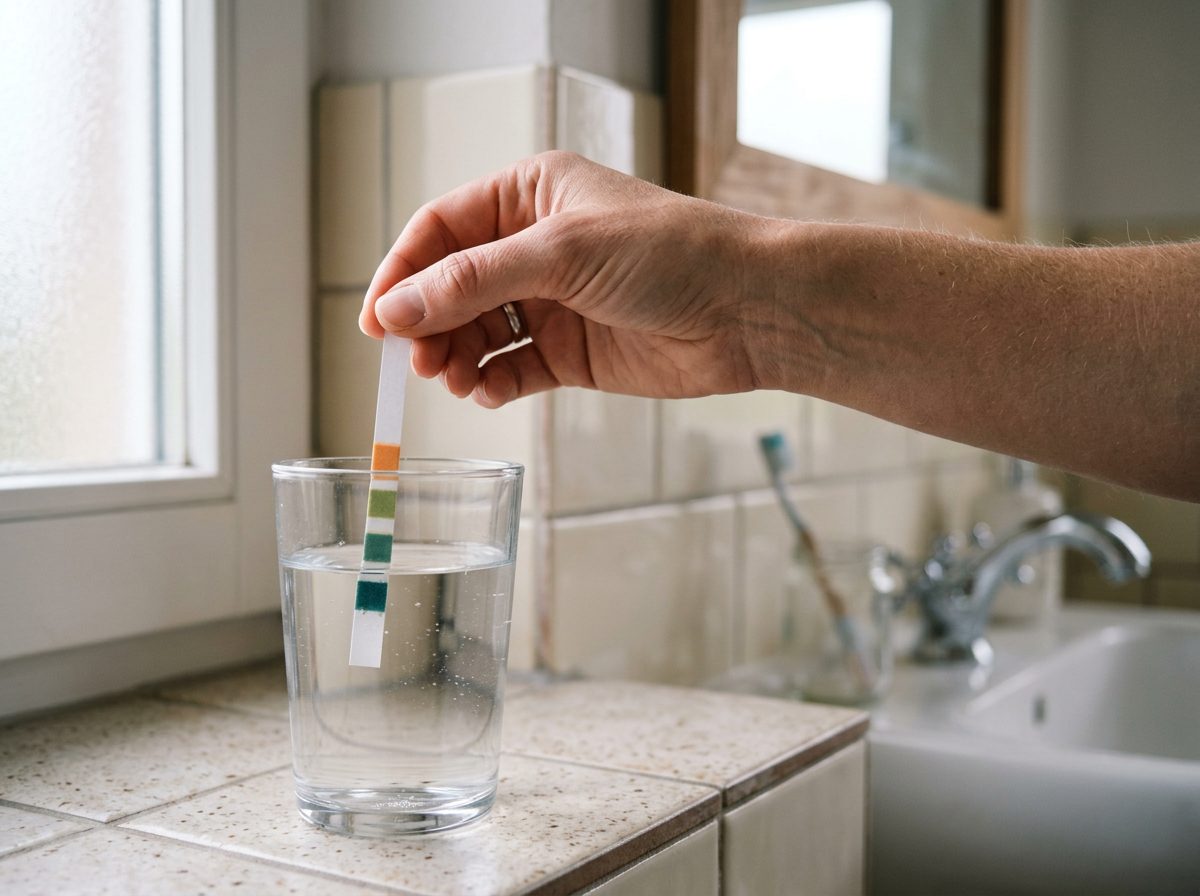
Method 2: Water Hardness Test Strips
Cost: €5-15 for 50-100 strips
Where to buy: Amazon, pharmacies, hardware stores
Accuracy: Good (±20 ppm)
How to use: 1. Fill a glass with cold tap water 2. Dip test strip for 1-2 seconds 3. Wait 15-30 seconds 4. Match color to chart on package
Recommended brands: JBL, Tetra, API
Method 3: Soap Test (DIY)
Materials: Clear bottle, tap water, liquid soap
Instructions: 1. Fill bottle halfway with tap water 2. Add 10 drops liquid soap 3. Shake vigorously for 10 seconds
Results: – Lots of bubbles, clear water: Soft water – Some bubbles, slightly cloudy: Moderately hard – Few bubbles, milky/cloudy: Hard to very hard
This is a rough test, but it works in a pinch.
Conclusion: The Right Shampoo Bar Makes All the Difference
European hard water doesn’t have to ruin your shampoo bar experience. The key is matching your bar’s chelating power to your water’s mineral content.
Quick summary: – Soft water (<60 ppm): Any bar works – Moderately hard (60-180 ppm): True soap, vinegar rinse once or twice a week – Hard (180-250 ppm): True soap, vinegar rinse after most washes – Very hard (250-350 ppm): True soap with a vinegar rinse every wash, or a detergent bar – Extremely hard (350+ ppm): EDTA bars + ACV rinses + consider shower filter
Test your water, choose the right bar, and supplement with ACV rinses if needed. Once you dial in the right combination, shampoo bars work beautifully—even in the hardest European water.
Natural Answer Products are true cold process soap — six certified-organic plant oils saponified with lye, 100% natural ingredients. In hard water any real soap can leave a film; one tablespoon of apple cider vinegar in 250 ml of water after washing dissolves it and closes the cuticle. That is the whole trick, and it is what customers across the UK, Netherlands, Belgium, Germany and France do. No greasy feeling. Just healthy, shiny hair.
Related reading: if your shampoo bar is leaving a waxy film, here’s why and how to fix it.
Frequently Asked Questions
Q: Can I use soap shampoo bars in hard water if I do an ACV rinse?
A: An acidic rinse does not prevent soap scum forming during the wash, but removing it afterwards is exactly the point — that is what the rinse is for. Done consistently it keeps hair clear. If you would rather not add a step, a synthetic detergent bar avoids the reaction altogether, at the cost of no longer being 100% natural.
Q: My city has very hard water (300 ppm). Can any shampoo bar work?
A: Yes. Wash as normal and finish with a vinegar rinse — one tablespoon of apple cider vinegar in 250 ml of water. Plenty of people in Barcelona, Valencia and London use true soap bars this way without any buildup.
Q: I travel frequently across Europe. Should I bring different shampoo bars?
A: No need. One bar travels fine — just pack a small bottle of vinegar, or buy some when you arrive, for the [harder water regions](/shampoo-bars-hard-water/).
Q: Do chelating shampoo bars strip hair color?
A: Good-quality chelating bars are pH-balanced (5-7) and won’t fade color more than regular shampoo. EDTA is safe for color-treated hair. With true soap (pH 9-10) always finish with an acidic rinse — it closes the cuticle and protects colour.
Q: I live in Germany. Where can I find my exact water hardness?
A: Search “[your city] Wasserwerk” and look for “Wasserhärtebereich” or “Analysewerte” on their website. German water utilities publish detailed reports.
Q: Are there any European countries where shampoo bars don’t work?
A: No — shampoo bars work everywhere in Europe. In hard-water regions a true soap bar wants an acidic rinse; a synthetic bar does not. Even in extreme hardness areas like Palma de Mallorca or Valencia, EDTA bars + ACV rinses solve the problem.
Author’s Note: I’ve researched water hardness reports from 50+ European cities to create this guide. If you’re struggling with shampoo bars in Europe, it’s almost always a water hardness issue—not a problem with bars themselves. Choose the right formulation for your water, and you’ll love the results.
Try Natural Answer shampoo bars: Cold-process soap that works in European hard water with a vinegar rinse. Ships to all EU countries. Works in Amsterdam, Paris, Berlin, Brussels—wherever your hard water comes from.