


Last updated: October 5, 2026
Introduction
Every year, 552 million shampoo bottles end up in landfills—just in the United States alone. Globally, the cosmetics industry produces more than 120 billion units of packaging annually, most of which is plastic that takes 400-1,000 years to decompose.
But here’s the thing: sustainability claims are everywhere, and it’s hard to know what’s actually making a difference. Are shampoo bars truly better for the environment, or is it just clever marketing?
This article breaks down the real environmental impact of shampoo bars versus bottled shampoo—covering plastic waste, carbon emissions, water usage, packaging, and lifecycle analysis. By the end, you’ll know exactly what you’re choosing when you switch to a bar.
Key finding: One shampoo bar can replace 2-3 plastic bottles, eliminating ~80-120 grams of plastic waste per bar. Over a lifetime, that’s 5-7 kg of plastic you’re keeping out of oceans and landfills.
—
The Plastic Side of the Environmental Impact of Shampoo Bars
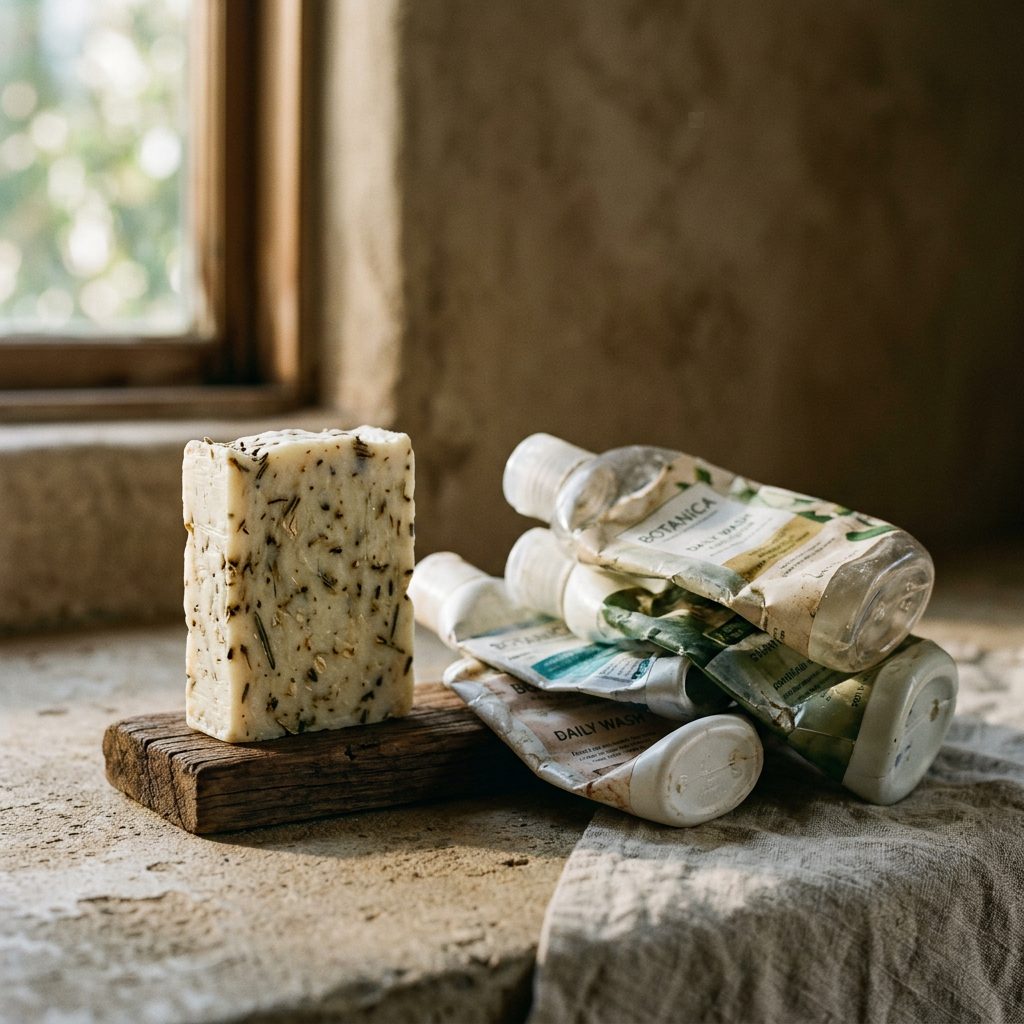
Shampoo Bottles: Hidden Costs
Most liquid shampoo comes in HDPE (#2) or PET (#1) plastic bottles. While technically recyclable, the reality is bleak:
- Only 9% of all plastic ever made has been recycled (UN Environment Programme)
- Cosmetics packaging has one of the lowest recycling rates globally (~14%)
- Pumps and caps are non-recyclable mixed materials
- Colored bottles reduce recyclability further
Per-bottle breakdown:
- Average 250ml bottle: 40-50 grams of plastic
- Pump mechanism: 5-10 grams (non-recyclable)
- Label/wrapper: 2-3 grams
- Total: ~50-60 grams per bottle
Most households use 4-6 bottles per year = 200-360 grams of plastic waste annually.
Shampoo Bars: Minimal Packaging
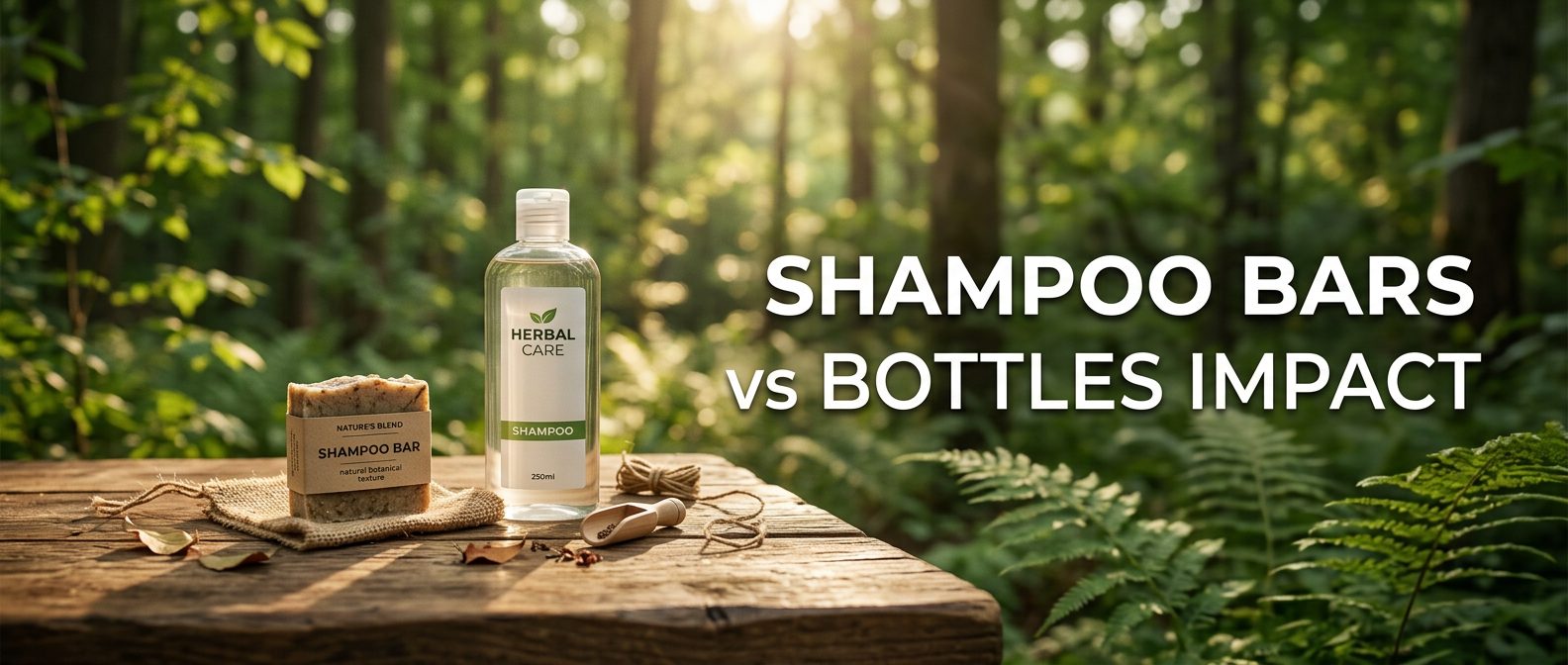
Quality shampoo bars use:
- Paper/cardboard packaging: biodegradable, compostable
- No plastic pumps or caps
- No liquid = 80% less weight during shipping
Per-bar breakdown:
- Average 60-80g bar: 0 grams of plastic
- Cardboard box: 10-15 grams (biodegradable)
- Total plastic waste: 0 grams
One bar replaces 2-3 bottles = 80-180 grams of plastic eliminated per bar.
—
Carbon Footprint: Manufacturing & Shipping
Water Content = Wasted Energy
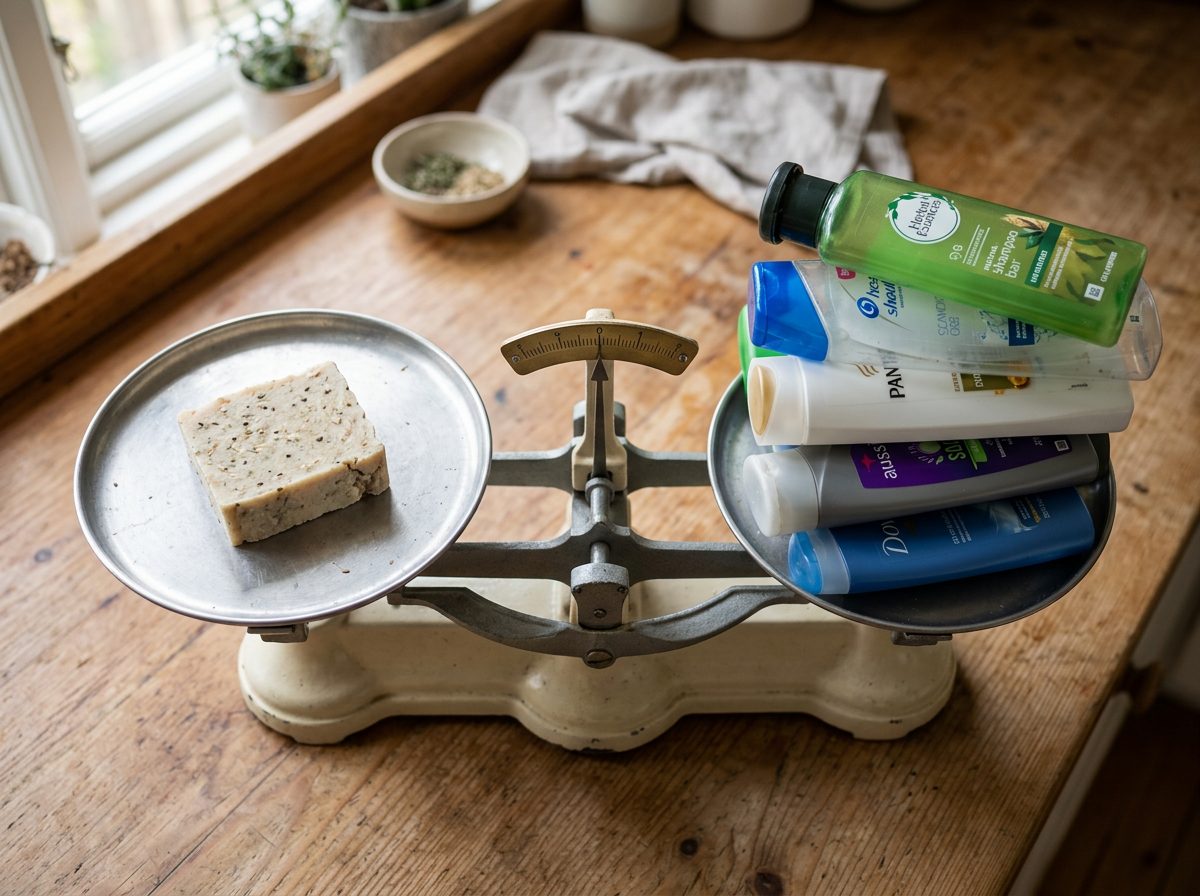
Liquid shampoo is 70-80% water. You’re essentially paying to:
1. Ship water around the world
2. Package water in plastic
3. Store water in warehouses
Carbon impact comparison:
- Liquid shampoo: ~1.5 kg CO₂ per bottle (manufacturing + transport)
- Shampoo bar: ~0.3 kg CO₂ per bar (concentrated formula, no water weight)
Why bars win:
- Bars weigh 67% less than bottles (100g vs. 300g for equivalent washes)
- Shipping 1,000 bars = same carbon as shipping 200 bottles
- No refrigeration needed (bottles often require climate control)
- Compact size = more efficient packaging (5x more bars fit in a shipping box)
Real-world example: If you use 5 bottles per year, you’re generating 7.5 kg CO₂. Switch to bars (2-3 per year), and you reduce that to 0.6-0.9 kg CO₂—an 85% reduction.
—
Water Usage: Production & Consumer Waste
Manufacturing Water Footprint
Creating liquid shampoo requires:
- Water for formulation (70-80% of product volume)
- Water for cleaning equipment between batches
- Water for bottle manufacturing (plastic production is water-intensive)
Estimates:
- 1 liter of liquid shampoo = 5-7 liters of water used in production
- 1 shampoo bar (100g) = 0.2-0.3 liters of water used in production
Consumer Water Waste
Here’s something most people don’t think about:
Bottled shampoo encourages over-dispensing:
- Average person uses 3-5x more product than needed per wash
- Rinses out excess product = wasted water down the drain
- Runoff contains surfactants, preservatives, fragrances (water pollution)
Shampoo bars force portion control:
- You only use what touches your hair
- Less product = shorter rinse time = 20-30% less water per wash
- Fewer synthetic chemicals in wastewater
Over a year, switching to bars can save 500-1,000 liters of water (manufacturing + rinse waste combined).
—
Chemical Runoff & Water Pollution
What’s in Your Drain?
Liquid shampoos often contain:
- Sulfates (SLS/SLES) → aquatic toxicity
- Parabens → hormone disruption in fish
- Silicones → non-biodegradable, accumulates in waterways
- Synthetic fragrances → microplastics (some formulas)
- Microplastics (polyethylene beads in exfoliating shampoos)
Problem: Wastewater treatment plants don’t fully remove these chemicals. They end up in rivers, lakes, and oceans.
Shampoo Bars: Cleaner Formulations
Quality bars (like Natural Answer’s) use:
- Cold-process saponified plant oils (natural soap, pH 9–10 — no surfactants)
- No silicones (natural oils condition instead)
- No parabens (preserved with natural antimicrobials or pH balance)
- Palm oil-free (no rainforest destruction)
Impact: Less chemical load on aquatic ecosystems. Studies show biodegradable surfactants break down 10-30x faster than synthetic alternatives.
—
Lifecycle Analysis: Environmental Impact of Shampoo Bars Cradle to Grave
Let’s compare the full environmental cost of both options:
Liquid Shampoo (250ml bottle)
1. Raw materials: Petroleum-based plastic, water, chemicals (high impact)
2. Manufacturing: Energy-intensive plastic molding, chemical synthesis
3. Packaging: Plastic bottle, pump, label, cardboard box
4. Shipping: Heavy (water weight), requires large boxes
5. Consumer use: Over-dispensing, water waste
6. End of life: 91% ends up in landfill or ocean, takes 400+ years to decompose
Total environmental cost (simplified): 10/10 impact units
Shampoo Bar (100g)
1. Raw materials: Natural oils, plant-based surfactants (low-moderate impact)
2. Manufacturing: Cold/hot process (energy-efficient), small-batch
3. Packaging: Cardboard or paper (biodegradable)
4. Shipping: Lightweight (no water), compact (5x more efficient)
5. Consumer use: Controlled portions, less rinse water
6. End of life: Packaging composts in 2-6 months, zero plastic waste
Total environmental cost (simplified): 2/10 impact units
Bars are ~80% more sustainable across the full lifecycle.
—
Hard Water & Environmental Impact
Here’s something most sustainability guides miss: hard water makes bottled shampoo even worse for the environment.
Why Hard Water Matters
In hard water areas (60% of Europe, 85% of the US), minerals (calcium, magnesium) react with liquid shampoo surfactants, causing:
- Buildup residue → you use MORE product to compensate
- Longer rinse times → wasted water trying to remove residue
- Need for clarifying treatments → additional plastic bottles
- Soap scum in drains → harsh chemical drain cleaners (more pollution)
Natural Answer shampoo bars are specifically formulated for hard water:
- cold-process soap (pH 9-10) — minimal soap scum in hard water; use an acidic rinse (ACV or citric acid) after washing to close the cuticle
- No buildup = less product needed per wash
- Shorter rinse = 20-30% less water waste
- No need for clarifying shampoos = fewer bottles overall
In hard water areas, switching to bars can cut your environmental impact by 90%.
—
Palm Oil: The Hidden Environmental Cost
Many shampoo bars (and some liquid shampoos) contain palm oil—a major driver of deforestation in Southeast Asia.
Why Palm Oil Is a Problem
- 300 football fields of rainforest are cleared every hour for palm plantations
- Destroys habitats for orangutans, tigers, elephants (endangered species)
- Releases massive CO₂ from burning forests
- Often involves child labor and exploitative practices
Not All Bars Are Eco-Friendly
Check labels carefully:
- Avoid bars with “sodium palmate” (palm oil soap)
- Look for “palm oil-free” certification
- Choose brands that use coconut oil, shea butter, or cocoa butter instead
Natural Answer bars are 100% palm oil-free (certified), using sustainable coconut oil from Fair Trade farms.
—
Vegan & Cruelty-Free Considerations
Sustainability isn’t just about plastic—it’s about ethical sourcing too.
Animal-Derived Ingredients in Shampoo
Many liquid shampoos contain:
- Keratin (from animal hooves/horns)
- Lanolin (from sheep wool)
- Glycerin (often animal-derived)
- Shellac (from lac beetles)
Vegan shampoo bars avoid all animal ingredients, using:
- Plant-based proteins (quinoa, soy, rice)
- Coconut-derived glycerin
- Shea butter, cocoa butter (plant fats)
Cruelty-Free Testing
EU banned animal testing for cosmetics in 2013, but loopholes exist:
- Brands can test in China (where it’s required)
- Ingredient suppliers may test on animals
Look for certifications:
- Leaping Bunny (strictest cruelty-free standard)
- PETA Vegan & Cruelty-Free
- Choose Cruelty-Free
Natural Answer bars are vegan + cruelty-free certified, ensuring no animal harm at any stage.
—
Cost vs. Impact: Is It Worth It?
Sustainability shouldn’t be a luxury. Let’s look at the economics:
Liquid Shampoo
- Average 250ml bottle: €5-8
- Lasts: 4-6 weeks (depending on hair length)
- Annual cost: €50-90
- Plastic waste: 200-360 grams
- CO₂ emissions: 7.5 kg
Shampoo Bars
- Average 60-80g bar: €8-12
- Lasts: 8-12 weeks (80-100 washes)
- Annual cost: €30-50
- Plastic waste: 0 grams
- CO₂ emissions: 0.6-0.9 kg
You save €20-40 per year while cutting plastic waste by 100% and CO₂ by 85%.
—
Common Objections: “But What About…?”
“Aren’t bars wrapped in plastic sometimes?”
Yes—cheap bars often use plastic shrink wrap. Avoid these. Look for:
- Cardboard boxes
- Paper wrapping
- No packaging (if buying in-store)
“Don’t bars use more energy to manufacture?”
No. Cold-process bars require minimal heat, while liquid shampoo needs:
- High-temperature chemical synthesis
- Energy-intensive plastic molding
- Water purification systems
Bars use 60-80% less energy to produce.
“What if I travel? Bars seem inconvenient.”
Bars are TSA-approved (no liquid restrictions), don’t leak, and weigh almost nothing. Far more sustainable (and practical) than bringing bottles.
“Do bars work as well as liquid shampoo?”
Quality cold-process soap bars clean and condition hair effectively—without surfactants, synthetic additives, or water filler.
—
Choosing a Bar That Minimises the Environmental Impact of Shampoo Bars
Not all bars are equal. Here’s what to look for:
✅ Green Flags
- Palm oil-free (or RSPO-certified sustainable palm)
- Vegan + cruelty-free certified
- Biodegradable packaging (cardboard, paper, or none)
- Hard water formulation (if you live in a hard water area)
- Transparent ingredient lists (no vague “fragrance” or “parfum”)
- Made in EU (stricter environmental regulations than US/Asia)
❌ Red Flags
- Plastic shrink wrap packaging
- Palm oil (sodium palmate) without certification
- “Natural” claims without ingredient transparency
- Unusually cheap price (likely cutting corners on ethics)
- No company info (anonymous brands avoid accountability)
Natural Answer bars check all green flags:
- 100% palm oil-free (coconut oil base)
- Vegan, cruelty-free (certified)
- Cardboard packaging (plastic-free)
- True soap that handles hard water with a simple vinegar rinse
- Trees planted to offset manufacturing and shipping
—
The Bigger Picture: Individual Actions Matter
Switching to shampoo bars won’t solve climate change alone—but collective action does.
Impact at Scale
If just 1 million people switch to bars:
- 50-60 tons of plastic waste eliminated annually
- 7,500 tons of CO₂ saved (equivalent to 1,600 cars off the road)
- 500 million liters of water conserved
- Demand signals push big brands to change
Beyond Shampoo
Once you see the impact of ditching bottled shampoo, you start noticing:
- Liquid soap → bar soap
- Bottled conditioner → conditioner bar
- Plastic razors → safety razors
- Disposable cotton pads → reusable cloths
The shampoo bar is often the gateway to a zero-waste bathroom.
—
Conclusion: The Verdict
Shampoo bars are objectively better for the environment than bottled liquid shampoo—by every measurable metric:
| Factor | Liquid Shampoo | Shampoo Bar | Winner |
|————|——————-|—————-|———–|
| Plastic waste | 200-360g/year | 0g/year | Bar (100% reduction) |
| CO₂ emissions | 7.5 kg/year | 0.6-0.9 kg/year | Bar (85% reduction) |
| Water usage | High (production + rinse) | Low (no water filler) | Bar (60-80% reduction) |
| Chemical runoff | Moderate-high | Low (biodegradable) | Bar |
| Lifecycle impact | 10/10 units | 2/10 units | Bar (80% reduction) |
| Cost | €50-90/year | €30-50/year | Bar (€20-40 saved) |
The switch to shampoo bars is one of the easiest, highest-impact changes you can make—saving money, reducing waste, and cutting your carbon footprint by 85%.
Hard water areas: Bars are even more essential (no buildup = less product waste).
Concerned about performance? Modern cold-process soap bars clean and condition hair effectively—without the plastic and water filler.
Ready to make the switch? Choose a palm oil-free, vegan, hard water-optimized bar like Natural Answer—and join the zero-waste revolution.
—