


Last updated: October 12, 2026
Why Blonde Hair Needs Special Care
Blonde hair—whether natural, highlighted, or fully colored—faces unique challenges that darker hair types don’t encounter. The lighter your hair, the more visible every impurity, mineral deposit, and color shift becomes.
The three biggest threats to blonde hair:
- Mineral buildup from hard water (creates brassy, dull tones)
- Oxidation from UV exposure (turns blonde yellow or orange)
- Damage from chemical treatments (highlights, bleach, toners)
Traditional liquid shampoos often contain sulfates that strip color and create static. Meanwhile, soap-based shampoo bars can leave mineral residue when you skip the acidic rinse—bad news for blonde tones.
How Hard Water Ruins Blonde Hair (The Hidden Problem)
If your blonde hair looks dull, brassy, or yellowish despite using purple shampoo, hard water minerals are likely the culprit.
What happens: Hard water contains calcium and magnesium ions that bond to hair. On blonde hair, these deposits:
- Create a chalky, dull film
- Reflect warm (brassy) tones instead of cool highlights
- Block purple pigments from neutralizing yellow
- Make hair feel rough and look lifeless
Soap-based shampoo bars can add to this if you skip the acidic rinse. Soap reacts with hard water minerals to form a film—exactly what you’re trying to avoid. The fix is simple: rinse with diluted apple cider vinegar.
What to Look for in a Shampoo Bar for Blonde Hair
1. Cold-Process Soap + an Acidic Rinse
Why it matters: Soap can react with hard water minerals and leave a film on light hair. An acidic rinse after every wash (1 tbsp apple cider vinegar in 1 cup of water) removes it and keeps blonde bright. Natural Answer bars are cold-process soap (pH 9-10), made to be used this way.
2. Hard Water Protection
Look for: an acidic rinse — vinegar, citric acid or sodium citrate
What they do: Bind to hard water minerals, preventing buildup and brassiness
3. Color-Safe, Sulfate-Free Formula
Why it matters: Sulfates (SLS, SLES) strip hair color and damage cuticles
What to avoid: Sodium lauryl sulfate, sodium laureth sulfate
4. Purple or Blue Pigments (Optional)
For toning: If you want brass-neutralizing benefits, look for violet or blue pigments
Note: Not all blonde hair needs purple shampoo—ash blondes and platinum benefit most
5. Moisturizing Ingredients
Look for: Natural oils (argan, coconut), glycerin, panthenol
Why it matters: Blonde hair (especially highlighted) tends to be drier and more fragile
The Best Shampoo Bars for Blonde Hair
For Highlighted & Bleached Blonde Hair
What you need: Gentle cleansing + damage repair + hard water protection
Key ingredients to look for:
- Gentle cleansing base (saponified plant oils)
- Chelators (citric acid, sodium citrate)
- Keratin or protein (rebuilds damaged bonds)
- Natural oils (coconut, argan, jojoba)
For Natural Blonde Hair
What you need: Gentle daily cleansing + shine enhancement
Key ingredients to look for:
- Mild cleansers (coco-glucoside, decyl glucoside)
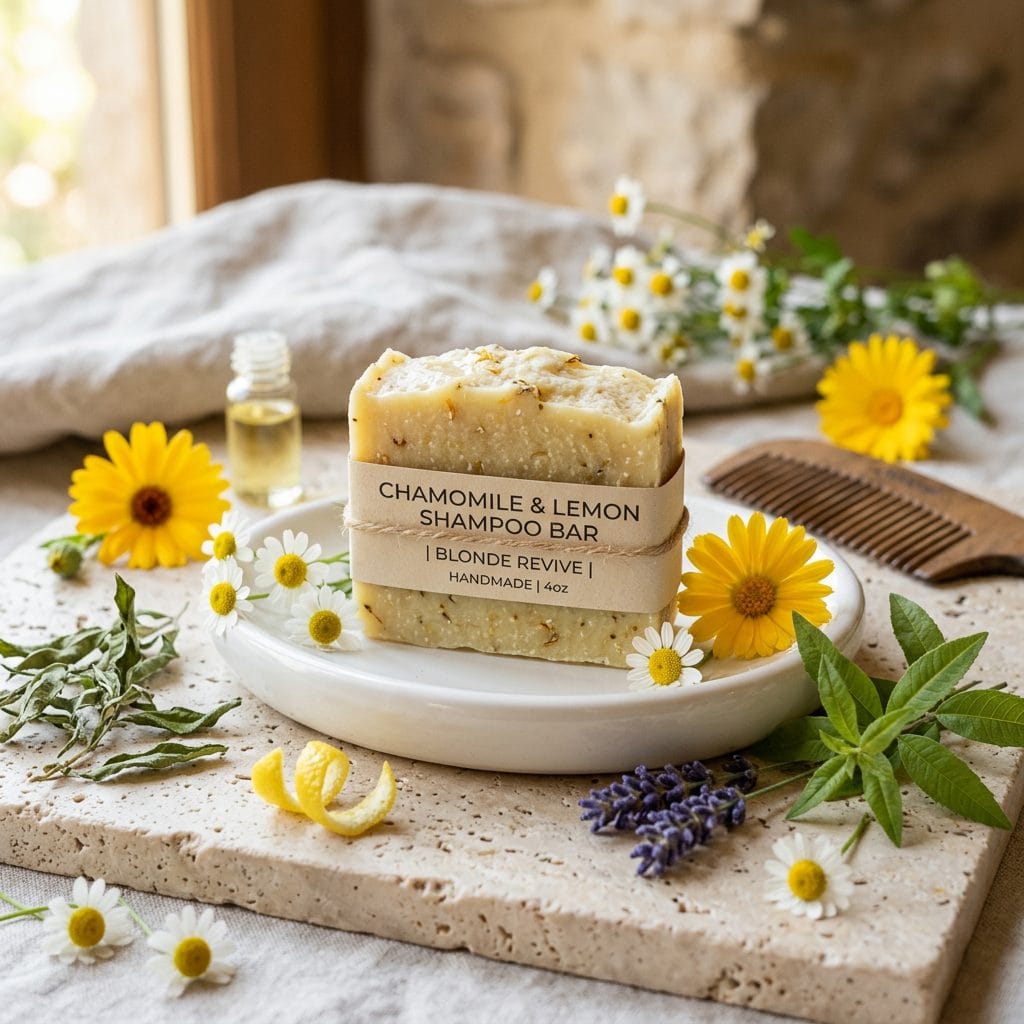
- Chamomile extract (brightens naturally)
- Lemon or citrus oils (adds shine)
- Glycerin (moisture without weight)
For Platinum or Silver Blonde Hair
What you need: Brass neutralization + extreme moisture
Key ingredients to look for:
- Violet or blue pigments (neutralize yellow)
- Citric acid (prevents mineral yellowing)
- Rich butters (shea, cocoa)
- UV filters (protect from sun damage)
For Strawberry Blonde or Warm Tones
What you need: Color preservation without purple tones
Key ingredients to look for:
- Color-safe cleansers (sulfate-free)
- No purple pigments (they’ll cancel your warm tones)
- Antioxidants (vitamin E, rosehip oil)
- UV protection (keeps reds from fading)
How to Use a Shampoo Bar on Blonde Hair
For best results and color protection:
The Proper Technique
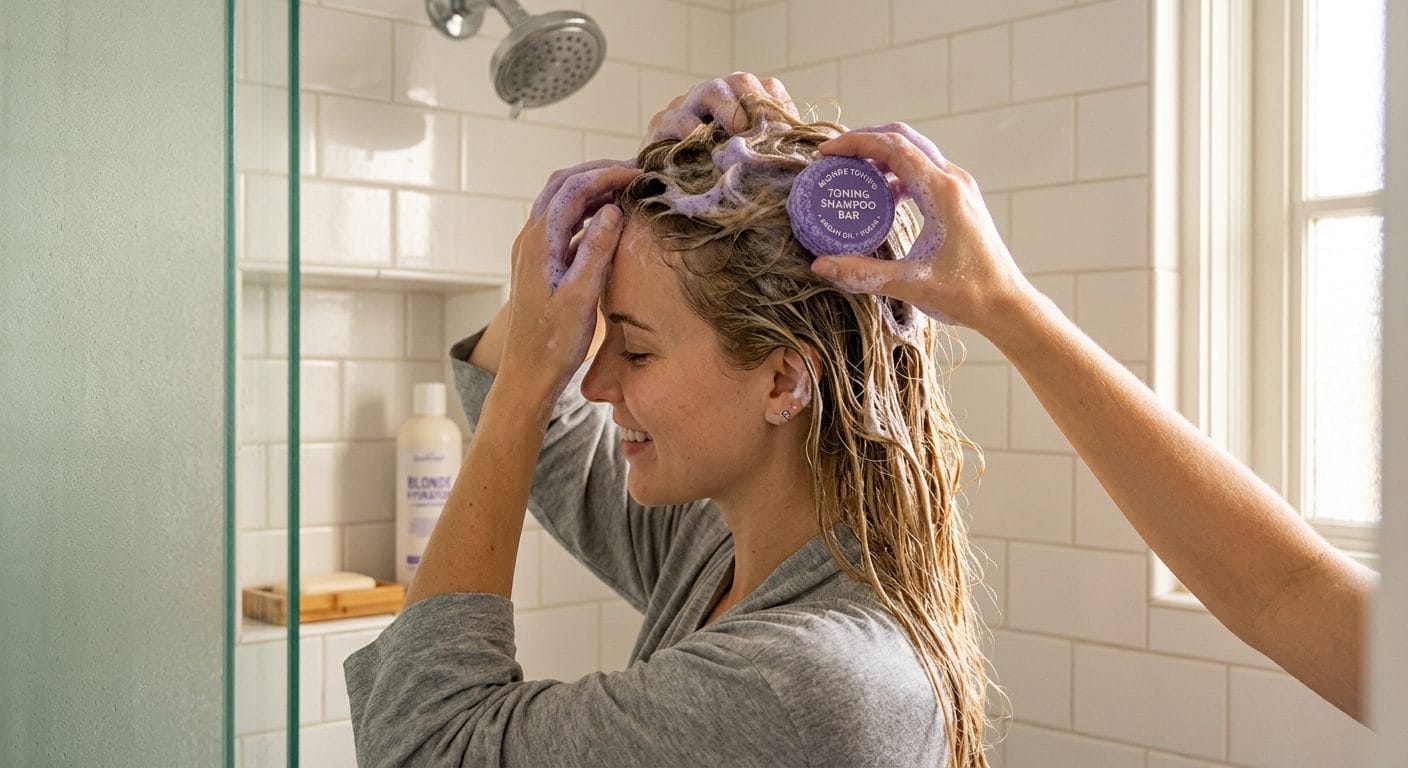
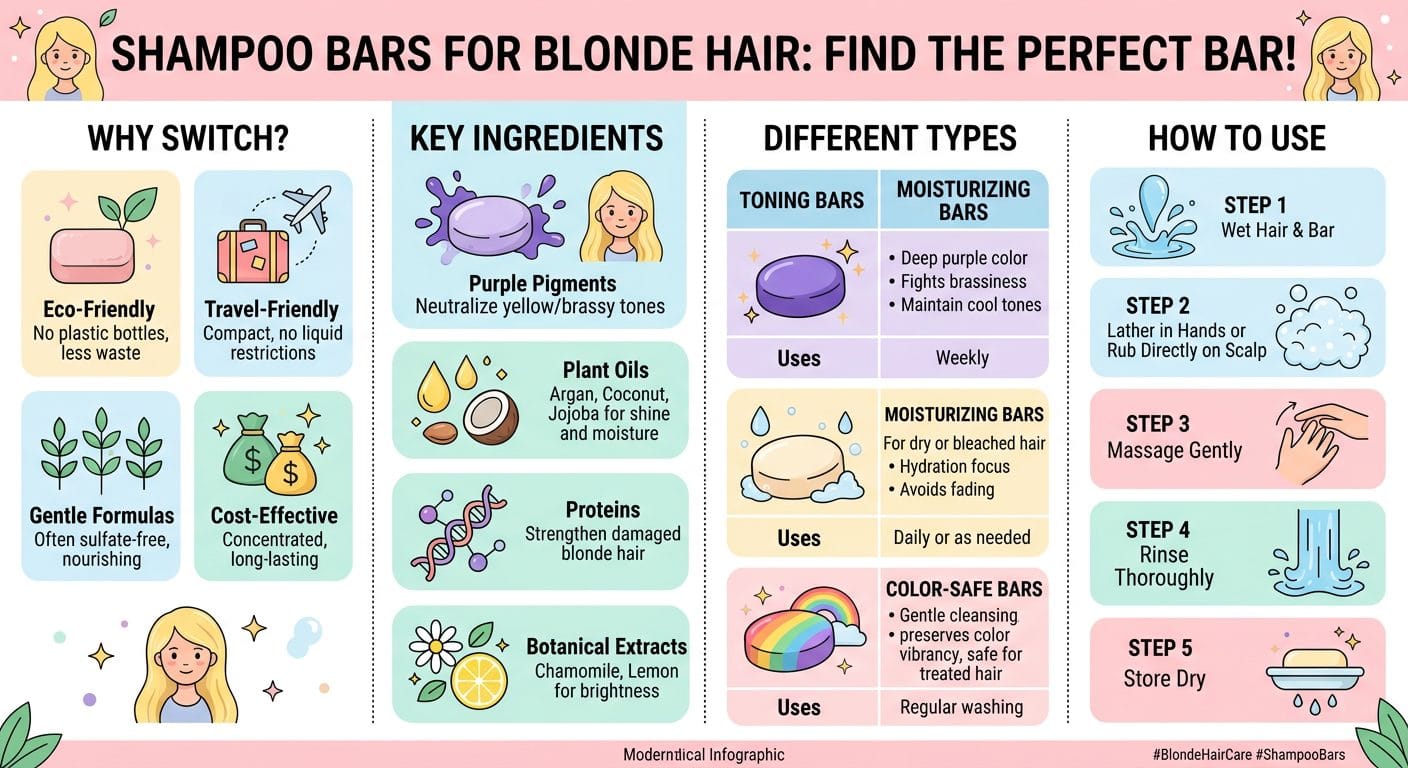
- Wet hair thoroughly with warm (not hot) water
- Wet the bar and rub between hands to create lather
- Apply lather to scalp (not lengths) using gentle circular motions
- Massage for 30-60 seconds, focusing on roots
- Rinse completely with cool water (seals cuticle, enhances shine)
- Follow with conditioner or apple cider vinegar rinse
Hard Water Hack for Blonde Hair
If you have hard water, add this extra step:
- Final rinse: 1 tablespoon apple cider vinegar in 1 cup water
- Why it works: Acidic rinse removes mineral deposits and restores pH
- Result: Brighter, shinier, less brassy hair
How Often to Wash
Highlighted/bleached blonde: 2-3 times per week maximum
Natural blonde: 3-4 times per week
Platinum/silver: Every other day if needed (use purple bar once a week)
Why: Overwashing strips natural oils blonde hair desperately needs.
Common Blonde Hair Problems & How Shampoo Bars Help
Problem 1: Brassy or Yellow Tones
Cause: Hard water minerals, chlorine, UV exposure, oxidation
Solution:
- Cold-process soap bar with an ACV rinse (prevents mineral buildup)
- Purple pigments 1-2x per week (neutralizes yellow)
- Apple cider vinegar rinse after washing
Problem 2: Dull, Lifeless Hair
Cause: Mineral buildup coating the hair shaft
Solution:
- Add an ACV rinse after every wash
- Use a citric acid rinse once a week
- Avoid hot water (use lukewarm instead)
Problem 3: Dry, Straw-Like Texture
Cause: Chemical damage + hard water + sulfates
Solution:
- Moisturizing natural shampoo bar with oils/butters
- Deep conditioning mask weekly
- Reduce wash frequency
Problem 4: Color Fading Fast
Cause: Harsh cleansers stripping pigment
Solution:
- Sulfate-free, color-safe shampoo bar
- Cool water rinses only
- UV-protecting ingredients
Problem 5: Green Tint (From Chlorine)
Cause: Chlorine bonding to blonde hair
Solution:
- Pre-swim: wet hair with clean water + apply conditioner
- Post-swim: cleansing shampoo bar removes chlorine
- Weekly treatment: vitamin C powder + shampoo (cleanses metals)
Shampoo Bar vs. Liquid Shampoo for Blonde Hair
Why shampoo bars can be better for blonde hair:
| Factor | Shampoo Bar | Liquid Shampoo |
|---|---|---|
| Sulfates | Often sulfate-free (soap bars always are) | Usually contains SLS/SLES |
| Hard water | Soap bars need an ACV rinse to stop a film | No soap film (detergent-based) |
| Travel | Solid, won’t leak | Liquid limits, spills |
| Concentrate | No water filler | Mostly water |
| Plastic waste | Little or none | Plastic bottle |
| pH | 9–10 (soap), balanced by an ACV rinse | Usually 5–7 |
When liquid might be better:
- You need very specific purple pigment levels
- You’re used to silicone-heavy products
- You want instant lather without technique
The transition period: It takes 2-4 weeks for blonde hair to adjust to shampoo bars (especially if switching from silicones).
Ingredients to Avoid (Blonde Hair Edition)
Absolutely Avoid
❌ Sodium lauryl sulfate (SLS) — strips color, damages cuticle
❌ Artificial fragrances — can contain oxidizing chemicals
Use Caution With
⚠️ Purple pigments — too much = purple/gray tones
⚠️ Essential oils — some are photosensitizing (cause darkening)
⚠️ Lemon/citrus oils — great for shine, but can lighten color
ℹ️ Using a soap bar? Cold-process soap (pH 9–10) is a fine choice for blonde hair. Finish with an ACV rinse so hard water minerals can’t build up and the cuticle lies flat.
How to Choose the Right Shampoo Bar for Your Blonde
Step 1: Identify your blonde type
- Natural blonde → gentle daily bar
- Highlighted → damage repair + cleansing
- Platinum/silver → purple toning bar
- Strawberry/warm → color-safe, no purple
Step 2: Check your water hardness
- Hard water (most areas) → an acidic rinse (ACV) after every wash is essential
- Soft water → more flexibility in formula
Step 3: Assess your hair’s condition
- Dry/damaged → moisturizing oils + proteins
- Oily roots → lighter formula, focus on scalp
- Fine/thin → volumizing, lightweight
- Thick/coarse → richer, more conditioning
Step 4: Read the ingredient list
- First ingredients should be saponified plant oils (sodium cocoate, sodium olivate)
- Look for citric acid or sodium citrate, or plan on an ACV rinse
- Avoid sulfates
Storage & Care (Maximize Your Bar’s Lifespan)
Proper storage prevents waste and maintains effectiveness:
- Keep it dry between uses
- Use a draining soap dish with slats
- Store away from shower spray
- Let it air dry completely
- Avoid water pooling
- Never leave it sitting in water
- Elevate it on a dish or rack
- Use a soap saver bag for travel
- Expected lifespan
- Average: 50-80 washes (2-3 months for shoulder-length hair)
Blonde Hair Shampoo Bar FAQs
Q: Will a shampoo bar strip my blonde color?
A: Not if it’s sulfate-free and you finish with an acidic rinse. Sulfate-containing bars can strip color. Always check the ingredient list.
Q: Can I use a purple shampoo bar every wash?
A: No—purple bars are toning treatments, not daily cleansers. Use 1-2x per week maximum to prevent over-toning (gray/dull color).
Q: Why does my blonde hair feel waxy after switching to a shampoo bar?
A: Two reasons: (1) Hard water minerals are reacting with the soap, so add an ACV rinse, or (2) You’re in the transition period (2-4 weeks) as your hair adjusts from liquid shampoo.
Q: How do I prevent brassiness without purple shampoo?
A: Use an apple cider vinegar rinse after every wash (removes minerals), and avoid hot water. Hard water is usually the real culprit.
Q: Can shampoo bars damage blonde highlights?
A: Quality shampoo bars are gentler than most liquid shampoos. Always choose sulfate-free formulas, and finish with an acidic rinse.
Q: Will a shampoo bar make my fine blonde hair flat?
A: Not if you choose a lightweight formula. Avoid heavy oils and butters; look for volumizing ingredients like hydrolyzed wheat protein.
Natural Answer Products for Blonde Hair
Full disclosure: we make shampoo bars, and they are real soap. Here is what that means for blonde hair.
What’s in our bars:
- Cold-process soap — six organic plant oils (coconut, sesame, sunflower, olive, castor, shea butter) saponified with lye
- Sulfate-free by definition — no SLS/SLES, no silicones, no synthetic fragrance
- No palm oil and no plastic packaging
- Alkaline pH (9–10) — finish with an ACV rinse (1 tbsp in 250 ml water) to remove hard water film and lay the cuticle flat
Be honest with yourself about your water. A true soap bar works best in soft to moderately hard water. In hard water, the ACV rinse is not optional. Skip it and blonde hair can look dull or feel frizzy; use it and the shine comes straight back.
Final Thoughts: Blonde Hair Deserves the Best
Blonde hair shows everything—every mineral deposit, every bit of damage, every color shift. That’s why choosing the right shampoo bar matters.
The key takeaways:
- Rinse with ACV (no hard water buildup)
- Plan for hard water (an acidic rinse prevents brassiness)
- Avoid sulfates (color-stripping, damaging)
- Use purple sparingly (1-2x per week max)
- Rinse with cool water (seals cuticle, enhances shine)
The right shampoo bar can make blonde hair brighter, healthier, and easier to maintain than any liquid shampoo—while eliminating plastic waste.
Your hair (and the planet) will thank you.
Last updated: October 2026