



Last updated: September 26, 2026
—
What Does pH Mean for Shampoo Bars?
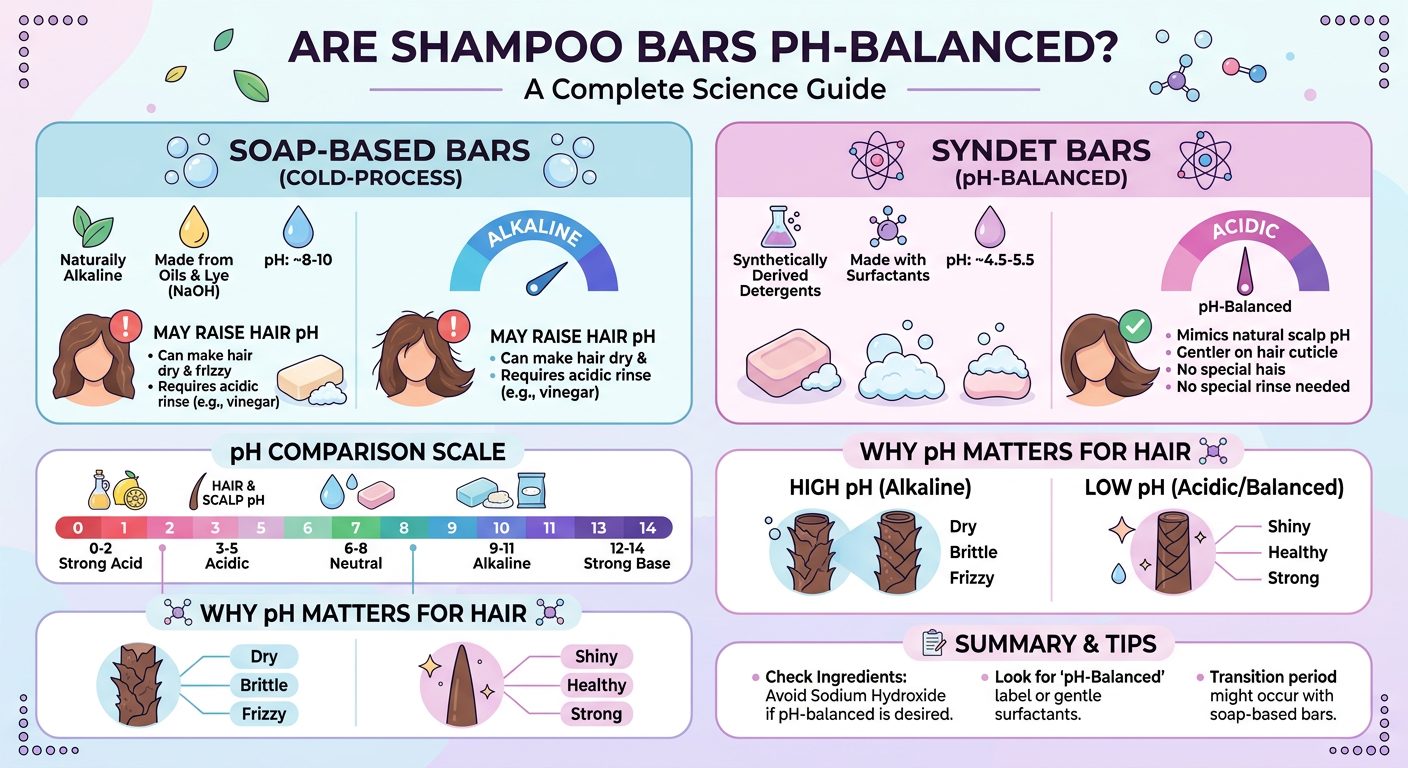
pH (potential hydrogen) measures how acidic or alkaline a substance is, on a scale from 0 to 14:
- 0-6.9 = Acidic (lemon juice, vinegar, your hair)
- 7 = Neutral (pure water)
- 7.1-14 = Alkaline (baking soda, soap, bleach)
Your hair and scalp naturally sit at pH 4.5-5.5 (slightly acidic). When the cuticle stays flat, you get:
- ✅ Smooth, shiny hair
- ✅ Reduced frizz
- ✅ Better color retention
- ✅ Less tangling
- ✅ Stronger hair shaft
When the pH is high (alkaline), the hair cuticle lifts like roof shingles in wind. Left that way, it can mean:
- Rough, dull hair
- More frizz
- Faster color fade
- Tangles and breakage
The short answer to the title question: it depends on the type of bar. Syndet bars are made at a hair-like pH (about 4.5-6). Cold-process soap bars, like Natural Answer, are alkaline (pH 9-10) and are balanced afterwards with a simple acidic rinse. Both routes end in the same place: a closed, smooth cuticle.
Two Kinds of Shampoo Bar, Two Ways to Reach the Right pH
Cold-Process Soap Bars
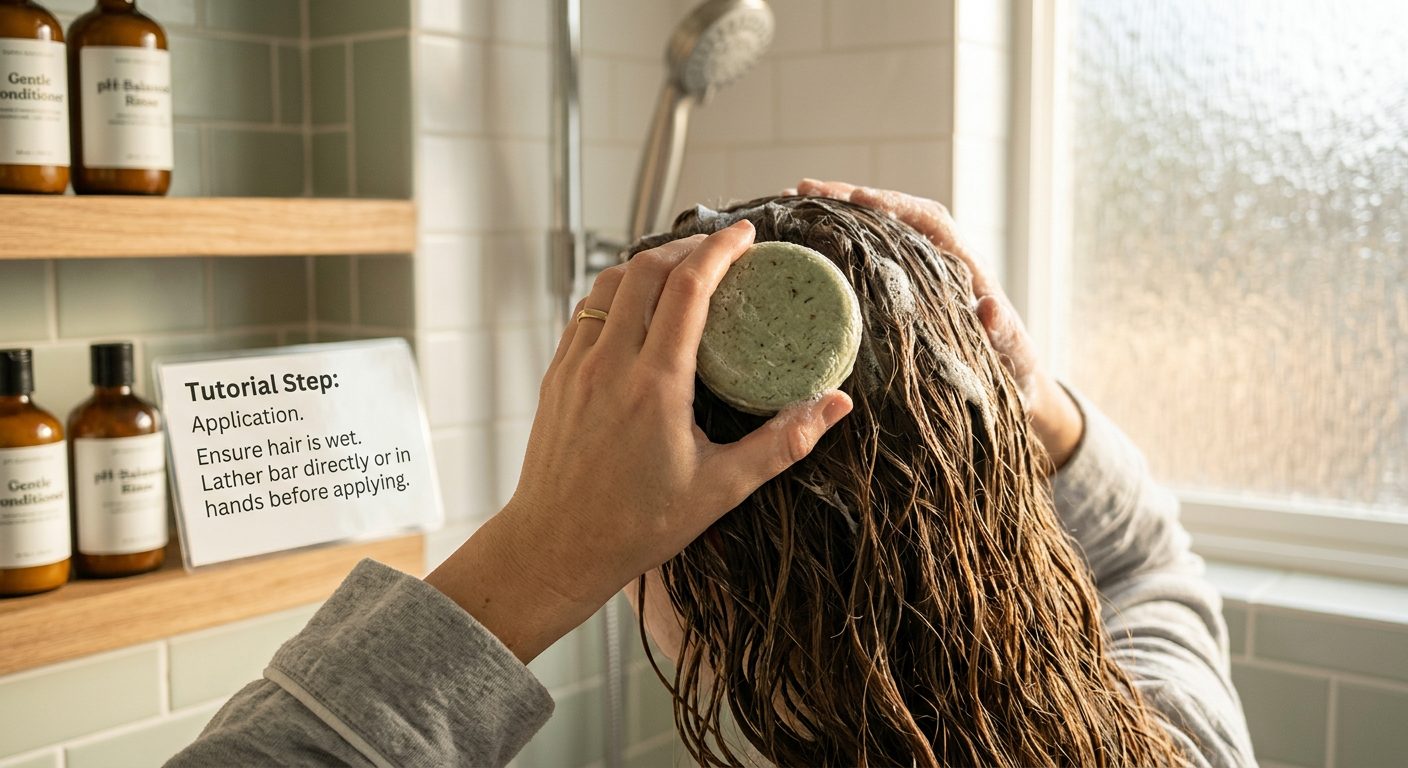
Cold-process soap is made by saponification: plant oils react with lye (sodium hydroxide) to form soap and natural glycerin. The result has a pH of 9-10. That is alkaline by nature, and it is how every true soap works.
Here is what happens when you wash hair with soap:
1. The cuticle lifts (pH rises above your hair’s natural 4.5-5.5)
2. Dirt and oil lift away (this is the cleaning step)
3. In hard water, calcium and magnesium can bind to the soap and leave a film
4. An acidic rinse fixes both (it closes the cuticle and dissolves the film)
The fix takes ten seconds: mix 1 tablespoon of apple cider vinegar in 1 cup of water, pour it over your hair after washing, then rinse.
Syndet Bars (Synthetic Detergent Bars)
Syndet stands for “synthetic detergent.” These bars use surfactants such as SCI, SCS or SLSA instead of saponified oils. Makers formulate them to sit at about pH 4.5-6.
| Feature | Cold-process soap bars | Syndet bars |
|———|————-|———–|
| pH range | 9-10 (alkaline) | 4.5-6 |
| Made from | Plant oils + lye (saponified) | Synthetic surfactants |
| Hard water | Use an acidic rinse to clear the film | Little reaction with minerals |
| Aftercare | ACV rinse after every wash | Rinse optional |
| Glycerin | Kept in the bar | Usually added separately |
| Ingredient list | Short: oils, lye, essential oils | Longer: surfactants, binders, adjusters |
Bottom line: neither type is “wrong.” A syndet bar starts at a hair-like pH. A soap bar reaches it with an acidic rinse. Choose the routine you will actually follow.
Ideal pH Range for Your Hair
The Science Behind pH 4.5-5.5
Your hair’s natural pH is 4.5-5.5. Here is what different pH levels do to the cuticle:
pH 4.5-5.0 (slightly acidic):
- ✅ Closes the hair cuticle tightly
- ✅ Maximizes shine
- ✅ Helps lock in color
- ✅ Smoothest texture
pH 5.0-6.0 (mildly acidic):
- ✅ Balanced cleansing and conditioning
- ✅ Cuticle stays relatively flat
- ✅ Good for most hair types
pH 9-10 (soap while you wash):
- ✅ Strong, effective cleansing (good for oily scalps)
- ⚠️ Cuticle lifts during the wash
- ⚠️ Needs an acidic rinse to close the cuticle afterwards
Pro tip: what matters most is where your hair ends up after the wash. A cold-process bar followed by an ACV rinse brings the hair surface back to about pH 4.5-5.
How pH Affects Different Hair Types
Fine/Thin Hair
Target finish: pH 4.5-5.0 (tighter cuticle = more body and volume)
Why it matters:
- Fine hair has fewer cuticle layers (more fragile)
- A lifted cuticle makes hair look stringy
- An acidic rinse keeps the cuticle flat (adds shine without weight)
Recommendation: use a diluted ACV rinse (1 tsp per cup of water) after every wash
Thick/Coarse Hair
Target finish: pH 5.0-5.5 (balanced cleansing and smoothing)
Why it matters:
- Thick hair has more cuticle layers (more durable)
- It tolerates a stronger rinse and needs effective cleansing (thicker hair = more sebum)
Recommendation: a standard ACV rinse (1 tbsp per cup of water) works great
Curly/Coily Hair
Target finish: pH 4.5-5.0 (moisture retention + frizz control)
Why it matters:
- Curly hair is naturally drier (sebum doesn’t travel down curves)
- Open cuticles = moisture escapes = more frizz
- An acidic rinse seals the cuticle and locks in moisture
Recommendation: rinse with ACV or a citric acid rinse after every wash, then condition
Color-Treated Hair
Target finish: pH 4.5-5.0 (color protection + cuticle sealing)
Why it matters:
- Open cuticle = color molecules escape faster
- A closed cuticle traps color inside
- Extends time between color treatments
Recommendation: an acidic rinse (ACV) after washing boosts color retention
Damaged/Chemically-Treated Hair
Target finish: pH 4.5-5.0 (maximum protection)
Why it matters:
- Damaged hair has a compromised cuticle (more vulnerable)
- A lifted cuticle causes further damage
- An acidic rinse helps “heal” the cuticle temporarily
Recommendation: never skip the acidic rinse, and follow with a light conditioner on the ends
How to Test Shampoo Bar pH at Home
Testing tells you which type of bar you have. Do not judge a bar by its number alone: soap reads pH 9-10 and that is normal for soap.
Method 1: pH Test Strips (Easiest)
What you need:
- pH test strips (available online or at a pharmacy)
- Your shampoo bar
- Small bowl of distilled water
Steps:
- Wet the shampoo bar and create a lather in your hands
- Mix the lather with a few drops of distilled water in a bowl
- Dip the pH strip into the mixture
- Wait 10-15 seconds
- Compare the color to the chart on the package
Interpreting results:
- Yellow/orange (pH 4-6): a syndet-style bar, hair-like pH
- Green (pH 7-8): in between
- Blue/purple (pH 9+): a soap bar. Plan on an acidic rinse.
Cost: ~$10 for 100 strips (years of testing)
Method 2: Digital pH Meter (Most Accurate)
What you need:
- Digital pH meter ($15-30 online)
- Calibration solutions (usually included)
- Distilled water
Steps:
- Calibrate your meter according to instructions
- Create a shampoo bar “solution” (wet bar + lather + distilled water)
- Insert the meter probe
- Read the digital display
Interpreting results:
- 4.5-6.0: hair-like pH (syndet style)
- 9.0-10.0: cold-process soap. Follow with an acidic rinse.
Cost: $15-30 (reusable for years)
Method 3: Red Cabbage Indicator (Free, DIY)
What you need:
- Red cabbage
- Boiling water
- Clear glasses
- Your shampoo bar
Steps:
- Boil chopped red cabbage in water for 10 minutes
- Strain and save the purple liquid (this is your indicator)
- Pour some into a clear glass
- Add a small amount of shampoo bar lather
- Watch the color change
Interpreting results:
- Pink/red: Acidic (pH 1-4)
- Purple: Mildly acidic (pH 5-6), hair-like
- Blue: Neutral to slightly alkaline (pH 7-8)
- Green/yellow: Alkaline (pH 9+), the range of soap
Cost: Free (fun science experiment!)
Why Some Bars Are Alkaline: How Soap and Syndet Bars Are Made
Soap Is Simple and Honest
Cold-process soap follows a short, traditional recipe:
- Mix plant oils + lye (sodium hydroxide)
- The oils saponify into soap and glycerin
- Cure the bars for several weeks
The recipe makes a soap that is pH 9-10 by nature. Good makers say so, and tell you to finish with an acidic rinse.
Syndet Bars Take More Steps
Making a syndet bar at a hair-like pH is a different process:
- Source specific synthetic surfactants (SCI, SCS, SLSA)
- Calculate ratios for the target pH
- Add pH adjusters such as citric acid
- Test the final pH
- Adjust and retest
What to Look For on the Label
- Soap bar: “saponified oils,” “sodium cocoate,” “sodium olivate.” Expect pH 9-10 and use an acidic rinse.
- Syndet bar: “sodium cocoyl isethionate,” “cocamidopropyl betaine.” Expect pH 4.5-6.
- A good maker of either type tells you the pH and what aftercare to use.
Acidic Rinses: The Simple Way to Balance pH
Why Use an Acidic Rinse?
An acidic rinse lowers the pH of the hair surface after washing. It is the standard partner for cold-process soap.
Common acidic options:
- Apple cider vinegar (ACV) – the classic, easy to find, cheap
- Citric acid – a pinch in water; also binds hard water minerals
- Lactic acid – gentle, mild
- Tartaric acid – from grapes, less common
Apple Cider Vinegar Rinse:
- Mix 1-2 tablespoons ACV + 1 cup water
- After shampooing, pour over hair
- Let sit 1-2 minutes
- Rinse with cool water
Effect:
- Lowers the hair’s surface pH back to 4.5-5
- Closes the cuticle
- Adds shine
- Dissolves any mineral film from hard water
Hard Water + pH: The Double Challenge
Why pH Matters Even More in Hard Water
Hard water (high mineral content) adds two challenges:
Problem 1: Soap scum formation
- Soap + hard water minerals = calcium/magnesium film
- Can form a waxy coating on hair
- Hard to rinse out with water alone
Problem 2: Alkaline water
- Hard water is often pH 7.5-8.5 (slightly alkaline)
- It nudges the hair’s pH up when combined with an alkaline wash
- The cuticle opens more than with soft water
The solution: an acidic rinse after every wash
Why this works:
- The acid dissolves the calcium/magnesium film (no scum left)
- Citric acid or sodium citrate binds minerals and stops them from depositing
- The hair surface returns to its safe pH range, whatever the water
Natural Answer: Cold-Process Soap for Hard Water
At Natural Answer, we make soap on purpose, and we make it for hard water:
✅ Cold-process soap (saponified plant oils, made with lye, pH 9–10)
✅ 6 organic plant oils (no synthetic detergents)
✅ ACV rinse recommended (an apple cider vinegar rinse closes the cuticle and clears hard-water minerals)
✅ Handmade (small-batch, quality controlled)
✅ Palm oil-free (better for skin and environment)
Why Natural Answer bars work in hard water:
90% of Europe has hard water. Our routine is designed for your actual water, not just “ideal” soft water: wash with the bar, then rinse with vinegar.
👉 Shop Natural Answer Shampoo Bars
Signs Your Hair Needs an Acidic Rinse
How to Tell Without Testing
If the cuticle stays open after washing, you may notice:
Immediate signs (within 1-2 washes):
- Hair feels rough or “squeaky clean” (cuticle is open)
- Tangles more than usual
- Looks dull, not shiny
- Harder to comb through when wet
After 1-2 weeks:
- Waxy or greasy feel (especially in hard water)
- Color fades faster (for color-treated hair)
- Increased frizz
- Hair feels dry despite conditioning
About the “transition period”:
Switching from liquid shampoo takes a few weeks while your scalp resets. An acidic rinse makes that period much easier.
If you are experiencing these issues:
- Add an ACV rinse after every wash
- Rinse the bar and your hair thoroughly
- In hard water, add a weekly citric acid or ACV clarifying rinse
- Give it 2-4 weeks
Most transition problems fade once the acidic rinse becomes a habit.
Soap or Syndet: Which Matters More?
The Ingredient Debate
Common question: “Should I choose a soap bar or a synthetic detergent bar?”
The answer: either can work, if you match the routine to the bar.
Option 1: Cold-process soap bar (pH 9-10)
- ✅ Made from plant oils + lye, with natural glycerin
- ✅ Short ingredient list
- ✅ Biodegradable
- ✅ Effective cleansing
- ⚠️ Needs an acidic rinse after every wash
Option 2: Syndet bar (pH 4.5-6)
- ✅ Hair-like pH from the start
- ✅ Little reaction with hard water minerals
- ⚠️ Synthetic surfactants (still biodegradable)
- ⚠️ Longer ingredient list
Which is better for your hair? The one you will use correctly. If you like a short ingredient list and a two-step routine, choose cold-process soap plus an ACV rinse.
The Role of Conditioner pH
Should Conditioner Be Acidic Too?
Yes. Conditioner works best at pH 3.5-5 (even more acidic than shampoo).
Why:
- Any wash opens the cuticle slightly
- Conditioner’s job is to close it back down
- An acidic pH (3.5-5) smooths the cuticle flat
- Adds shine, reduces tangling
Best practice:
- Wash with your shampoo bar (gentle cleansing)
- Rinse with diluted ACV (pH about 3) to close the cuticle
- Optional: light conditioner on the ends for extra softness
FAQs
Q: Are all shampoo bars soap?
A: No. Some are cold-process soap (like Natural Answer) and some are syndet bars made from synthetic surfactants. Check the ingredient list, or test the pH.
Q: Can I use a soap bar if I follow with an acidic rinse?
A: Yes. That is the intended routine. The wash lifts the cuticle slightly, and the acidic rinse closes it again. Use 1 tablespoon of ACV in 1 cup of water after every wash.
Q: Do soap bars lather less in hard water?
A: Soap can lather less in very hard water because of mineral reaction. An acidic rinse clears the film, and washing with plenty of water helps the lather.
Q: Is pH 7 (neutral) safe for hair?
A: It is slightly higher than hair’s natural 4.5-5.5, so the cuticle can open a little. A quick acidic rinse fixes that.
Q: Can I lower my shampoo bar’s pH at home?
A: You cannot change the bar itself, since the pH is built in during manufacturing. You lower the pH of your hair with an acidic rinse after washing.
Q: How often should I test my shampoo bar’s pH?
A: Once when you first buy it. Reputable makers keep the pH consistent across batches, so you do not need to test every bar.
Final Thoughts
pH matters, and the routine is what gets you there.
Your hair needs to end the wash at pH 4.5-5.5, whether the bar starts there (syndet) or you finish with an acidic rinse (cold-process soap).
Key takeaways:
✅ Hair’s natural pH is 4.5-5.5 (slightly acidic)
✅ Cold-process soap is pH 9-10 by nature; an ACV rinse closes the cuticle afterwards
✅ Syndet bars start at pH 4.5-6 and use synthetic surfactants
✅ Test pH at home with strips ($10) or red cabbage (free)
✅ Hard water makes the acidic rinse even more useful
✅ Most “transition periods” ease once the rinse is a habit
Ready to try the two-step routine?
👉 Shop Natural Answer Shampoo Bars – cold process soap (pH 9–10), pair with an apple cider vinegar rinse, designed for hard water.
Related reading: How to use an apple cider vinegar rinse with shampoo bars and hard water vs soft water and shampoo bars.