


Last updated: October 13, 2026
Key takeaways
- EU and UK cosmetic law requires ingredients to be listed in descending order of weight — the first three or four entries reveal what the bar is mostly made of.
- Any ingredient ending in ‘-ate’ in a soap context is a saponified oil, not a synthetic additive.
- Detergent bars (led by sodium cocoyl isethionate or SLSA) are pH-buffered and closer to liquid shampoo in bar form — a fundamentally different product from cold-process soap.
- Red-flag ingredients include sodium palmate (sustainability concern), methylisothiazolinone (a common cause of contact dermatitis), and coal-tar dyes (banned in the EU).
- A genuine cold-process bar typically has fewer than ten ingredients, with glycerin present and no synthetic surfactants or added water.
You pick up a “natural shampoo bar” at a farmer’s market and the label says sodium cocoate, sodium palmate, sodium olivate, aqua, glycerin, fragrance, sodium chloride, tetrasodium etidronate. Half of those words look terrifying. Half of them are actually fine. Knowing which is which is the difference between a great bar and an expensive disappointment.
Here’s the field guide to reading a shampoo bar ingredient label.
Shampoo bar ingredient label rule one: order matters
EU and UK cosmetic law requires ingredients to be listed in descending order of weight. The first three or four ingredients tell you what the bar mostly is. Everything in trace amounts (under ~1%) can be listed in any order, usually at the end.
So focus your eyes on the top of the list.
Saponified oils: the “sodium ___ate” family
When plant oils are saponified with sodium hydroxide, they become sodium fatty-acid salts. Each oil has its own INCI name:
- Sodium olivate: saponified olive oil
- Sodium cocoate: saponified coconut oil
- Sodium palmate: saponified palm oil (red flag for environmentalists)
- Sodium palm kernelate: also from palm
- Sodium ricinoleate / sodium castorate: saponified castor oil
- Sodium sheaate / sodium butyrospermate: saponified shea
- Sodium tallowate / sodium lardate: animal fats (not vegan)
- Sodium ricibate (rice bran): sometimes listed differently
Anything starting with “sodium” and ending in “ate” in a soap context is a saponified oil. They’re not chemicals added to the soap; they are the soap.
Detergent/surfactant bars look completely different
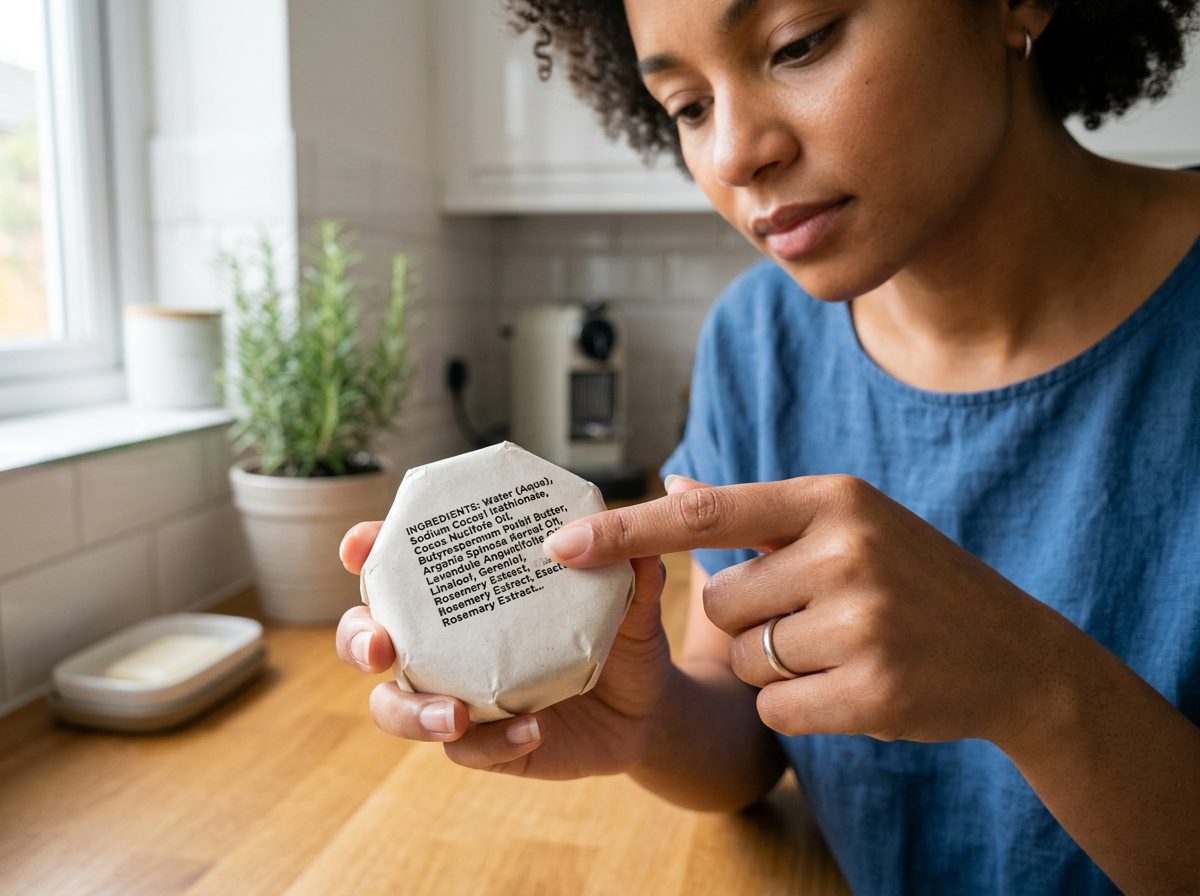
If your bar’s first ingredient is one of these, you’re not holding a cold-process bar — you’re holding a detergent bar (synthetic detergent) bar pressed into a bar shape:
- Sodium cocoyl isethionate (SCI): the most common detergent bar base
- Sodium lauryl sulfoacetate (SLSA): milder than SLS but still synthetic
- Disodium laureth sulfosuccinate: mild surfactant
- Cocamidopropyl betaine: common co-surfactant
Detergent bars have their place — they’re pH-buffered around 5.5, work well in hard water, and can be very mild — but they’re a fundamentally different category. They’re closer to liquid shampoo in solid form than to traditional soap.
The “good” trace ingredients
- Glycerin: a humectant naturally produced during saponification. Always present in real cold-process bars; sometimes listed, sometimes not.
- Tocopherol (vitamin E): antioxidant, stops oils from going rancid.
- Citric acid: often added to balance pH or chelate hard-water minerals.
- Kaolin / bentonite clay: absorbs oil; great for oily scalps.
- Activated charcoal: mild detoxifier; useful for clarifying.
The “yellow flag” ingredients
- Fragrance / parfum: a single label entry that can hide up to 100 fragrance chemicals. Not bad per se — just opaque. If you’re sensitive, choose unscented.
- Phenoxyethanol: a preservative. Necessary in many liquids, unusual in true bars.
- Tetrasodium EDTA / tetrasodium etidronate: chelators that bind calcium so the bar lathers in hard water. Fine in moderation but used to mask poor formulation choices.
The “red flag” ingredients
- Sodium palmate / sodium palm kernelate: palm oil derivatives. Not unsafe to use, but a major sustainability problem. Avoid unless RSPO-certified at minimum, or just choose palm-oil-free.
- Methylisothiazolinone (MIT / CMIT): EU-restricted preservative; common cause of contact dermatitis.
- BHT / BHA: synthetic antioxidants under regulatory review for endocrine effects.
- Coal-tar dyes: banned in the EU but still sold in some imported bars; look for “FD&C” or “D&C” prefixes followed by a number.
Spot a real cold-process bar from its shampoo bar ingredient label
- Top ingredients are “sodium ___ate” entries
- List is short — usually under 10 ingredients
- Glycerin appears on the list
- No SLS, SLES, SCI, SLSA
- No “aqua” / water on the list
Spot a detergent bar from its shampoo bar ingredient label
- Top ingredient is sodium cocoyl isethionate or similar
- “Aqua” near the top of the list
- Often longer list (15–25 ingredients)
- Includes preservatives like phenoxyethanol
- Often labelled “pH-balanced”
A worked example
Here’s our six-oil bar’s ingredient list:
Sodium olivate, sodium cocoate, sodium ricinoleate, sodium sheaate, sodium amygdalate, sodium ricibate, glycerin, aqua, parfum [for scented variants only].
Reading top to bottom: olive, coconut, castor, shea, sweet almond, rice bran, glycerin from saponification, water from the soap-making process, optional natural scent. Nothing else.
FAQ
Why does the label say “aqua” if there’s no added water? A small amount of water is used during saponification and remains trapped in the bar even after curing. EU labelling requires it to be listed.
Is “sodium hydroxide” on a soap label a problem? No. After saponification, no lye remains. Listing it on the label is required by INCI rules in some markets, even though it’s reacted away.
What’s “superfat”? Extra unsaponified oil left after the soap reaction completes. Provides conditioning and labels often disclose 5–8% superfat.
Want to read our full label and see the math? Browse our shampoo bars — six ingredients, full transparency, palm-oil-free.