


Last updated: September 25, 2026

The Short Answer
Written by the Natural Answer team · Last reviewed September 23, 2026
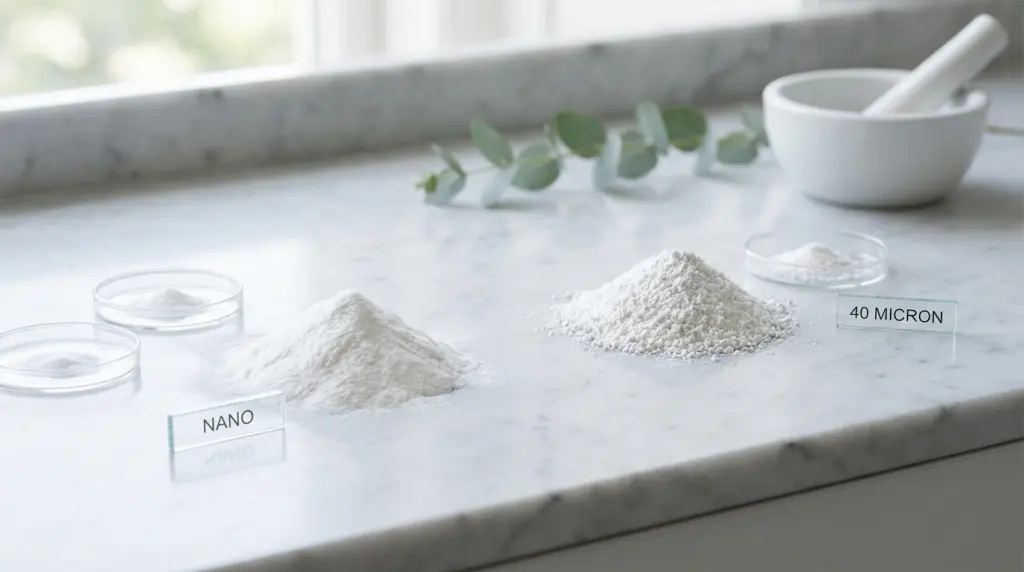
Nano hydroxyapatite (60nm) penetrates deep into your enamel to support remineralization from within. Use it daily. 40-micron hydroxyapatite sits on top of your enamel to polish, protect, and remove surface stains. Use it weekly. They’re the same mineral, just different sizes — and they do fundamentally different things to your teeth.
Searching for nano vs. micro hydroxyapatite? Our 40-micron grade is a micro hydroxyapatite. We name it by its actual particle size, because “micro” on its own has no standard definition.
How “Micro” Hydroxyapatite Compares to 40-Micron Powder
Most brands and articles compare “nano” with “micro” hydroxyapatite. Nano means particles measured in nanometers (billionths of a meter). Micro simply means particles measured in micrometers (millionths of a meter) — and there’s no agreed size. One brand’s micro-HA can be a few micrometers across; another’s can be far larger. So a label that just says “micro” tells you little.
Our coarser grade is 40 micrometers (0.04 mm). That puts it firmly in the micro class: too large to enter enamel, large enough to polish the surface and leave a protective mineral layer behind. It’s also why we suggest using it once or twice a week, not every day — polishing is a weekly job, remineralization a daily one. That guideline applies to the pure powder; a small pinch of 40-micron mixed into your nano is mild enough for daily use. When you read “nano vs. micro” comparisons elsewhere, the micro side maps to our 40-micron powder.
Understanding Particle Size
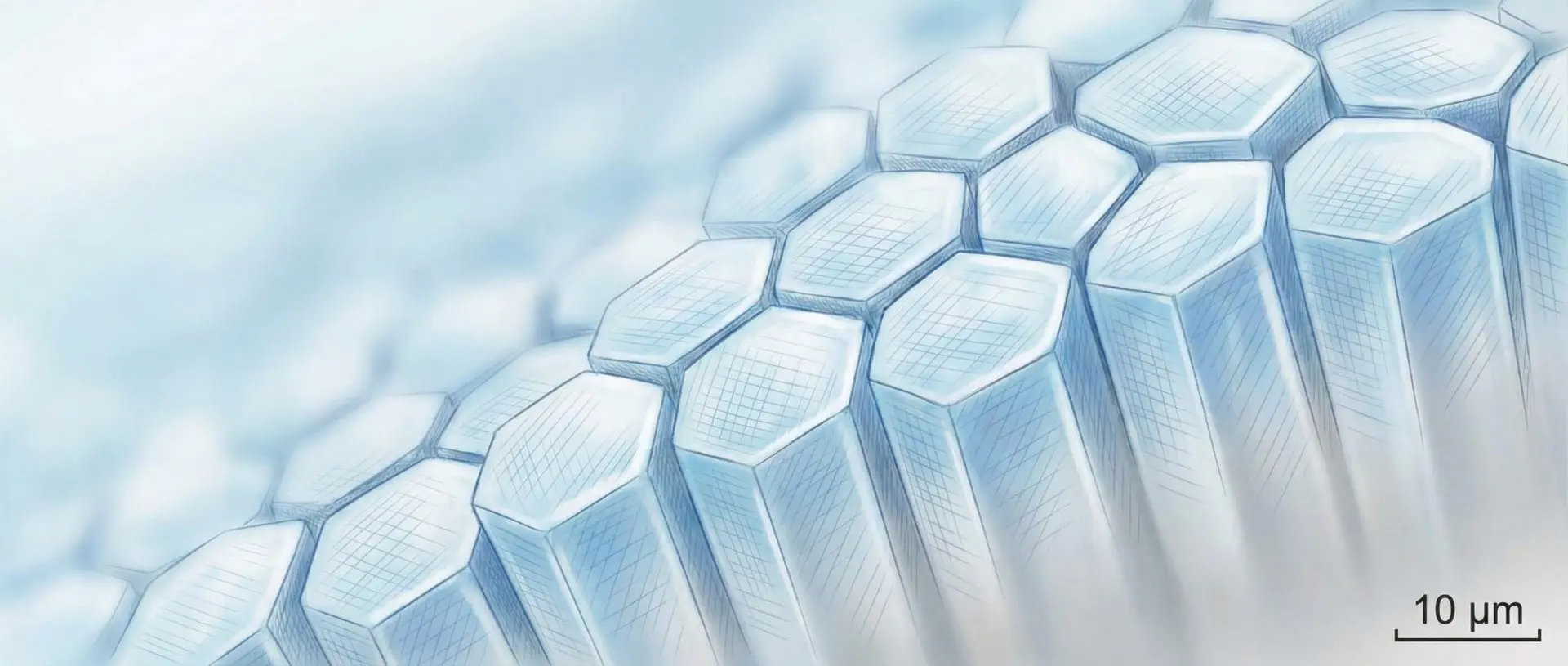
To grasp why size matters, you need to understand tooth enamel at the microscopic level. Your enamel isn’t a solid shield. Under a microscope, it’s made up of tightly packed hexagonal rods called enamel prisms, roughly 4-8 micrometers wide. Between these prisms are tiny gaps. Within the prisms themselves, there are nano-scale pores and defects that accumulate over time from acid exposure, brushing wear, and general use. These microscopic imperfections are where cavities begin. Bacteria colonize the gaps. Acids widen the pores. Minerals leach out. Eventually, a microscopic problem becomes a visible cavity. The size of your hydroxyapatite particles determines where they can reach and how they help.
Nano Hydroxyapatite: The Deep Repair Agent
How Small Is 60 Nanometers?
A nanometer is one-billionth of a meter. At 60nm, these particles are:
- 1,000 times smaller than a human hair
- Smaller than most viruses
- Small enough to enter the spaces between enamel prisms
- Small enough to fill the nano-pores within the prisms themselves
You can’t see them. You can’t feel them individually. When you brush with nano hydroxyapatite powder, it feels silky smooth — like brushing with nothing at all.
What Nano Particles Do
Penetrate enamel structure. They’re small enough to enter the same microscopic spaces that acids attack. Once inside, they bond chemically with existing hydroxyapatite — your tooth literally absorbs them into its structure. Fill dentin tubules. If your enamel has worn thin enough to expose dentin (the layer underneath), open dentin tubules transmit temperature and pressure directly to the nerve. This is what causes sensitivity. Nano hydroxyapatite particles flow into these tubules and seal them. Smooth at the nano-scale. By filling micro-pores and surface defects, nano HAp creates an enamel surface that’s smoother at the molecular level. Smoother enamel means:
- Less bacterial adhesion (bacteria need rough surfaces to grip)
- More light reflection (naturally whiter appearance)
- Better resistance to acid attack
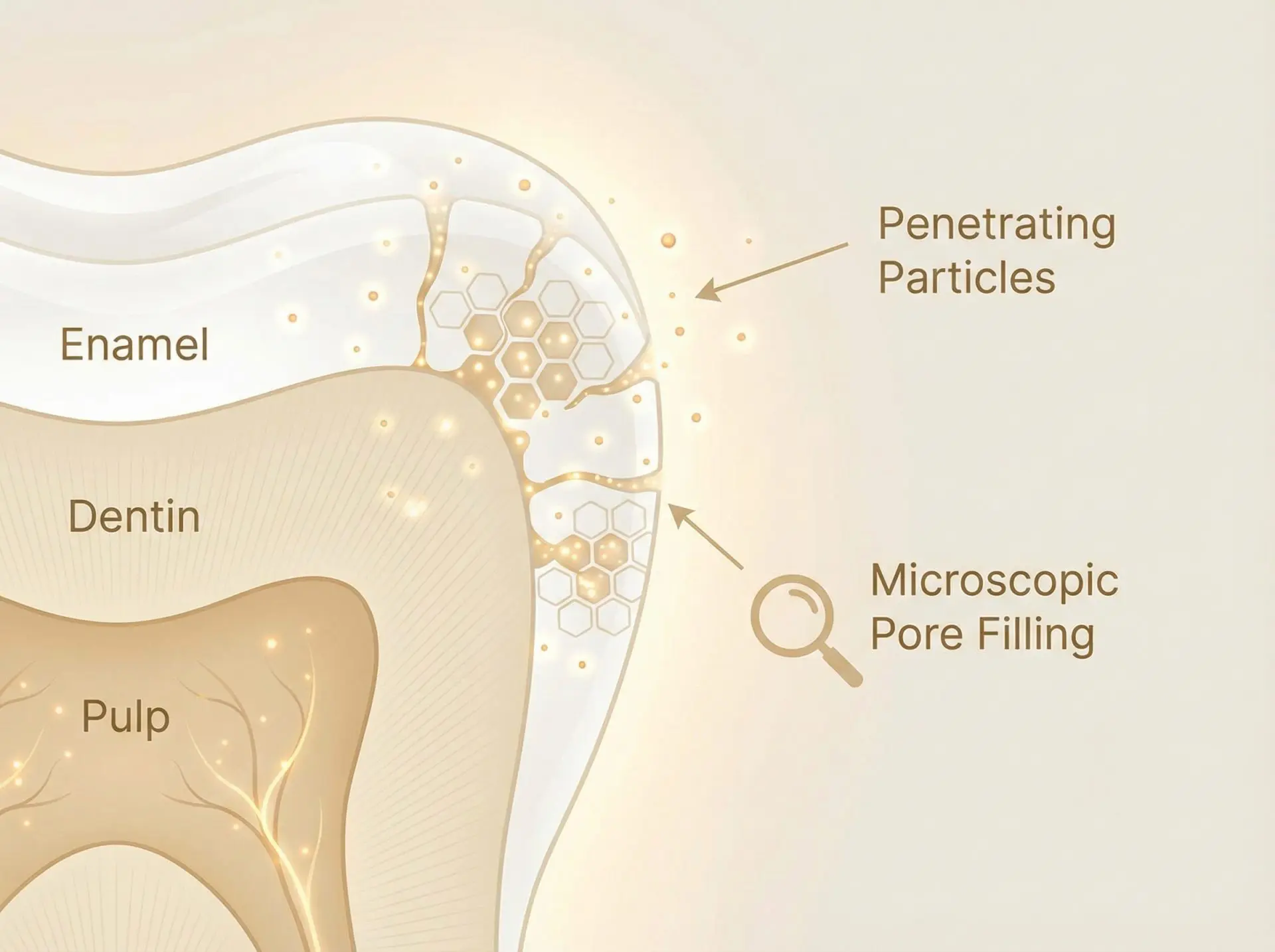
Remineralize early cavities. White spot lesions — the earliest visible stage of cavity formation — are areas where minerals have leached out of enamel. Nano hydroxyapatite replaces those lost minerals with the exact same material, potentially reversing the decay process before it becomes a cavity.
Best Use Cases for Nano
- Daily brushing (morning and evening)
- Sensitivity treatment
- Post-whitening enamel repair
- Early cavity remineralization
- Children’s dental care (non-toxic)
- Nighttime routine (minerals work while you sleep)
40-Micron Hydroxyapatite: The Surface Guardian
How Big Is 40 Micrometers?
A micrometer is one-millionth of a meter. At 40µm, these particles are:
- About 667 times larger than nano particles
- Roughly half the width of a human hair
- Visible as a fine powder (like talc or baking powder)
- Too large to penetrate into enamel prism structure
You can feel them. When you brush with 40-micron powder, there’s a slight grittiness — a gentle, polishing sensation.
What 40-Micron Particles Do
Gentle polishing. The particles are large enough to act as a mild abrasive, removing surface stains from coffee, tea, red wine, and other chromogens. But unlike baking soda, activated charcoal, or whitening toothpaste abrasives, hydroxyapatite is the same hardness as your enamel — so it polishes without scratching. This is a crucial distinction. Many “whitening” products achieve results by being harder than enamel and essentially sanding it down. That removes stains but also removes enamel — permanently. Hydroxyapatite polishes at enamel-matching hardness: stains come off, enamel stays intact.
Protective mineral coating. Larger particles can’t penetrate enamel, but they can deposit on its surface. After brushing, a thin layer of hydroxyapatite remains on your teeth, acting as a sacrificial shield. Acids attack this deposited layer first, buying your natural enamel time. Think of it like waxing a car: the wax takes the damage so the paint doesn’t. Surface smoothing. While nano particles smooth enamel at the molecular level, 40-micron particles smooth it at the surface level — filling visible scratches and wear marks that trap stains and bacteria.
Best Use Cases for 40-Micron
- Weekly deep cleaning (1-2 times)
- Surface stain removal
- Post-meal cleaning (especially after staining foods)
- Adding a protective mineral layer before bed
- Complementing daily nano use
- For people who want a “clean” polished feeling

Side-by-Side Comparison
| Feature | Nano (60nm) | 40 Micron |
|---|---|---|
| Particle size | 0.00006 mm | 0.04 mm |
| Can penetrate enamel? | Yes — deep into structure | No — sits on surface |
| Texture when brushing | Silky smooth | Slightly gritty |
| Primary function | Remineralize from inside | Polish and protect from outside |
| Sensitivity relief | Yes — seals dentin tubules | Minimal |
| Stain removal | Indirect (smoother surface) | Direct (gentle polishing) |
| Cavity prevention | Strong — fills mineral gaps | Moderate — surface protection |
| Recommended frequency | Twice daily | 1-2 times per week |
| Feel after brushing | Smooth, clean | Polished, slick |
Using Both: The Complete Protocol
Here’s why using both isn’t redundant — they work on different levels of the same problem.
The Two-Layer Strategy
Layer 1 (Nano — daily): Repairs and strengthens enamel from within. Builds density. Seals tubules. Makes teeth structurally stronger. Layer 2 (40-micron — weekly): Cleans and protects the surface. Removes stains. Deposits a protective coating. Keeps teeth looking their best. It’s the difference between structural renovation and exterior maintenance. You need both for a building to last — and you need both for teeth to stay strong and clean.
Suggested Weekly Schedule
Monday through Friday:
- Morning: Nano hydroxyapatite powder, 2-minute brush
- Evening: Nano hydroxyapatite powder, 2-minute brush
Saturday:
- Morning: 40-micron hydroxyapatite powder (weekly polish)
- Evening: Nano hydroxyapatite powder
Sunday:
- Morning: Nano hydroxyapatite powder
- Evening: Nano remineralization mask (leave paste on teeth for 10-15 minutes before rinsing)
For Specific Goals
Maximum sensitivity relief: Use nano exclusively for the first 2 weeks, twice daily, with extra 5-minute spot treatments on sensitive areas. Maximum whitening: Use 40-micron every other day for the first week, then twice weekly. Follow each session with nano to remineralize the freshly polished surface. Post-orthodontic repair: Focus on nano daily for 3 months to remineralize white spots around former bracket positions. Add 40-micron once weekly after the first month. Maintenance (healthy teeth): The standard schedule above. Nano daily, 40-micron once or twice weekly.
Why Most Brands Only Offer One
Most hydroxyapatite dental products use a single (usually unspecified) particle size. They don’t differentiate between nano and micro because: 1. Controlling particle size precisely costs more 2. Explaining the difference requires educating consumers 3. A single product is simpler to market But the science is clear: different sizes do different things. A product that claims to do everything with one particle size is either nano (good for remineralization, weak on polishing) or micro (good for polishing, can’t penetrate enamel). It can’t be both. Offering both sizes as separate pure powders lets you apply the right tool for the right job. It’s more effective and more economical — you use nano where you need deep repair and micro where you need surface work.
How to Spot a True Pure Powder vs. Toothpaste with Added HAp
Read the ingredient list. Most “hydroxyapatite toothpastes” list HAp as one ingredient among many: humectants, thickeners, sweeteners, flavors and preservatives. A pure powder lists one thing: hydroxyapatite (CAS 1306-06-5). Natural Answer’s pure hydroxyapatite powder contains no fillers, binders or sweeteners — you decide what, if anything, goes with it. Our EU Safety Data Sheet is published below.
What the Research Says About Hydroxyapatite Particle Size
Both sizes have evidence behind them, for different jobs. A review of nano-hydroxyapatite in dentistry (Pepla et al., 2014) describes how nano-sized crystals, close in size to enamel’s own apatite crystals, can deposit into surface pores and early lesions. Laboratory work on nano-HAp gels shows remineralization of artificial carious lesions (Juntavee & Juntavee, 2021).
Micro-sized hydroxyapatite works mainly at the surface — and it still performs clinically. In a one-year randomized trial in young children, a toothpaste with microcrystalline hydroxyapatite was non-inferior to a fluoride toothpaste for caries progression (Paszynska et al., 2021). For sensitivity, a 2023 meta-analysis found that hydroxyapatite in oral care products reduced dentin hypersensitivity (Limeback et al., 2023).
Why Some Brands Argue for Micro Over Nano — and What They Get Right
Some brands sell only micro hydroxyapatite and say it’s the better choice. They have a point. Micro particles are easier and cheaper to produce, they polish in a way nano can’t, and they sidestep the questions some people have about nanomaterials. And as the trial above shows, micro HAp is not a weak option.
Where we differ: nano and micro aren’t rivals. Nano works inside the enamel’s tiny pores; micro works on the surface. You get the most from both layers — which is why we sell each as a separate pure powder.
The Science Behind Particle Size
For those who want the technical details: Nano-HAp penetration: Studies using electron microscopy show that hydroxyapatite particles under 100nm can enter enamel interprismatic spaces (the gaps between enamel rods). Particles in this size range show good penetration and bonding with natural enamel structure in laboratory studies (Juntavee et al., 2021). Micro-HAp surface effects: Larger particles (10-50µm range) primarily interact with the enamel surface. They deposit as a coating that has been shown in laboratory studies to reduce enamel dissolution in acidic conditions. RDA (Relative Dentin Abrasivity): Hydroxyapatite has an RDA comparable to natural enamel, meaning it can polish without causing damage. For comparison: baking soda ≈ 7 RDA, whitening toothpastes ≈ 100-200 RDA, activated charcoal ≈ varies wildly. Hydroxyapatite provides cleaning action at a safe abrasion level.
Frequently Asked Questions
“Can I mix nano and 40-micron together?”
Yes — many people do. A small amount of 40-micron blended into mostly nano gives you a light daily polish on top of the daily remineralization. The weekly rule is about concentration: brushing with pure 40-micron powder is a full polishing session, so keep that to once or twice a week.
“I only want to buy one. Which should I choose?”
Nano. It does the most important job (remineralization and sensitivity relief) and has the strongest clinical evidence. Add 40-micron later when you want the polishing benefits.
“How long does each last?”
At the recommended usage, a 50g pouch of either lasts 4-6 months. If you use both, you’ll go through the nano faster (daily use) and the 40-micron much slower (weekly use).
“Is bigger always better for polishing?”
No. Particles larger than 40-50µm become too abrasive. The 40-micron sweet spot provides effective polishing while staying gentle enough not to damage enamel. Bigger isn’t better — it’s just more aggressive.
“Do dentists know about this nano vs. micro difference?”
Increasingly, yes. Dental research distinguishes between particle sizes, and dentists who stay current with remineralization science understand the different applications. Some may still default to recommending fluoride, but the evidence for size-specific hydroxyapatite use is growing.
What is the difference between nano and micro hydroxyapatite?
Size and job. Nano hydroxyapatite (ours is 60nm) is small enough to enter enamel’s tiny pores and support remineralization from within. Micro hydroxyapatite (ours is 40 micron) is too large to enter enamel; it polishes the surface and leaves a protective mineral layer. Same mineral, different depth.
Can nano hydroxyapatite penetrate tooth enamel?
It can reach into enamel’s surface pores and early lesions, which larger particles cannot. Laboratory and review studies describe nano crystals depositing into these defects and remineralizing them. It won’t rebuild a cavity that has already broken through the enamel — that still needs a dentist.
Is 40 micron hydroxyapatite the same as micro-HA?
It’s one kind of micro-HA. “Micro” covers any particle measured in micrometers, with no standard size, so products labelled micro can differ a lot. We state the actual size — 40 micrometers — so you know you’re getting a polishing grade for weekly use.
Should I use nano or micro hydroxyapatite daily?
Use nano daily, morning and evening — remineralization depends on steady contact. Use pure 40-micron once or twice a week as a polish, or blend a small amount into your nano for a light daily polish. If you only buy one, start with nano and add the 40-micron powder later for polishing.
The Bottom Line
Nano and 40-micron hydroxyapatite aren’t competing products — they’re complementary tools for different aspects of dental care. Understanding which does what lets you build a more effective routine than any single product can provide. Your teeth need internal repair (nano) and external protection (40-micron). Give them both. Natural Answer offers both forms as pure powder: Nano Hydroxyapatite (60nm) for daily remineralization and 40 Micron Hydroxyapatite Powder for weekly polishing. No fillers. No additives. Just the mineral your teeth need, in the right size for the right job.
Related Articles
- Hydroxyapatite vs Fluoride: Which Is Better for Your Teeth?
- Best Hydroxyapatite Powder 2026: Complete Buyer’s Guide
Safety Information: Nano Hydroxyapatite
Our hydroxyapatite powder can be used independently as a tooth remineralisation treatment. If you are using nano hydroxyapatite powder, please review the Safety Data Sheet (SDS), provided in accordance with EU REACH regulations.
Make Your Own Toothpaste
Hydroxyapatite powder can also be used as an ingredient for homemade toothpaste. Download our free Hydroxyapatite e-book for recipes and detailed usage instructions.
Related reading
Sources
- Pepla E, et al. Nano-hydroxyapatite and its applications in preventive, restorative and regenerative dentistry: a review of literature. Ann Stomatol. 2014. PubMed 25506416
- Juntavee A, Juntavee N. Nano-hydroxyapatite gel and its effects on remineralization of artificial carious lesions. Int J Dent. 2021. PubMed 34790238
- Paszynska E, et al. Impact of a toothpaste with microcrystalline hydroxyapatite on the occurrence of early childhood caries: a 1-year randomized clinical trial. Sci Rep. 2021. PubMed 33514787
- Limeback H, et al. Clinical evidence of biomimetic hydroxyapatite in oral care products for reducing dentin hypersensitivity: an updated systematic review and meta-analysis. Biomimetics. 2023. PubMed 36648809
Looking for the powder this guide covers?
See Nano Hydroxyapatite Powder (60nm) in our shop.
View Nano Hydroxyapatite Powder (60nm) →