


Last updated: August 28, 2026
 Nano Hydroxyapatite vs Fluoride: What the Science Actually Says
The internet is full of strong opinions on fluoride. Some call it essential. Others call it poison. The reality is more nuanced — and a mineral called hydroxyapatite is at the centre of this conversation.Here’s what the research actually says. No ideology, just evidence. Nano Hydroxyapatite vs Fluoride: What the Science Actually Says
What fluoride does to your teeth
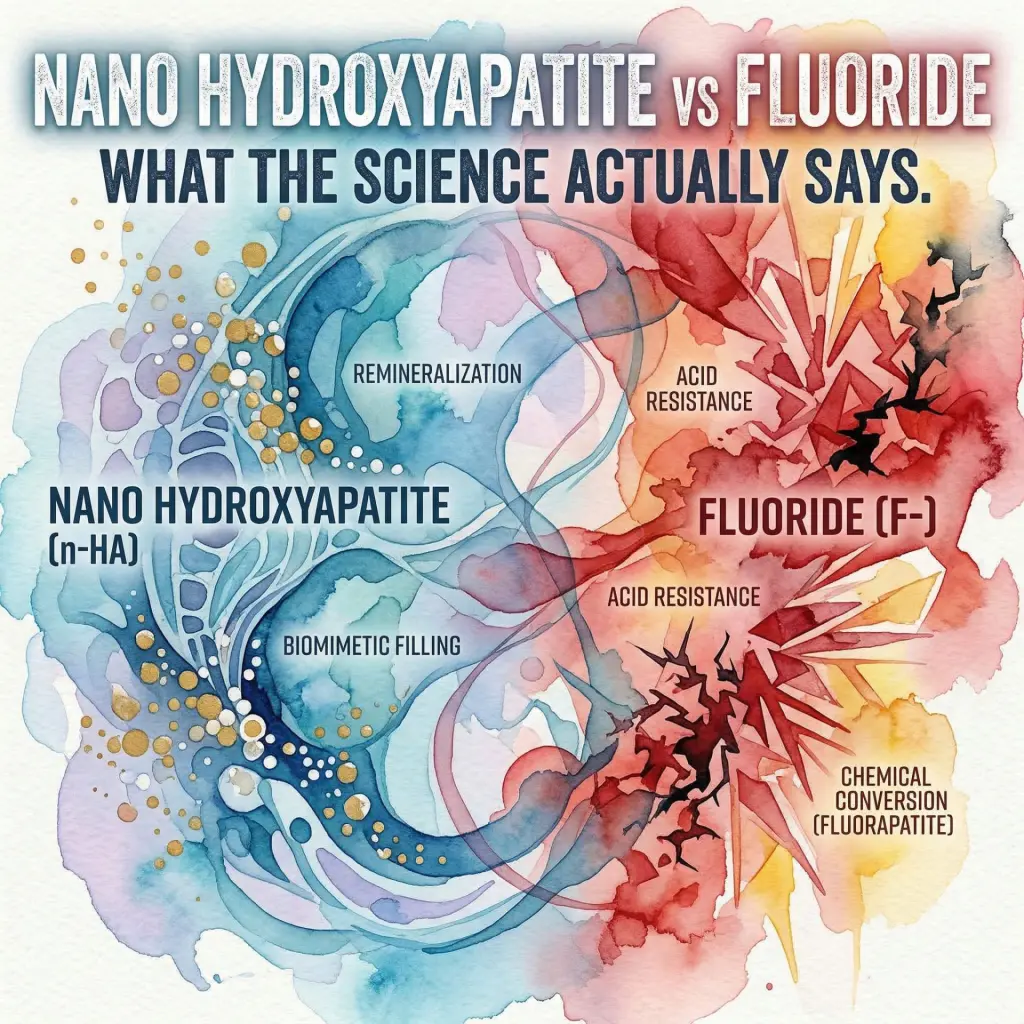
Fluoride works through chemical transformation. When it contacts demineralised enamel, it converts hydroxyapatite — the mineral your teeth are made of — into fluorapatite. Fluorapatite is harder and more acid-resistant than regular enamel.This is well-established science. Fluoride toothpaste has prevented millions of cavities since it became widespread in the 1960s.The trade-off: Fluoride is effective but foreign to your body. At recommended doses, it’s safe. But it’s toxic in larger quantities, which is why children’s toothpaste has lower concentrations and why you’re told not to swallow it.What hydroxyapatite does to your teeth
Hydroxyapatite takes a fundamentally different approach. Instead of chemically transforming your enamel, it replenishes it with the same mineral it’s already made of.Your tooth enamel is 97% hydroxyapatite. When you apply nano-hydroxyapatite (particles around 60 nanometres), they:- Fill micro-cracks in the enamel surface
- Seal exposed dentine tubules (reducing sensitivity)
- Create a protective layer that mimics natural enamel
- Bond with existing enamel through crystal-to-crystal interaction
Head-to-head: what the studies show
The most comprehensive comparison is a 2023 meta-analysis published in Clinical Oral Investigations reviewing multiple randomised controlled trials:| Outcome | Hydroxyapatite | Fluoride |
|---|---|---|
| Caries prevention | Comparable | Comparable |
| Enamel remineralisation | Effective | Effective |
| Sensitivity reduction | Superior | Moderate |
| Whitening effect | Yes (surface repair) | No |
| Biofilm reduction | Moderate | Moderate |
| Safety if swallowed | Safe (bioidentical) | Toxic at high doses |
Japan: 40+ years of evidence
Japan has used hydroxyapatite in dental care since 1980, when Sangi Co. launched the first HAp toothpaste. Today, HAp is found in over 50 dental products in Japan and is considered mainstream — not alternative. The Japanese approach is instructive. They don’t frame it as “fluoride vs. HAp.” Many products contain both. The question isn’t which one is “right” — it’s which approach suits your needs.
When hydroxyapatite makes more sense
Hydroxyapatite is particularly relevant for:- Children — no toxicity risk if swallowed
- Sensitive teeth — seals dentine tubules more effectively than fluoride
- DIY dental care — pure powder can be mixed into custom formulations
- Whitening — repairs surface enamel for a naturally brighter appearance
- People who prefer fluoride-free — equally effective alternative
Particle size matters more than you think
Not all hydroxyapatite is equal. The particle size determines how it interacts with your enamel:Nano-hydroxyapatite (60nm): Penetrates into micro-fissures for deep remineralisation. This is what clinical studies use. It’s the particle size that matches the crystal structure of natural enamel.Micro-hydroxyapatite (40μm): Acts as a gentle polishing agent. Good for surface-level whitening and filling larger defects. Think of it as a fine sandpaper for your teeth — but one that actually repairs instead of abrading.The combination: Using both sizes gives you surface polishing plus deep repair. This is why serious DIY toothpaste recipes specify both.How to use pure hydroxyapatite powder
If you’re making your own dental care products, you need pure hydroxyapatite powder, not a finished toothpaste. Here’s a basic formulation:Simple remineralising tooth powder:- 44% Calcium carbonate
- 40% Kaolin clay
- 10% Nano-hydroxyapatite (60nm)
- 5% Xylitol
- 1% Peppermint essential oil
What to look for when buying HAp powder
The market is growing, but quality varies enormously:- Specified particle size — If a supplier doesn’t tell you the exact nanometre size, they’re selling generic powder.
- Purity ≥99% — Anything less contains impurities.
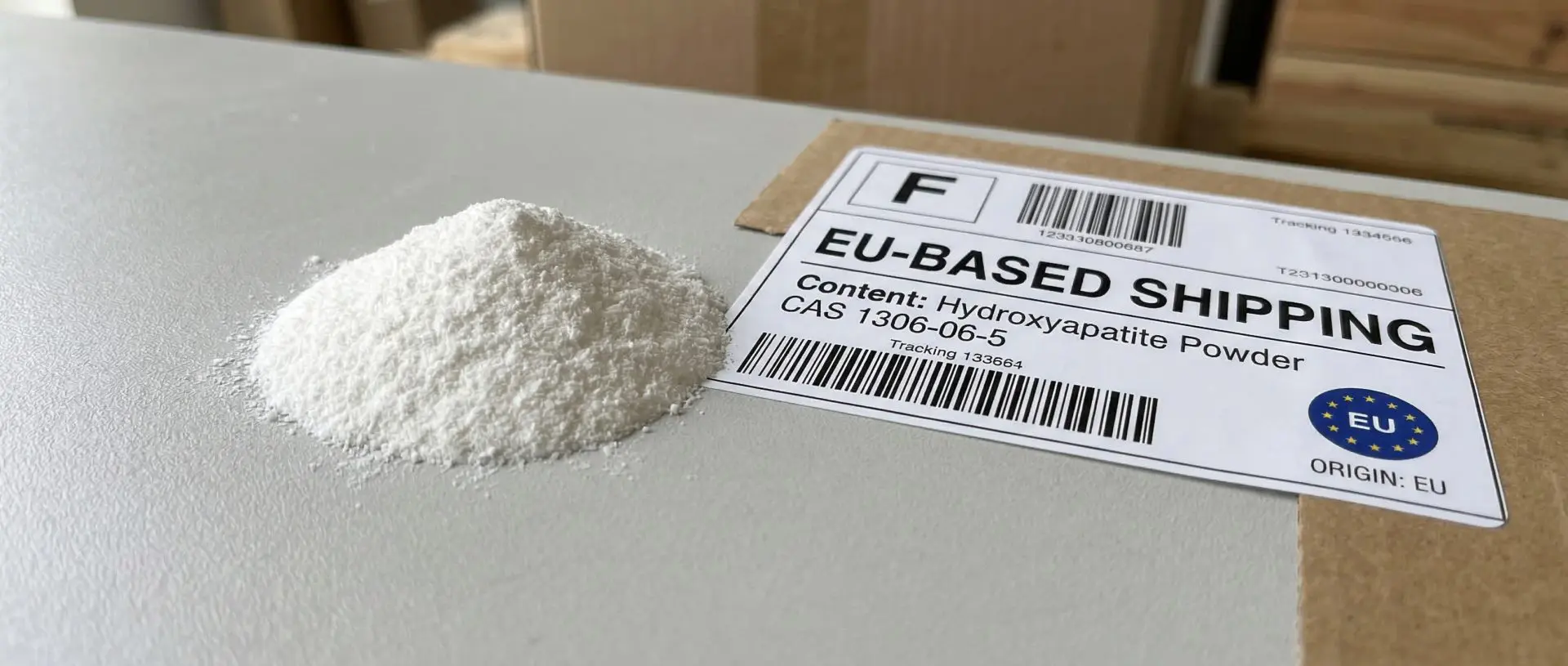
- CAS number 1306-06-5 — Confirms genuine hydroxyapatite.
- EU compliance — Not all imported powders meet European cosmetic standards.
- Safety Data Sheet (SDS) — Professional suppliers provide this.
- EU-based shipping — Avoids customs, faster delivery, consumer protection.
The bottom line
Fluoride works. Hydroxyapatite works. The science says they’re comparable for preventing cavities, and hydroxyapatite has advantages for sensitivity and whitening.The real question isn’t which one is “better” — it’s which one fits your values, your needs, and your comfort level. If you want fluoride-free dental care with equivalent protection, hydroxyapatite is the most evidence-backed option available.And if you want full control over what goes in your mouth, pure nano-hydroxyapatite powder lets you build your own formulations from scratch.Related reading
- Best Hydroxyapatite Powder 2026: Complete Buyer’s Guide
- Nano vs 40 Micron Hydroxyapatite: What’s the Difference?
- Hydroxyapatite for Children: Is It Safe?
- Hydroxyapatite vs Fluoride: Which Is Better for Your Teeth?
The Science: What Studies Actually Show
The evidence base for nano hydroxyapatite has grown substantially in recent years. Here are the most important studies:
- 2021 Meta-Analysis (Scientific Reports): The most comprehensive review to date — 21 clinical studies analyzed. Conclusion: nano hydroxyapatite is “non-inferior to fluoride” for cavity prevention. This is the gold standard reference for HAp efficacy claims.
- Journal of Clinical Dentistry, 2019: Nano-HAp reduces dental sensitivity more effectively than fluoride by sealing exposed dentinal tubules. Significant difference after just 4 weeks.
- Clinical Oral Investigations, 2023: Nano-HAp shows superior remineralization on early enamel lesions compared to standard fluoride toothpastes at equivalent brushing frequency.
- Japanese Dental Practice, 1980-present: 40+ years of clinical use without documented adverse effects — the longest safety track record of any dental remineralizing agent.
Fluoride vs. Hydroxyapatite: Side-by-Side Comparison
| Factor | Nano Hydroxyapatite | Fluoride |
|---|---|---|
| Mechanism | Deposits identical enamel mineral (direct remineralization) | Forms protective fluorapatite layer + inhibits bacteria |
| Children safety | ✅ No fluorosis risk, non-toxic if swallowed | ⚠️ Dental fluorosis risk if overdosed |
| Sensitivity treatment | ✅ Seals dentinal tubules effectively | Limited effectiveness |
| Depth of action | Penetrates into micro-cracks | Surface protection only |
| DIY-friendly | ✅ Easy to incorporate in homemade toothpaste | Complex formulation required |
| Evidence level | Strong (non-inferior to fluoride, 2021 meta-analysis) | Very strong (70 years of data) |
| EU authorized | ✅ REACH compliant since 2006 | ✅ Standard |
Who Should Choose Hydroxyapatite Over Fluoride?
Nano hydroxyapatite is particularly beneficial for:
- Children under 6 — Zero fluorosis risk. Parents concerned about fluoride toxicity can use HAp without age or dosage restrictions.
- Pregnant or breastfeeding women — Safer alternative without accumulation concerns.
- Highly sensitive teeth — HAp seals dentinal tubules more effectively than fluoride, reducing hot/cold/acid pain.
- Clean beauty/natural living — Coherent with a synthetic-chemical-free approach.
- Post-whitening recovery — Chemical whitening depletes enamel minerals; nano-HAp restores them rapidly.
- DIY formulators — Easiest active mineral to incorporate in homemade dental care (no complex dosage constraints).
How to Use Nano Hydroxyapatite Powder
Method 1 — DIY Toothpaste: Mix 1-2 teaspoons nano-HAp into a base of coconut oil + white kaolin clay + xylitol. Store in a glass jar. Use twice daily.
Method 2 — Direct application: Apply a small pinch (0.1-0.2g) directly to a wet toothbrush. Brush gently for 2 minutes. Don’t rinse immediately — let the mineral work.
Method 3 — Remineralizing mouth rinse: Dissolve 1 teaspoon in 100ml warm distilled water. Swish for 2 minutes before bed. Excellent for intensive sensitivity treatment.
Where to Buy Pure Nano Hydroxyapatite Powder in Europe
Pure HAp powder for DIY use is rarely available in pharmacies — most brands sell finished toothpaste products. Natural Answer is one of the few EU-based suppliers of pure nano hydroxyapatite powder, manufactured in the EU and shipped throughout Europe in 3-5 business days.
→ Buy Nano Hydroxyapatite Powder 60nm (€34) | → Buy 40 Micron Hydroxyapatite (€19.82)
{ “@context”: “https://schema.org”, “@type”: “FAQPage”, “mainEntity”: [ { “@type”: “Question”, “name”: “Is nano hydroxyapatite as effective as fluoride for cavity prevention?”, “acceptedAnswer”: { “@type”: “Answer”, “text”: “Yes. A 2021 meta-analysis in Scientific Reports reviewing 21 clinical studies concluded that nano hydroxyapatite is ‘non-inferior to fluoride’ for cavity prevention. It has been used in Japanese dentistry since 1980 with excellent long-term results.” } }, { “@type”: “Question”, “name”: “What is the difference between nano hydroxyapatite and regular hydroxyapatite?”, “acceptedAnswer”: { “@type”: “Answer”, “text”: “Nano hydroxyapatite (60nm particle size) has ultra-fine particles that penetrate deep into enamel micro-cracks for intensive remineralization. Regular/40-micron hydroxyapatite has larger particles, excellent for gentle polishing and daily cleaning at lower cost.” } }, { “@type”: “Question”, “name”: “Is nano hydroxyapatite safe to use?”, “acceptedAnswer”: { “@type”: “Answer”, “text”: “Yes. Nano hydroxyapatite is EU REACH compliant (CAS 1306-06-5), authorized as a cosmetic ingredient since 2006, non-toxic, and biocompatible — it’s the same mineral your teeth are made of. Safe for children and pregnant women.” } }, { “@type”: “Question”, “name”: “How do I use hydroxyapatite powder in a DIY toothpaste?”, “acceptedAnswer”: { “@type”: “Answer”, “text”: “Mix 1-2 teaspoons of hydroxyapatite powder with 2 tablespoons coconut oil, 1 tablespoon white kaolin clay, 1 teaspoon xylitol, and 10 drops peppermint essential oil. Store in a glass jar. Use twice daily like regular toothpaste.” } } ] }