


Last updated: October 10, 2026
Looking for truly organic natural shampoo bars without the greenwashing? You’re not alone. The “natural” beauty market is full of misleading claims, vague ingredient lists, and products that aren’t as clean as they seem.This guide cuts through the marketing noise. We’ll show you what makes a shampoo bar genuinely natural, which certifications actually matter, and how to choose bars that align with clean beauty values—without sacrificing performance.Written by the Natural Answer team · Last reviewed September 30, 2026
Quick answer
An organic or natural shampoo bar uses plant-derived cleansers and no synthetic sulfates, parabens, or synthetic fragrance. Cold-process soap bars — plant oils saponified with lye — are one of the most traditional natural options, though in hard water they work best paired with an acidic rinse.
In this guide
- What makes a shampoo bar “natural” or “organic”?
- Is cold-process soap organic or natural?
- 7 greenwashing red flags to watch for
- Natural vs. synthetic: the nuance
- Best organic & natural shampoo bars by category
- How to choose the right bar for you
- How to read a shampoo bar ingredient list (INCI)
- Ingredients to avoid
- The hard water advantage
- How to use natural shampoo bars
- FAQs
What Makes a Shampoo Bar “Natural” or “Organic”?
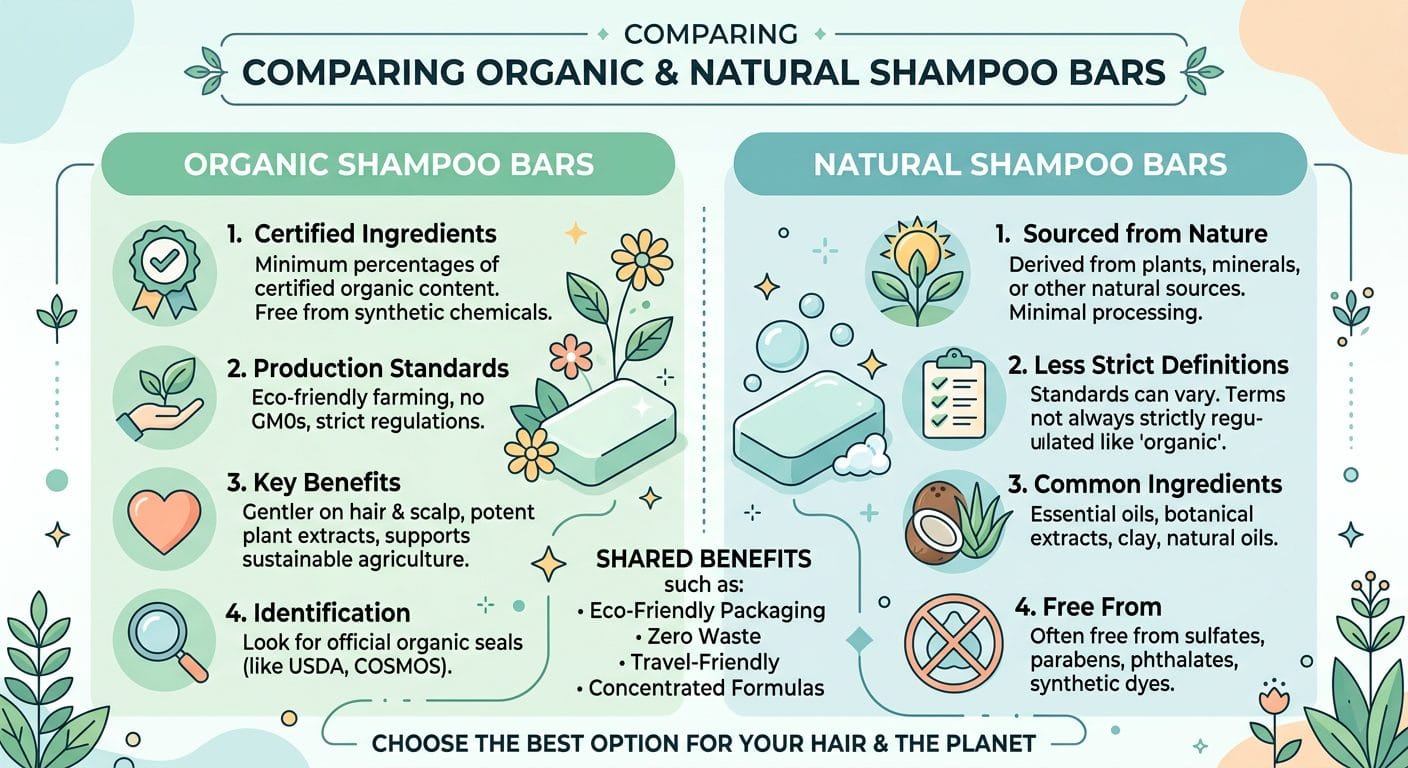
In short: a natural shampoo bar cleans with plant-derived ingredients instead of petroleum-based sulfates, with no synthetic fragrance, parabens, or phthalates. “Organic” goes a step further — it means a fixed share of those ingredients is grown without synthetic pesticides and verified by an independent certifier, not just claimed on the label.
Certifications That Actually Mean Something
Look for these third-party certifications:- COSMOS Organic/Natural – European standard, strict ingredient sourcing
- USDA Organic – For agricultural ingredients (rarely full products)
- Ecocert – French certification, rigorous standards
- BDIH – German standard for natural cosmetics
- NaTrue – Three-tier system (natural, natural with organic, organic)
- Soil Association Organic – UK-based, comprehensive
What “Natural” Should Mean (In Practice)
- Use plant-derived cleansers (not petroleum-based sulfates like SLS)
- Avoid synthetic fragrances and dyes
- Skip parabens, phthalates, formaldehyde releasers
- Source ingredients from renewable resources
- Minimize processing (cold-pressed oils > refined oils)
Is a Cold-Process Soap Bar Organic or Natural? What the Certification Bodies Say
Cold-process soap — plant oils combined with lye through saponification — is one of the oldest natural formulation methods there is; people were making soap this way long before “natural cosmetics” became a marketing category. On its own, that history doesn’t earn a product a certification logo.
Certification bodies look at the finished formula, not just the method. If the plant oils going into the soap are certified organic and the finished product meets a body’s sourcing, processing, and labelling rules, a cold-process bar can carry COSMOS Organic, COSMOS Natural, or NaTrue Organic certification — several organic soap brands do exactly that.
Natural Answer’s shampoo bars are made from organic plant oils — each ingredient on our product pages that comes from an organic source is marked with an asterisk — but the finished bars don’t carry a third-party certification today. We’d rather say that plainly than let a leaf icon do the talking. For more on how we source and label, see our About page.
| Certification | Who issues it | Covers | Strictness | NAP status |
|---|---|---|---|---|
| COSMOS Organic | COSMOS-accredited bodies (e.g. Ecocert, Soil Association) | Sourcing, composition, manufacturing & labelling of the finished cosmetic | High — min. 95% of plant ingredients organic; min. 20% organic content in the total formula (10% for rinse-off products) | Not certified |
| COSMOS Natural | Same COSMOS-accredited bodies | Same standard, natural tier — no minimum organic-content requirement, strict rules on ingredient origin | Moderate-high | Not certified |
| USDA Organic | USDA-accredited certifying agents (National Organic Program) | Primarily agricultural products; for cosmetics, ingredient-level organic sourcing | High for agricultural inputs | Not certified |
| Ecocert | Ecocert (itself a COSMOS-accredited certification body) | Certifies to the COSMOS-standard — same scope as COSMOS Organic/Natural above | High | Not certified |
| NaTrue | NATRUE AISBL, via approved certifiers | Three tiers — Natural, Natural with Organic Portion (being phased out), Organic (min. 95% of natural substances organic) | High for the Organic tier; bans GMOs, silicones, parabens, microplastics, synthetic fragrance | Not certified |
| Soil Association | Soil Association Certification (UK) | Certifies cosmetic products to the COSMOS-standard, plus its own standard for non-cosmetic personal-care items | High | Not certified |
Greenwashing: 7 Red Flags on “Natural” Shampoo Bar Labels
These phrases show up constantly on “natural” shampoo bar packaging. None of them are automatically dishonest, but each one is a cue to look closer before you buy.
- ⚠️ “Made with natural ingredients” with no percentage given.
- ⚠️ “Free from [X]” claims with no full ingredient list to check them against.
- ⚠️ “Organic” used with no certification logo or licence number.
- ⚠️ Vague “plant-based” descriptions that don’t name a single plant.
- ⚠️ “Eco-friendly” with no supporting sourcing or life-cycle data.
- ⚠️ “Fragrance” or “parfum” hiding undisclosed ingredients.
- ⚠️ No published INCI ingredient list at all.
Natural vs. Synthetic: The Nuance No One Talks About
When Synthetic Ingredients Are Better
Hard truth: Some synthetic cleansers are gentler and more sustainable than their “natural” counterparts.Example: Sodium Cocoyl Isethionate (SCI) – derived from coconut, processed in a lab. It’s technically synthetic, but:- Biodegrades quickly
- Works in hard water without an extra step
- Gentle on scalp
- Uses less water in manufacturing than soap saponification
- Needs an ACV rinse in hard water (otherwise leaves mineral buildup)
- Strips hair in soft water
- Leaves waxy residue
- High pH damages hair cuticles
The Hard Water Problem with Natural Soap
- Waxy, impossible-to-rinse buildup
- Dull, greasy-looking hair
- Scalp irritation from residue
- Requires acidic rinse (apple cider vinegar) after every wash
- Work well in hard water
- No buildup once the rinse is part of your routine
- Alkaline pH (9-10), balanced by the acidic rinse
- Better hair health long-term
How we selected these bars: We compared these shampoo bars using verifiable facts from each brand’s own product pages and ingredient lists: bar type (soap vs. syndet), INCI transparency, and how each formula behaves in hard water. We haven’t run side-by-side wash tests on every bar here — where we describe how a bar performs, that’s based on its published formulation and, for our own bars, direct product knowledge.
Best Organic & Natural Shampoo Bars in 2026 (By Category)
Best for Hard Water + Natural Focus: Natural Answer Bars
Why they work:- Cold-process soap — six organic plant oils and organic shea butter, saponified with lye, no synthetic surfactants
- Works in hard water when paired with an ACV rinse—critical for 85% of Europe
- No sulfates, parabens, silicones, synthetic fragrance
- Palm oil-free, vegan, cruelty-free
- Handmade in small batches
- Plastic-free packaging
Best Certified Organic: Ethique Eco-Friendly Shampoo Bars
Certifications: B Corp, Climate Neutral Certified Why they’re good:- Plant-based ingredients, many certified organic
- Vegan, cruelty-free, palm oil-free
- Transparent ingredient sourcing
- Carbon-neutral manufacturing
Best for Clean Beauty Purists: Kitsch Rice Water Protein Shampoo Bar
Why it’s clean:- Rice water protein (traditional beauty ingredient)
- Vegan, cruelty-free
- No sulfates, parabens, phthalates
- Biodegradable ingredients
Best Budget Natural Option: Beauty Kubes Shampoo Cubes
Why they’re clever:- Concentrated cubes (one cube = one wash)
- Minimal water content (sustainable shipping)
- Plant-based cleansers
- Plastic-free packaging
Best Soap-Based (For Soft Water): Dr. Bronner’s Organic Castile Bar
If you have SOFT water:- USDA Organic certified
- Fair trade ingredients
- Simple, clean formula (coconut + olive oils)
- Multi-purpose (hair, body, cleaning)
How to Choose the Right Natural Shampoo Bar for You
Step 1: Check Your Water Hardness
This is non-negotiable. Hard water creates soap scum on soap-based bars — an ACV rinse after washing prevents this.Find your area’s water hardness:- UK: Check your water company’s website
- US: USGS water quality map
- EU: Contact local water supplier
Step 2: Define “Natural” for Yourself
What matters most to you?If you want:- Certified organic ingredients → Ethique (SCI-based syndet, works in hard water) or Dr. Bronner’s (true soap, soft water only)
- Cold-process soap + natural oils → Natural Answer (saponified plant oils, pH 9-10 + ACV rinse)
- Zero synthetics (even beneficial ones) → Soap bars (soft water required)
- Sustainable + effective → natural shampoo bars with plant oils
Step 3: Match to Hair Needs
Dry/damaged hair:- Look for shea butter, cocoa butter, argan oil
- Avoid high-coconut oil soap bars (too cleansing)
- Choose natural shampoo bars with added oils
- Light oils (jojoba, grapeseed)
- Clay-based bars (kaolin, bentonite)
- Avoid heavy butters
- pH 9-10 (NAP cold-process soap) + acidic ACV rinse brings the pH down after washing
- Sulfate-free (even “natural” sulfates like SLS)
- UV protection (rosemary extract, vitamin E)
- High-moisture formulas (shea, mango butter)
- Glycerin for slip
- Avoid stripping cleansers
- See our full guide to organic and natural shampoo bars for gray and silver hair
- If hormone shifts are part of the picture, our shampoo bars for menopause and hormone changes guide covers scalp changes too
How to Read a Shampoo Bar Ingredient List (INCI): A 2-Minute Guide
Every cosmetic sold in the EU or US must list ingredients by their INCI name — plant oils show their Latin botanical name in parentheses, e.g. Cocos Nucifera (Coconut) Oil. Ingredients are listed roughly in descending order by weight, so the first few names tell you what the bar is mostly made of.
For a cold-process soap bar, check whether the oils are listed as the plant oil itself (Cocos Nucifera Oil, Olea Europaea Fruit Oil) or as a sodium salt (Sodium Cocoate, Sodium Olivate) — both point to the same saponified soap, just described two different ways. A syndet bar, by contrast, lists surfactants such as Sodium Cocoyl Isethionate or Sodium Coco Sulfate instead.
As an example, Natural Answer’s Orange & Cedarwood bar lists: Cocos Nucifera (Coconut) Oil*, Sesamum Indicum (Sesame) Oil*, Helianthus Annuus (Sunflower) Seed Oil*, Olea Europaea (Olive) Fruit Oil*, Ricinus Communis (Castor) Seed Oil*, Butyrospermum Parkii (Shea) Butter*, plus the scent oils — the asterisk marks organic source. No SLS, no SCI, no synthetic fragrance on the list.
A short list you can read in full, with no vague “fragrance” or “parfum” catch-all, is one honest sign of a transparent brand.
Ingredients to Avoid (Even in “Natural” Bars)
Greenwashing Red Flags
These appear in “natural” products but aren’t as clean as they sound:“Derived from coconuts” sulfates:- Sodium Lauryl Sulfate (SLS) – harsh, stripping
- Often marketed as “coconut-derived” (technically true, but processed aggressively)
- Legal loophole: “fragrance” can hide 100+ undisclosed chemicals
- Even “natural fragrance” is poorly regulated
- Better: individual essential oils listed
- Often contaminated with carcinogens (1,4-dioxane)
- Common in “natural” bars as emulsifiers
- Look for: PEG-40, PEG-100, etc. in ingredient lists
- Phenoxyethanol – synthetic, irritating to some
- Benzyl alcohol – natural source, but processed
- Not inherently bad, but not “preservative-free” as claimed
Ingredients That Are Fine (Despite Sounding Scary)
Sodium Cocoyl Isethionate (SCI):- Coconut-derived, lab-processed
- Gentle, biodegradable, effective
- Your best bet in hard water
- Coconut-derived surfactant
- Mild, safe, well-studied
- Often in “natural” formulas
- Sounds synthetic, actually from citrus fermentation
- pH adjuster, natural ingredient (binds hard water minerals)
- Beneficial, not harmful
The Hard Water Advantage: Why It Matters for Natural Bars
85% of Europe has hard water. So do most major US cities (Los Angeles, Phoenix, Chicago, Miami, Las Vegas).If you ignore water chemistry, you’ll waste money on products that can’t work.Hard Water and Soap Bars: What Happens
Soap (saponified oils) + hard water minerals (calcium, magnesium) = insoluble precipitate (soap scum) — unless you rinse it off.Skip the rinse, and here’s what you’ll see:- Waxy buildup that won’t rinse
- Dull, lifeless appearance
- Tangled, rough texture
- Scalp itchiness from residue
- Looks greasy even when freshly washed
Why Soap Bars Need an Acidic Rinse in Hard Water
Controversial take: a cold-process soap bar plus an ACV rinse works with your water chemistry instead of against it.In hard water, a soap bar needs:- An acidic rinse (apple cider vinegar) after every wash
- An occasional clarifying wash if you skip rinses for a while
- Works well
- Leaves no buildup
- Needs only a quick rinse, not extra washing
- Supports good hair health
How to Use Natural Shampoo Bars (Properly)
The Right Technique
1. Wet hair thoroughly (30 seconds minimum in hard water) 2. Rub bar directly on hair OR lather in hands first 3. Focus on scalp (roots get oily, ends stay clean from lather runoff) 4. Massage 60 seconds (give cleansers time to work) 5. Rinse completely (2-3 minutes in hard water—minerals make rinsing harder)Pro tip: If you have long hair, divide into sections. Soap one section at a time for even distribution.Transition Period (If Switching From Liquid)
First 2-4 weeks can be weird. Here’s why:Your scalp adapted to liquid shampoo (likely silicone-heavy). Silicones coat hair, hiding damage and creating false smoothness.When you switch to natural bars:- Silicones wash out (hair feels rough initially)
- Scalp oil production rebalances (may be greasy or dry temporarily)
- Hair texture changes (real texture, not silicone-smoothed)
- Better scalp health
- Less oil production (scalp stops overcompensating)
- Shinier hair (natural oils, not silicone coating)
Troubleshooting Natural Bars
Problem: Hair feels waxy/greasy after washing- Hard water + soap bar → Switch to natural shampoo bar
- Product buildup → Clarifying treatment (baking soda rinse)
- Using too much bar → Less is more (bars are concentrated)
- Too much cleansing → Reduce washing frequency
- Wrong bar for hair type → Switch to higher-moisture formula
- Hard water minerals → Use cleansing spray or rinse
- Soap residue (hard water) → Switch bar type
- Essential oil sensitivity → Try fragrance-free
- Not rinsing enough → Double your rinse time
Natural Shampoo Bars vs. Liquid Natural Shampoo
Why Bars Are Better (Usually)
Sustainability:- No plastic bottles
- Concentrated (no water weight in shipping)
- Last 2-3X longer than liquid bottles
- Zero microplastic contamination
- Bars: €0.10-€0.20
- Natural liquid: €0.30-€0.60
- Savings over 1 year: €50-€150
- Bars: 80%+ active ingredients
- Liquid: 60-80% water
- You’re paying for water in bottles
- Bars: Often preservative-free (low water content)
- Liquid: Requires preservative system (even “natural” ones)
When Liquid Natural Shampoo Is Better
Situations where liquid wins:- Severe scalp conditions (medical shampoos not available in bars)
- Very long/thick hair (bars tire out your arms)
- Travel (bars can get messy in checked luggage)
- Sharing bathrooms (others may not want to share bar)
Environmental Impact: Are Natural Bars Actually Better?
The Plastic Problem
230 million shampoo bottles end up in landfills/oceans annually (US alone).Most “recyclable” bottles aren’t recycled:- Mixed plastics (pump + bottle = different types)
- Residue contamination
- Too small for sorting machines (pumps, caps)
- Paper/cardboard packaging (actually recycled)
- Zero plastic waste
- Compostable packaging options
Carbon Footprint
Bars win by a landslide:Liquid shampoo:- 60-80% water (you’re shipping water across oceans)
- Heavy (higher fuel costs)
- Large packaging (more material, more waste)
- Concentrated (no water weight)
- Light (lower shipping emissions)
- Minimal packaging
Water Usage (Manufacturing)
This gets complicated:Soap bars (cold process):- High water use (saponification process)
- But: No water in final product
- Lower water use in manufacturing
- Efficient, modern processes
- Water is the primary ingredient
- But: Uses less water in manufacturing than soap-making
Price Comparison: Are Natural Bars Worth It?
Cost Per Wash Breakdown
Natural Answer Bars:- €10-12 per bar
- 80-100 washes
- Cost per wash: €0.10-€0.15
- €14-16 per bar
- 60-80 washes
- Cost per wash: €0.18-€0.27
- €12-18 per 250ml bottle
- 30-40 washes
- Cost per wash: €0.30-€0.60
- €5-8 per 400ml
- 40-60 washes
- Cost per wash: €0.08-€0.20
Annual Savings (Washing 3X/Week)
156 washes per year:- Natural bars: €15-42/year
- Organic liquid: €47-94/year
- Conventional liquid: €12-31/year
FAQs: Natural & Organic Shampoo Bars
What makes a shampoo bar truly organic?
A truly organic shampoo bar has both organic-sourced ingredients and third-party certification (COSMOS Organic, USDA Organic, NaTrue Organic, or Soil Association) confirming a minimum share of certified-organic content. “Organic” on a label with no certification logo hasn’t been independently verified — check for the certifier’s name and licence number.Is cold-process soap a natural shampoo bar?
Yes. Cold-process soap is plant oils and lye combined through saponification, with no synthetic surfactants added — one of the oldest natural cleansing formulations there is. It washes at a naturally alkaline pH (9–10), so pair it with an acidic apple cider vinegar rinse, especially in hard water, to keep hair and scalp comfortable.Which organic shampoo bar certifications are most trustworthy?
COSMOS Organic/Natural (the standard behind Ecocert and Soil Association certification), NaTrue, and USDA Organic are the most recognised third-party certifications for organic and natural cosmetics. Each requires an accredited body to audit sourcing and formulation before a product can carry the logo — look for the certifier’s name and licence number, not just the word “organic.”Are natural shampoo bars safe for color-treated hair?
Yes—if you choose the right one.Look for:- pH compatibility: syndet bars (pH 5-6) or cold-process soap (pH 9-10) with an ACV rinse to seal the cuticle
- No sulfates (even “natural” SLS fades color)
- UV protection (rosemary extract, vitamin E)
- Moisture-rich (shea butter, argan oil)
- Soap bars without ACV rinse (cold-process soap pH 9-10 can open cuticles — always follow with ACV rinse)
- Strong essential oils (tea tree, peppermint can strip color)
Do organic shampoo bars work in hard water?
Only with the right routine.Organic soap bars (Dr. Bronner’s, most Castile bars, Natural Answer) react with hard water minerals and create waxy buildup — unless you finish with an acidic rinse.What works:- A cold-process soap bar (like Natural Answer) paired with an ACV or citric acid rinse
- A clarifying wash followed by an acidic rinse
How long do natural shampoo bars last?
60-100 washes depending on:- Hair length (short = 100+ washes, long = 60-80)
- Bar size (100-120g typical)
- Storage (dry between uses = longer life)
- Water type (hard water = need more product)
- Wash 2X/week: 7-12 months
- Wash 3X/week: 5-8 months
- Daily washing: 2-3 months
Can I use a natural shampoo bar every day?
You can, but you probably shouldn’t.Daily washing (even with gentle natural bars):- Strips natural scalp oils
- Triggers overproduction (scalp compensates)
- Dries out ends
- Wash 2-3X per week (most people)
- Rinse-only days in between (water removes sweat/dust)
- Dry shampoo for emergencies
Are shampoo bars better than liquid natural shampoo?
For most people, yes:Bars win on:- Sustainability (zero plastic waste)
- Cost per wash (30-50% cheaper)
- Portability (TSA-approved, no leaks)
- Longevity (last 2-3X longer)
- Concentration (more active ingredients)
- Convenience (faster application)
- Precision (easier to dose)
- Variety (more medical/specialty options)
Do natural shampoo bars cause hair loss?
No—but hard water + wrong bar can.Hair loss causes:- Hard water buildup → clogs follicles, irritates scalp (switch to natural shampoo bar)
- Soap bars without ACV rinse → can raise cuticle temporarily (always follow with ACV rinse after cold-process soap)
- Too much cleansing → strips scalp, triggers inflammation (reduce frequency)
What’s the shelf life of natural shampoo bars?
Unopened: 12-24 months (if stored properly) Opened: 6-12 monthsStorage tips:- Cool, dry place (not humid bathroom long-term)
- Airtight container (if storing for travel)
- Avoid direct sunlight (degrades natural oils)
- Rancid smell (oils oxidized)
- Color change (discoloration)
- Separation (oils seeping out)
Final Verdict: Best Natural Shampoo Bar Overall
If you have hard water (most people): Natural Answer Bars – cold-process soap, works in mineral-heavy water with an ACV rinse, natural oils, palm oil-free, vegan, excellent value.If you have soft water + want certified organic: Ethique Bars – B Corp, certified, transparent sourcing, SCI-based syndet (works well in any water hardness).If you’re on a budget: Beauty Kubes – Concentrated cubes, plant-based, plastic-free, good performance.If you want zero synthetics (soft water only): Dr. Bronner’s Castile Bar – USDA Organic, simple ingredients, multi-purpose.Bottom Line
The “best” natural shampoo bar depends on your water type, hair needs, and how you define “natural.”Hard water areas: A cold-process soap bar works fine — just finish every wash with an ACV rinse to dissolve mineral buildup.Soft water areas: Enjoy certified organic soap bars—they’ll work beautifully.Everyone: Check certifications, ignore greenwashing, choose based on performance + values—not marketing buzzwords.Your hair (and the planet) will thank you.Reading time: 16 minutes Internal links: Hard water guide, vegan bars, hair type guides, transition tips CTAs: Product pages, water hardness checker, ingredient glossaryReady to Make the Switch?
Ready to experience the benefits of a natural shampoo bar? Browse our complete collection of cold-processed soap bars — each one made with 6 organic plant oils and zero synthetic additives.