


Last updated: October 7, 2026
Written by the Natural Answer team · Last reviewed September 16, 2026
Introduction

Menopause brings significant changes to your hair and scalp. Declining estrogen levels can cause hair thinning, increased dryness, texture changes, and scalp sensitivity. If you’re experiencing menopausal hair changes, you’re not alone — female pattern hair loss affects millions of women (American Academy of Dermatology)—and switching to the right shampoo bar can make a remarkable difference.
This guide explains how menopause affects your hair, what ingredients to look for in shampoo bars, and how to adapt your hair care routine during this transition.
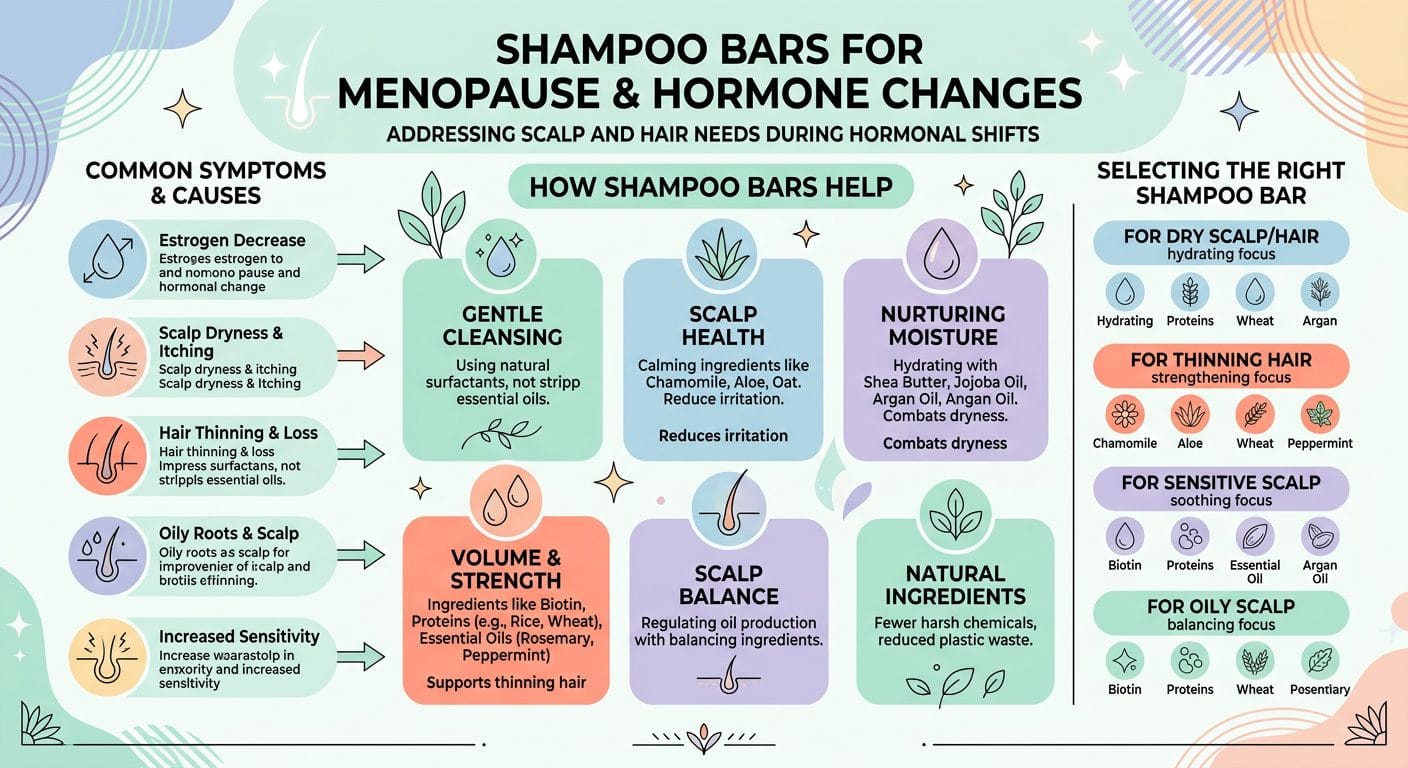
Menopausal hair changes at a glance
- Thinning: lower estrogen shortens the growth phase and can unmask pattern hair loss
- Dryness: sebum production falls, leaving strands brittle and frizz-prone
- Texture change: hair can turn wavier, coarser or more wiry as follicles change shape
- Scalp sensitivity: itching, flaking and product reactions become more common
—
How Menopause Affects Your Hair
1. Hair Thinning & Loss
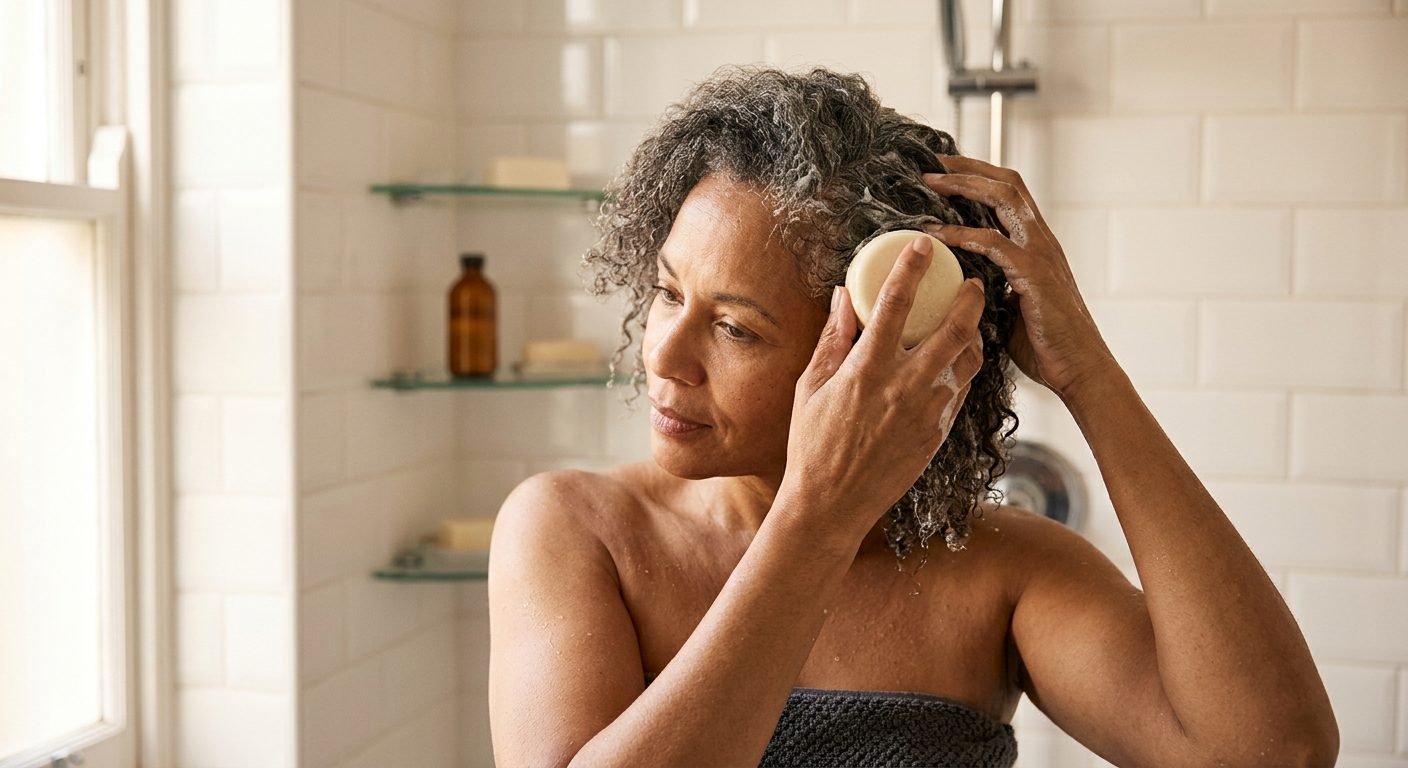
Declining estrogen levels can trigger telogen effluvium (temporary hair shedding) and reveal dormant androgenetic alopecia. You may notice:
- More hair in the shower drain
- Wider part lines
- Thinner ponytails
- Scalp becoming more visible
2. Increased Dryness
Lower estrogen reduces sebum production, leading to:
- Dry, brittle strands
- Increased breakage
- Coarse texture
- Frizz and static
3. Texture Changes
Many women notice their hair:
- Becomes wavier or curlier
- Loses previous curl pattern
- Feels coarser or more wiry
- Develops new cowlicks
4. Scalp Sensitivity
Hormonal changes can cause:
- Itchy, flaky scalp
- Increased sensitivity to products
- Seborrheic dermatitis flare-ups
- Dry scalp mimicking dandruff
5. Graying & Color Changes
Accelerated graying often coincides with perimenopause, requiring gentler cleansing to prevent yellowing or dullness.
—
Perimenopause vs. Menopause: Do Hair Changes Differ?
Yes — mostly in pattern. During perimenopause, estrogen doesn’t just fall, it fluctuates. Oil production can swing from greasy to dry within weeks, and shedding often comes in waves that track your cycle. In menopause, estrogen settles at a sustained low: dryness becomes chronic, individual strands miniaturise, and texture change sticks. Practically, that means perimenopausal hair benefits from flexibility — wash when your scalp asks for it, not on a fixed schedule — while post-menopausal hair rewards consistency: gentle cleansing, an acidic rinse every wash, and moisture on the ends every time.
What to Look For in Menopause-Friendly Shampoo Bars
Gentle Surfactants
Choose cold-process soap bars (like NAP, pH 9-10) with an acidic rinse:
- Saponified organic plant oils (like NAP bars): gentle, biodegradable, no synthetic surfactants
- Follow with an ACV or citric acid rinse (1 tbsp per cup water): closes cuticles and neutralises mineral residue in hard water
Moisturizing Ingredients
- Shea butter: Deep conditioning for dry, brittle hair
- Coconut oil: Penetrates hair shaft, reduces protein loss
- Argan oil: Antioxidants protect against aging
- Glycerin: Humectant attracts moisture
Strengthening Proteins
- Keratin or hydrolyzed wheat protein: Rebuild thinning hair structure
- Biotin (Vitamin B7): Supports healthy hair growth
- Panthenol (Pro-Vitamin B5): Strengthens, adds shine
Soothing Scalp Ingredients
- Aloe vera: Calms irritation, reduces inflammation
- Tea tree oil: Antimicrobial, soothes itchy scalp
- Chamomile: Anti-inflammatory, gentle
Volumizing Agents
- Rice protein: Adds body without weight
- Bamboo extract: Natural silica strengthens hair
- Citric acid: Balances pH, smooths cuticle, adds shine
The Right Final pH (an Acidic Finish)
Menopausal hair is more fragile, and an acidic finish closes cuticles and prevents breakage. What matters is the pH your hair is left at, not the pH printed on the bar: a cold-process soap bar washes at pH 9-10, and the ACV rinse (about pH 3) brings hair straight back to its natural acidic range afterwards.
—
ACV Rinse and pH: How Cold-Process Soap Works for Menopausal Hair
Cold-process soap bars wash at pH 9-10 — alkaline, well above hair’s natural 4.5-5.5. That sounds wrong for fragile menopausal hair, until you look at the whole routine. The cuticle responds to the pH your hair ends up at, not the pH of the wash itself. A diluted apple cider vinegar rinse (1 tablespoon per cup of water, about pH 3) poured through after shampooing returns hair to acidic immediately: cuticles close, shine comes back, and hard-water minerals dissolve in the same step. The net result mimics a pH-balanced shampoo with a far shorter ingredient list — saponified organic plant oils plus a spoonful of vinegar. The natural glycerine created during saponification stays in the bar and draws moisture to the strand, a real advantage for chronically dry menopausal hair.
| Cold-process soap bar (like Natural Answer) | Detergent (syndet) bar | |
|---|---|---|
| pH | 9-10 at the wash; acidic after the ACV rinse | Typically 4.5-6 as-is |
| Hard water | Needs the ACV rinse to dissolve mineral residue | Lathers as-is |
| Ingredients | Saponified organic plant oils, natural glycerine | Synthetic surfactants (usually SCI) plus additives |
| Rinse requirement | ACV or citric acid rinse, every wash | None |
| Our take | Best for a minimal, biodegradable routine — if you commit to the rinse | Reasonable choice if you won’t do an acidic rinse |
Hard Water & Menopause: A Double Challenge
If you live in a hard water area (most of the UK, Netherlands, Belgium, Germany, parts of US), minerals (calcium/magnesium) combine with:
1. Declining natural oils (from menopause) → extreme dryness
2. Protein loss (from aging hair) → buildup sticks to porous strands
3. Graying hair (mineral deposits cause yellowing)
Cold-process soap bars (like Natural Answer) work in hard water with an ACV rinse to dissolve mineral residue.
Hard Water Solution:
- Use a cold-process soap shampoo bar paired with an ACV rinse (dissolves mineral buildup)
- Finish with a diluted apple cider vinegar rinse (1 tbsp per cup water) — full how-to in our ACV rinse guide
- Consider a shower filter (removes calcium/magnesium)
Cities with very hard water (180-300+ ppm):
- London, Birmingham, Oxford (UK)
- Amsterdam, Rotterdam, Utrecht (NL)
- Brussels, Antwerp (BE)
- Munich, Frankfurt, Cologne (DE)
- Phoenix, Las Vegas, San Antonio (US)
—
How to Use Shampoo Bars for Menopausal Hair
1. Wet Hair Thoroughly
Warm (not hot) water opens cuticles gently. Hot water strips oils faster.
2. Rub Bar Directly on Hair
- Create gentle lather from roots to ends
- Focus on scalp (that’s where oil is)
- Don’t over-scrub—gentle circular motions
3. Massage Scalp
- 30-60 seconds massage stimulates blood flow
- Supports healthy follicles
- Reduces stress (which worsens hair loss)
4. Rinse Thoroughly
- Spend 2-3x longer rinsing than lathering
- Residue causes dullness, buildup
- In hard water areas: rinse even longer
5. Follow with ACV Rinse (Optional)
- Mix 1 tablespoon apple cider vinegar + 1 cup water
- Pour over hair after shampoo
- Rinse with cool water
- Closes cuticles, removes mineral buildup, adds shine
6. Condition Ends
- Use a conditioner bar or leave-in on mid-lengths to ends
- Avoid scalp (can cause buildup on thinning hair)
—
Best Ingredients to Avoid During Menopause
1. Sulfates (SLS/SLES)
Strip natural oils aggressively—your hair can’t afford that during menopause.
2. Skipping the Acidic Rinse After a Soap-Based Bar
- Soap washes at alkaline pH (9-10) — left un-neutralised, cuticles stay lifted and hair breaks more easily
- In hard water, skipping the rinse leaves soap scum on porous menopausal strands
- The fix is a 30-second ACV or citric acid rinse after every wash — not avoiding soap bars altogether
3. Heavy Silicones
- Dimethicone, cyclopentasiloxane build up on thinning hair
- Make hair look flat, greasy
- Require harsh sulfates to remove (vicious cycle)
4. Synthetic Fragrances
Sensitive scalps react to artificial perfumes—choose essential oil-scented or fragrance-free.
5. Parabens & Phthalates
May disrupt hormones further (research ongoing).
—
Can a Shampoo Bar Reduce Menopausal Hair Loss?
Honest answer: no shampoo — bar or bottle — reverses hormonal hair loss. What a good bar can do is protect the hair you have: gentle cleansing keeps follicles clear of buildup, and skipping harsh surfactants avoids the breakage that masquerades as shedding. The washing routine itself may help at the margins. A small 2016 study found that four minutes of daily standardized scalp massage over 24 weeks increased hair thickness (Koyama et al., 2016) — so the 30-60 second massage step in your shampoo routine is worth doing properly, every wash. For actual regrowth, the evidence points to minoxidil, HRT or other treatments: talk to your doctor.
DHT and Menopausal Hair Loss: What to Know
As estrogen declines, androgens — particularly dihydrotestosterone (DHT) — gain relative influence on the follicle. In women with a genetic sensitivity, this can unmask androgenetic alopecia that estrogen had kept quiet: gradual thinning at the part line and crown rather than patchy loss. Rosemary oil is the best-studied natural ingredient here — a randomized trial found it comparable to minoxidil 2% for hair count after six months (Panahi et al., 2015). If your thinning is progressing, ask your doctor about DHT-targeted treatment alongside gentle hair care.
Styling Tips for Menopausal Hair
1. Air-dry when possible — Heat styling accelerates thinning
2. Use a microfiber towel — Reduces friction, breakage
3. Wide-tooth comb on wet hair — Prevents snapping
4. Sleep on silk pillowcase — Less friction than cotton
5. Trim regularly (6-8 weeks) — Prevents split ends from traveling up
6. Avoid tight hairstyles — Traction alopecia worsens thinning
7. UV protection — Thinning hair = more scalp sun exposure
—
Lifestyle Support for Menopausal Hair Health
Nutrition
- Protein: Hair is 95% keratin (eat fish, eggs, legumes)
- Iron: Low iron worsens hair loss (spinach, red meat, lentils)
- Omega-3s: Anti-inflammatory (salmon, flaxseed, walnuts)
- Biotin: Supports keratin production (eggs, almonds, sweet potato)
- Vitamin D: Supports follicle health (sunshine, supplements)
Hydration
Drink 8+ glasses water daily—dehydration worsens dry hair.
Stress Management
- Chronic stress worsens telogen effluvium
- Try yoga, meditation, walking
- Prioritize sleep (7-9 hours)
Consult Your Doctor
- Hormone replacement therapy (HRT) may help hair
- Rule out thyroid issues (common during menopause)
- Check iron, vitamin D, B12 levels
—
Transition Period: What to Expect
Switching to shampoo bars during menopause may take 2-4 weeks adjustment:
Week 1-2:
- Hair may feel different (not necessarily bad—just different)
- Scalp adjusts oil production
- If hair feels waxy/greasy: hard water buildup (do ACV rinse)
Week 3-4:
- Hair feels cleaner, lighter
- Natural texture emerges
- Less breakage, improved manageability
If issues persist beyond 4 weeks: Try a different bar or consult a dermatologist.
—
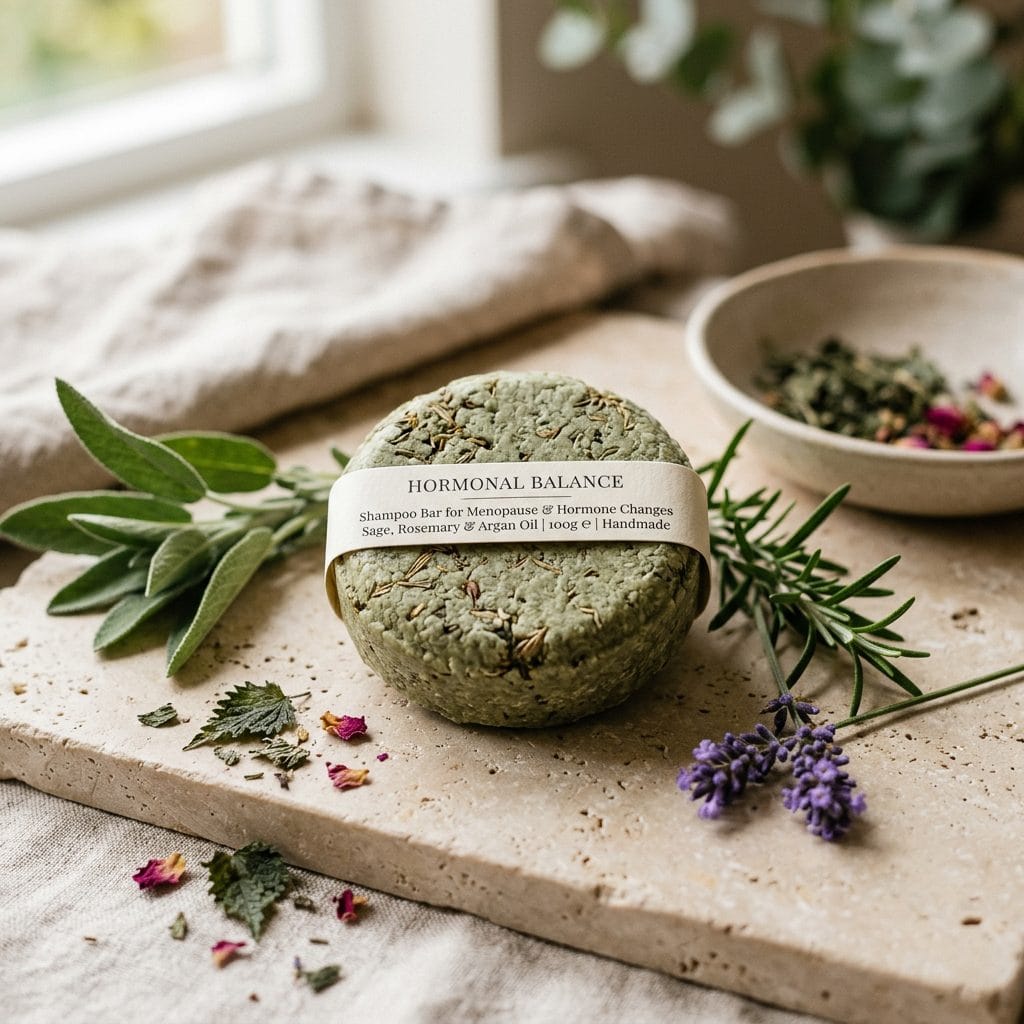
Natural Answer Shampoo Bars for Menopause
Why Natural Answer works for menopausal hair:
✅ True cold process soap (saponified organic oils, pH 9-10)
✅ Pair with your own ACV rinse (hard water solution)
✅ Shea butter + coconut oil (deep moisturizing)
✅ Vegan, cruelty-free, palm oil-free
✅ Handmade in small batches (quality control)
✅ Plastic-free packaging
✅ Works in very hard water (tested in Netherlands 220+ ppm)
What Each Oil Does for Menopausal Hair
| Ingredient | Benefit for menopausal hair | Evidence level |
|---|---|---|
| Shea butter | Deep conditioning for dry, brittle strands | Well-established emollient |
| Coconut oil | Penetrates the hair shaft, reduces protein loss | Supported by lab studies |
| Castor oil | Adds body and root lift without weight | Traditional use |
| Olive oil | Gentle cleansing with light moisture | Well-established emollient |
| Sesame oil | Light conditioning, scalp comfort | Traditional use |
| Sunflower oil | Softens without buildup on thinning hair | Well-established emollient |
Shop Natural Answer Shampoo Bars →
—
Frequently Asked Questions
Can shampoo bars cause more hair loss during menopause?
No. Gentle shampoo bars don’t cause hair loss. If you’re shedding excessively, see a doctor—it’s hormonal, not the bar. However, harsh cleansing without an acidic finishing rinse can cause breakage (which looks like loss).
Should I wash less often during menopause?
Yes—if your scalp is dry. Menopausal hair produces less oil, so washing 2-3x/week (instead of daily) helps retain natural moisture.
Do shampoo bars work for thinning hair?
Yes. Gentle bars clean without stripping — cold-process soap finished with an ACV rinse, or a mild syndet bar. Skip any bar with SLS, silicones or synthetic fragrance. Look for volumizing ingredients like rice protein.
Can I use the same bar for color-treated gray hair?
Yes. With true soap, always finish with an acidic rinse — it closes the cuticle and protects colour. Detergent bars are colour-safe by default.
Will shampoo bars help with menopausal scalp itchiness?
Yes, if the bar contains soothing ingredients (tea tree, aloe, chamomile) and you avoid irritants (sulfates, synthetic fragrance). Also ensure thorough rinsing.
How do I prevent yellowing in gray hair?
- Use purple shampoo bars 1-2x/week (neutralizes brassy tones)
- Do ACV rinse to remove mineral buildup (main cause of yellowing)
- Avoid hot water (opens cuticles, lets minerals penetrate)
Can I reverse menopausal hair thinning with shampoo bars?
Shampoo bars can’t reverse hormonal hair loss, but gentle cleansing prevents further damage (breakage, dryness, irritation). For regrowth, consult a doctor about minoxidil, HRT, or other treatments.
—
Are shampoo bars good for menopausal hair?
Yes, when they’re gentle. Cold-process soap bars finished with an ACV rinse, or mild syndet bars, both cleanse without the aggressive stripping menopausal hair can’t afford. Avoid sulfates, silicones and synthetic fragrance — those cause the dryness and irritation you’re trying to escape.
What ingredients should I look for in a shampoo for menopause?
Moisturising plant oils (shea butter, coconut, olive), soothing scalp ingredients (tea tree, chamomile, aloe) and an acidic finish — either a pH-balanced formula or an ACV rinse after a soap bar. Skip SLS, silicones and synthetic fragrance.
How long does menopausal hair loss last?
It depends on the cause. Shedding from telogen effluvium is usually temporary and settles within months once hormones stabilise. Pattern thinning driven by DHT sensitivity is gradual and ongoing without treatment — if your part keeps widening, see a doctor about options like minoxidil or HRT.
Can an ACV rinse help menopausal hair?
Yes. A diluted apple cider vinegar rinse (1 tablespoon per cup of water) closes the cuticle after washing, removes the hard-water minerals that dull greying hair, and adds shine — all things fragile menopausal hair benefits from. It takes 30 seconds at the end of your shower.
—
Bottom Line
Menopause changes your hair, but the right shampoo bar can support you through the transition. Choose a gentle bar — cold-process soap finished with an ACV rinse, or a mild syndet — with moisturizing, strengthening ingredients. And if you live in a hard water area, make the acidic rinse non-negotiable: it’s what keeps mineral buildup off fragile hair.
Your hair is adapting to a new hormonal reality. Give it the gentle, nourishing care it deserves.
—
Shop Natural Answer Shampoo Bars
*Handmade. Vegan. Palm oil-free. Designed for European hard water.*