


Last updated: September 27, 2026
Introduction
You love swimming. Your hair? Not so much.
The damage is real: green tints, brittle strands, that unmistakable chlorine smell that lingers for days. And if you swim regularly – whether for training, competition, or just because you love the water – your hair pays the price.
Traditional swimmer shampoos help, but they come with their own problems: harsh sulfates that strip everything (including the moisture you desperately need), plastic bottles piling up, and formulas that barely touch the chlorine buildup.
Enter: shampoo bars designed for swimmers. Concentrated, travel-friendly, and formulated to tackle chlorine damage without destroying your hair in the process.
This guide covers everything you need to know about using shampoo bars for swimming – from natural oils to pre-swim protection. Let’s get your hair back to healthy.
—
Why Chlorine Destroys Your Hair (The Science)
Understanding the problem helps you fix it. Here’s what happens when chlorine meets hair:
1. Chlorine Strips the Cuticle
Hair has an outer protective layer (the cuticle). Chlorine is a strong oxidizer – it literally lifts those cuticle scales, exposing the inner cortex. Result:
- Roughness and tangling
- Moisture loss
- Breakage
2. It Bonds to Hair Proteins
Chlorine doesn’t just sit on the surface – it chemically binds to the protein structure of your hair (keratin). Over time, this weakens the hair shaft.
3. Copper = Green Hair
That green tint? It’s not the chlorine itself – it’s copper in the pool water (from pipes, algaecides, or pH imbalance). Chlorine oxidizes the copper, which then binds to your hair. Blonde, light, or porous hair shows it most.
4. Dryness and Brittleness
Chlorine is hygroscopic – it pulls moisture out of hair. Combine that with sun exposure (if you swim outdoors), and you get crispy, straw-like hair.
Bottom line: Regular shampoo isn’t enough. You need something that can chelate (bind to and remove) chlorine and mineral buildup.
—
What Makes a Shampoo Bar Good for Swimmers?
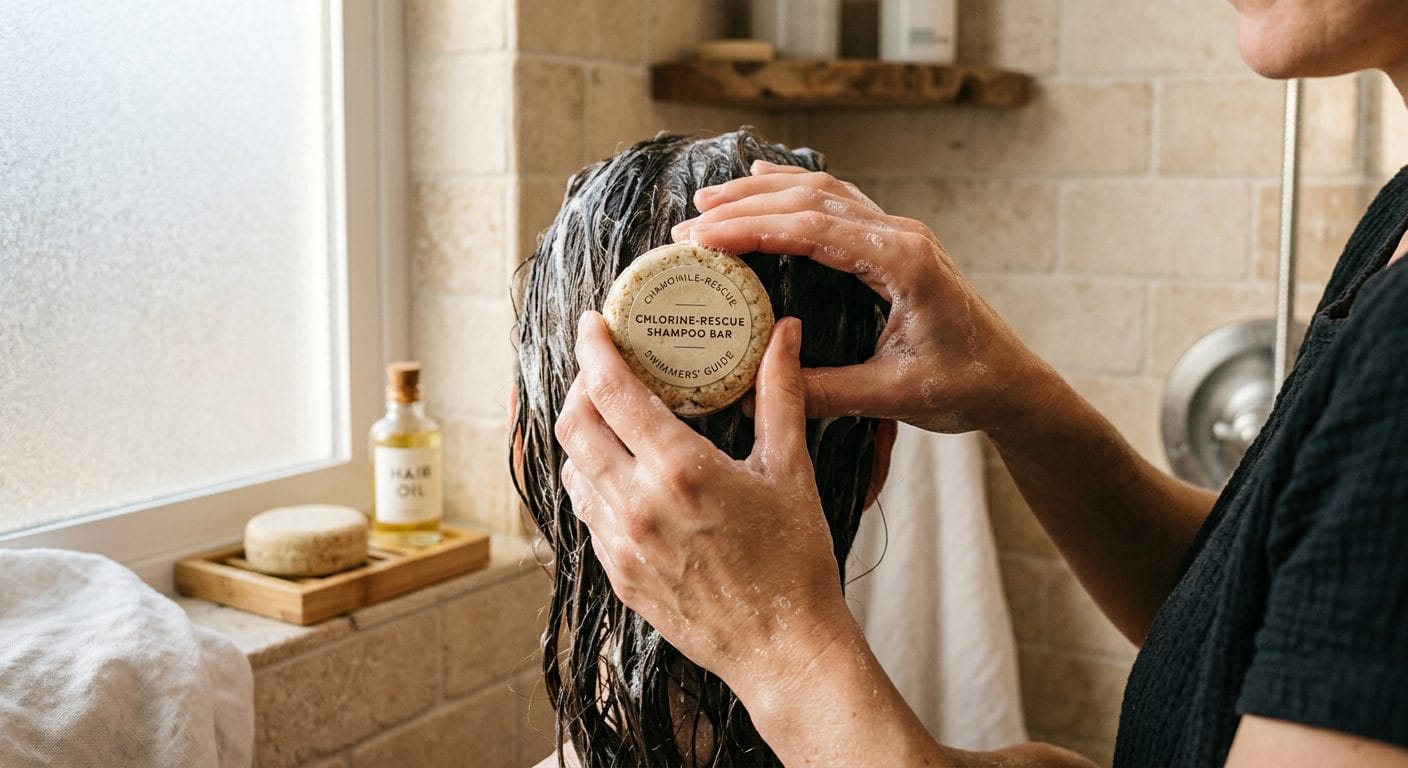
Not all shampoo bars are created equal. Here’s what you need in a swimmer-specific formula:
✅ Chelating Agents
These bind to chlorine and minerals, pulling them out of your hair. Look for:
- Citric acid – natural chelator, also balances pH
- EDTA (Tetrasodium EDTA) – powerful mineral binder
- Sodium gluconate – gentle chelator, eco-friendly
- Vitamin C (Ascorbic acid) – neutralizes chlorine
✅ Clarifying Power (But Not Harsh)
You need deep cleansing without stripping all your natural oils. Look for:
- saponified plant oils – effective but gentle
- Coco-Betaine – mild surfactant that supports cleansing
- Avoid harsh sulfates (SLS/SLES) – they make dryness worse
✅ Moisturizing Oils
After removing chlorine, you need to replenish moisture. Look for:
- Coconut oil – penetrates hair shaft
- Argan oil – rich in vitamin E, repairs damage
- Shea butter – seals cuticle, adds softness
- Jojoba oil – mimics natural sebum
✅ Protein for Strength
Chlorine damages hair proteins. Rebuild with:
- Hydrolyzed wheat protein
- Silk protein
- Keratin
✅ Re-Seal the Cuticle
Hair’s natural pH is 4.5-5.5 (slightly acidic). Chlorine raises it, making cuticles stay open. An acidic rinse after washing (apple cider vinegar or citric acid) helps re-seal them. Natural Answer bars are cold-process soap (pH 9-10), so always pair them with an ACV rinse.
—
Best Shampoo Bars for Swimmers (2026)
1. Natural Answer Hard Water Shampoo Bar
Best for: Swimmers in areas with hard water pools (most public pools)
Why it works:
Here’s the thing most swimmers don’t realize: pool water isn’t just chlorine. Public pools often have hard water (calcium, magnesium) plus chlorine. That’s a double-whammy of buildup.
Natural Answer bars, paired with an ACV rinse, handle mineral-heavy water well. That means:
- Pair with an ACV rinse to clear both chlorine and hard-water minerals
- No waxy buildup, as long as you rinse with ACV after every wash
- Gentle enough for daily use
- Long-lasting (80+ washes = perfect for frequent swimmers)
Active ingredients: Saponified plant oils (cold-process soap, pH 9-10)
Bonus: Palm oil-free and plastic-free packaging (good for the planet, which includes the oceans you swim in)
Price: €10.95 (lasts 2-4 months even with daily pool use)
—
2. Clarifying Charcoal Shampoo Bar
Best for: Heavy chlorine buildup or occasional deep cleansing
Why it works:
Activated charcoal acts like a magnet for impurities – including chlorine, oils, and product buildup. These bars give a deep clean.
Pros:
- Removes stubborn chlorine smell
- Great for weekly clarifying
- Visually satisfying (you can see the dirt coming out)
Cons:
- Can be too drying for daily use
- Not ideal for color-treated hair
- May need extra conditioning after
Best practice: Use 1-2x per week, alternate with a gentler bar.
—
3. Swimmer-Specific Vitamin C Bar
Best for: Neutralizing chlorine immediately post-swim
Why it works:
Vitamin C (ascorbic acid) chemically neutralizes chlorine. Some bars are formulated specifically for swimmers with high vitamin C content.
Pros:
- Fast-acting chlorine removal
- Prevents green hair (stops copper oxidation)
- Safe for color-treated hair
Cons:
- Can be pricey
- May need to follow with a moisturizing conditioner
- Harder to find (not as common as general shampoo bars)
—
4. 2-in-1 Swimmer Shampoo + Conditioner Bar
Best for: Convenience, travel, gym bags
Why it works:
Combines cleansing with moisture replenishment in one step. Perfect for quick post-swim showers.
Pros:
- Saves time
- Less stuff to carry
- Good for kids or beginners
Cons:
- May not cleanse as deeply as dedicated shampoo bars
- Not ideal for very damaged or long hair (might need separate deep conditioning)
—
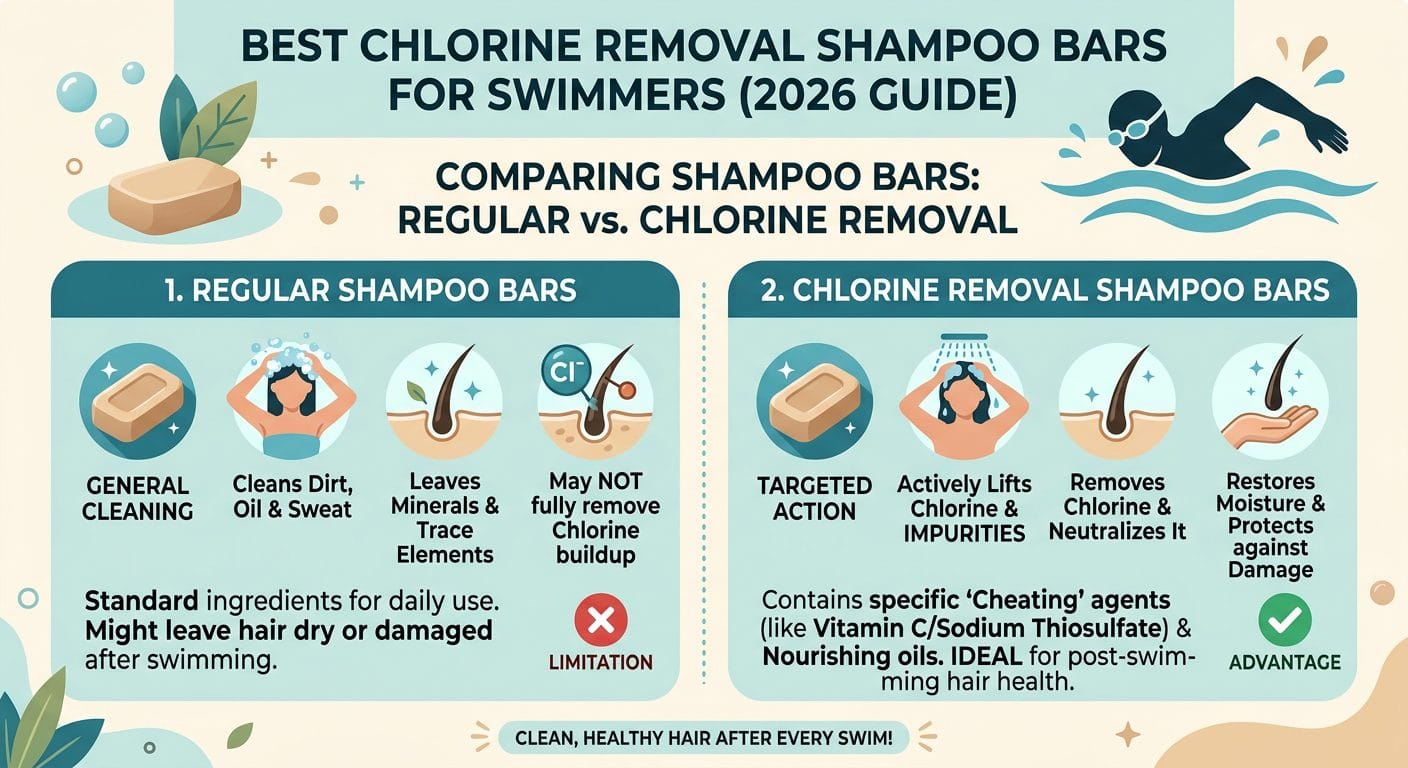
How to Use Shampoo Bars After Swimming
Timing and technique matter. Here’s the proven method:
Immediately After Swimming (Ideal):
Step 1: Pre-Rinse with Fresh Water
Before you even touch the shampoo bar, rinse your hair thoroughly with fresh water for 60-90 seconds. This removes surface chlorine and loosens buildup. (Many pools have rinse showers – use them!)
Step 2: Wet the Bar + Create Lather
Rub the bar between your hands or directly on your scalp (whichever you prefer). Work up a good lather. For swimmers, you might need more product than usual – chlorine is stubborn.
Step 3: Massage and Let It Sit
Don’t rush. Massage the lather into your scalp and through your hair for 1-2 minutes. Let it sit for 30 seconds (gives natural oils time to work).
Step 4: Rinse Thoroughly
Rinse until water runs completely clear. This is critical. Incomplete rinsing leaves behind both chlorine residue and shampoo residue. If your hair feels waxy or sticky afterward, you didn’t rinse enough.
Step 5: Condition Generously
Chlorine-damaged hair is thirsty. Use a deep conditioner or a conditioning bar. Focus on mid-lengths to ends (not the scalp).
Step 6: Final Cool Rinse
End with a 10-second cool water rinse. This seals the cuticle and locks in moisture.
If You Can’t Shower Right Away:
Life happens. Practice runs late, you’re rushing home, the pool showers are broken. Here’s the damage-control plan:
1. Rinse with any available water (better than nothing)
2. Apply leave-in conditioner or hair oil (creates a protective barrier)
3. Tie hair up (prevents friction and tangling)
4. Wash ASAP when you get home (ideally within 2-3 hours)
The longer chlorine sits on your hair, the more damage it does.
—
Pre-Swim Protection: Preventing Damage Before It Starts
The best defense is a good offense. Here’s how to protect your hair before you swim:
1. Wet Your Hair First
Dry hair is like a sponge – it absorbs the first liquid it touches. If that’s chlorinated pool water, you’re soaking up damage.
Solution: Wet your hair with clean water before entering the pool. Saturated hair absorbs less chlorine.
Pro tip: Use a water bottle in the locker room if there’s no pre-swim rinse available.
2. Apply a Protective Layer
Create a barrier between your hair and chlorine:
- Coconut oil – apply to dry hair, then wet it (the oil stays, creating a seal)
- Leave-in conditioner – adds a protective film
- Specialized swimmer pre-treatment oils – designed for this exact purpose
3. Wear a Swim Cap
Not foolproof (water still gets in), but reduces exposure by 60-70%. Silicone caps work better than latex.
Bonus: Keeps hair out of your face during laps.
4. Braid or Bun Long Hair
Less surface area exposed = less chlorine absorption. Plus, prevents tangling.
—
Dealing with Green Hair (Copper Staining)
Already green? Here’s the fix:
Method 1: Vitamin C Treatment (Fast)
1. Crush 5-10 vitamin C tablets (or use 2 tbsp powdered ascorbic acid)
2. Mix with enough water to make a paste
3. Apply to green areas, let sit 5-10 minutes
4. Shampoo with your chlorine-removal bar
5. Condition deeply
Why it works: Vitamin C reduces the oxidized copper back to its original state, breaking the bond with hair.
Method 2: Baking Soda Paste (Gentle)
1. Mix 2 tbsp baking soda + 1 tbsp water (paste consistency)
2. Apply to green areas, massage gently
3. Let sit 3-5 minutes
4. Rinse, then wash with shampoo bar
5. Condition
Why it works: Baking soda is a mild abrasive + alkaline, which helps lift copper deposits.
Method 3: Ketchup Trick (Yes, Really)
The acidity in ketchup (from tomatoes + vinegar) can neutralize copper.
1. Apply ketchup to green sections
2. Cover with a shower cap, wait 20-30 minutes
3. Rinse thoroughly
4. Wash with shampoo bar
5. Condition
Note: This is a last resort. It works, but it’s messy and smells weird.
—
Weekly Deep Cleanse Routine for Swimmers
If you swim 3+ times per week, add this to your routine:
Once a Week:
1. Clarifying wash – Use a charcoal or deep-cleansing bar
2. Apple cider vinegar rinse – Mix 1 tbsp ACV + 1 cup water, pour over hair after shampooing, wait 2 minutes, rinse (removes mineral buildup)
3. Deep conditioning mask – Leave on for 10-15 minutes
4. Cool water final rinse – Seals everything in
Why it matters: Even with great daily care, chlorine and minerals gradually build up. Weekly deep cleansing resets your hair.
—
Hard Water + Chlorine: The Double Whammy
If you swim in a pool with hard water (most public pools), you’re dealing with:
- Chlorine (drying, damaging)
- Calcium and magnesium (mineral buildup)
- Copper (green tint risk)
The result: Waxy, dull, tangled hair that feels “weird” no matter what you do.
The solution:
1. Use a hard water shampoo bar (Natural Answer is designed for this) – addresses minerals and chlorine
2. Acidic rinse – After shampooing, do a final rinse with diluted apple cider vinegar or lemon juice (neutralizes alkalinity from hard water + chlorine)
3. cleansing treatment – Once a month, use a dedicated cleansing shampoo or treatment to strip all buildup
How to test if hard water is your problem:
After shampooing, does your hair feel slippery but also weirdly sticky? That’s the mineral film. An acidic rinse should fix it instantly.
—
Travel Tips for Swimmers
Shampoo bars are perfect for swimmers who travel for competitions, training camps, or vacations:
✈️ TSA-Friendly
Solid bars aren’t liquids. No 100ml limit. Toss them in your carry-on without a second thought.
🏊 Poolside Convenience
Keep a bar in your swim bag. After practice, quick rinse, quick wash, done. No bottles to spill or forget.
🎒 Compact & Lightweight
One bar = 2-4 bottles of liquid shampoo. Saves luggage space and weight.
💧 Works Anywhere
Hotel shower. Gym locker room. Beach outdoor shower. As long as there’s water, you’re set.
Pro tip: Get a travel soap dish with drainage holes. Keeps the bar dry between uses and prevents it from making a mess in your bag.
—
Common Swimmer Hair Problems (Solved)
Problem: “My hair still smells like chlorine even after washing.”
Solution: You’re not removing all the chlorine. Try:
- Pre-rinse longer (90 seconds minimum)
- Use a clarifying wash, then an acidic rinse
- Let the lather sit for 1-2 minutes before rinsing
- Final rinse with diluted apple cider vinegar
Problem: “My hair is brittle and breaking.”
Solution: Chlorine + lack of moisture. Fix:
- Deep condition 2-3x per week
- Use a protein treatment once a month
- Apply leave-in conditioner before swimming
- Consider a pre-swim oil treatment
Problem: “I get tangles immediately after swimming.”
Solution: Cuticle damage from chlorine. Address with:
- Acidic rinse after shampooing (closes cuticle)
- Detangling conditioner
- Wide-tooth comb while hair is still wet + conditioned
- Satin pillowcase (reduces friction while sleeping)
Problem: “My scalp is dry and itchy.”
Solution: Over-cleansing or harsh products. Try:
- Switch to a gentler shampoo bar
- Shampoo scalp only (not lengths)
- Use a scalp oil or treatment once a week
- Rinse more thoroughly (residue causes itching)
—
Shampoo Bar vs. Liquid Swimmer Shampoo
Shampoo Bars:
✅ More concentrated (one bar = 3-4 bottles)
✅ No plastic waste
✅ Travel-friendly
✅ Often gentler (fewer harsh additives)
✅ Cost-effective (€10-15 lasts 2-4 months)
❌ Learning curve (technique matters)
❌ Harder to share (hygiene)
❌ Requires good drainage/storage
Liquid Swimmer Shampoos:
✅ Familiar, easy to use
✅ Good for families (easy to share)
✅ Some formulated with strong chelating agents
❌ Plastic bottles (environmental cost)
❌ Expensive over time
❌ Bulky for travel
❌ Often contain harsh sulfates
Verdict: Shampoo bars win for frequent swimmers who value effectiveness, eco-friendliness, and cost savings. Liquid wins for convenience and sharing.
—
How Often Should Swimmers Wash Their Hair?
Daily swimmers (5-7 days/week):
- Rinse immediately after every swim
- Full shampoo + condition: 3-4x per week (not every single time)
- Deep condition: 2x per week
- Clarifying treatment: 1x per week
Regular swimmers (3-4 days/week):
- Rinse + shampoo after every swim
- Deep condition: 1-2x per week
- Clarifying: Every 10-14 days
Occasional swimmers (1-2 days/week):
- Shampoo after each swim
- Deep condition: Once a week
- Clarifying: Once a month
Why not wash daily even if you swim daily?
Over-washing strips natural oils, making hair drier and more vulnerable. Rinsing removes most chlorine; full shampooing is for deeper cleansing.
—
Ingredients to Avoid (Swimmers Edition)
Your hair is already stressed. Don’t make it worse with:
❌ Sulfates (SLS/SLES) – Strip too aggressively, worsen dryness
❌ Silicones (without clarifying) – Build up, trap chlorine underneath
❌ Alcohol (high on ingredient list) – Drying
❌ Synthetic fragrances – Can irritate chlorine-sensitized scalps
❌ Parabens – Unnecessary preservatives
Look for instead: Natural oils, cleansing acids, gentle surfactants, moisturizing butters.
—
DIY Chlorine-Removing Rinse (Budget Option)
Can’t afford a specialized shampoo bar right now? Make your own chlorine rinse:
Recipe:
- 1 cup water
- 1 tbsp apple cider vinegar
- 5 drops lavender essential oil (optional, for scent)
How to use:
1. Shampoo hair with regular bar
2. Pour this mixture over your hair as a final rinse
3. Let sit 1-2 minutes
4. Rinse with cool water
Why it works: Acidity neutralizes chlorine alkalinity and helps remove mineral buildup. It’s not as effective as a dedicated cleansing bar, but it’s better than nothing.
Cost: ~€0.15 per use.
—
Long-Term Hair Health for Swimmers
Chlorine damage is cumulative. Protect your investment:
Monthly Protein Treatment
Repair broken protein bonds with hydrolyzed protein masks. 15 minutes, once a month.
Trim Regularly
Split ends can’t be repaired. Trim every 6-8 weeks to prevent breakage from traveling up the hair shaft.
Track Your Hair’s Response
What works for one swimmer might not work for another. Pay attention:
- Is your hair getting softer or rougher?
- Does it tangle less or more?
- How’s the texture changing?
Adjust your routine based on results.
Consider a Swim Cap
Yes, they’re annoying. Yes, they mess up your hair. But they reduce chlorine exposure by 60-70%. For serious swimmers, it’s worth it.
—
Final Thoughts
Swimming shouldn’t mean sacrificing healthy hair. With the right shampoo bar and a solid routine, you can have both.
The key: Don’t just wash – remove. Chlorine is clingy. You need cleansing, thorough rinsing, and moisture replenishment.
Start simple:
1. Get a good swimmer-friendly shampoo bar (ideally one suitable for all water types (ACV rinse recommended for hard water))
2. Rinse immediately after swimming
3. Condition generously
4. Do a weekly deep cleanse
Your hair will thank you. And you’ll actually enjoy swimming again without dreading the aftermath.
Ready to try? Browse swimmer-friendly shampoo bars here →
—
Questions? Drop a comment below!
—
Ready to Make the Switch?
Ready to experience the benefits of a natural shampoo bar? Browse our complete collection of cold-processed soap bars — each one made with 6 organic plant oils and zero synthetic additives.
Related reading: How to use an apple cider vinegar rinse with shampoo bars and hard water vs soft water and shampoo bars.