



Last updated: October 10, 2026
Introduction

Search for “solid shampoo” and you will find hundreds of bars. They look the same. They are not.
Some are real soap: plant oils turned into soap with lye. Others are detergent bars: synthetic surfactants pressed into a solid. Both get sold as “shampoo bars”. Both clean your hair. They behave differently, and they ask different things of you.
We make soap. So we have a side, and we will say so up front. But this guide tells you how both kinds work, what each one costs you, and how to tell them apart in thirty seconds.
Quick Answer: The Main Difference
“Shampoo bar” is a shape, not a chemistry. It tells you the product is solid. It does not tell you what is inside.
Soap bars are oils saponified with lye. They are alkaline, around pH 9–10. They are the oldest cleanser there is, and the ingredient list is short enough to read aloud.
Detergent bars are built on synthetic surfactants, adjusted to an acidic pH. They behave like liquid shampoo in solid form.
The trade-off: soap gives you real soap and a short, natural ingredient list. In return it asks for one extra step in hard water: a quick apple cider vinegar rinse. A detergent bar skips that step, but its base is a lab-made surfactant.
What Is a Soap Bar?
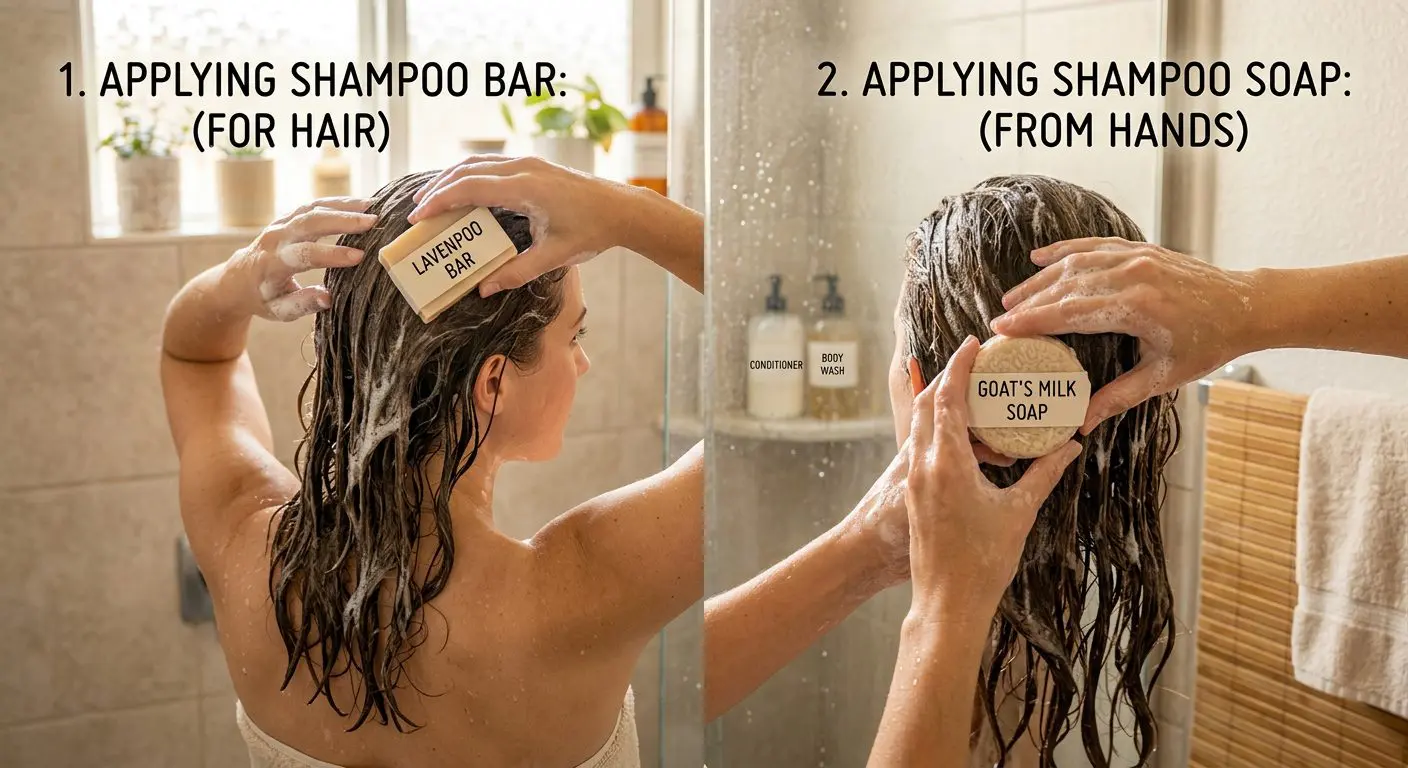
A soap bar for hair is made the same way soap has been made for centuries. Oils meet lye. The lye reacts with the oil and turns it into soap. When the bar has cured, no free lye is left.
How Cold-Process Soap Is Made
- Oils and butters (for example coconut, olive, castor, shea) are blended.
- Lye (sodium hydroxide) is mixed in. This starts saponification.
- The oils turn into soap. Glycerin forms naturally along the way and stays in the bar.
- The bar is moulded and left to cure for several weeks.
“Cold process” means the soap is not cooked. Industrial soap makers often pull the glycerin out and sell it separately. Cold-process soap keeps it.
What a Soap Bar Gives You
- Real soap, natural ingredients. Saponified plant oils, nothing assembled from petrochemicals.
- A short ingredient list. You can read it and know what every word means.
- Glycerin stays in.
- A deep, clean wash. Soap lifts oil and old product build-up well.
What a Soap Bar Asks of You
- An acid rinse in hard water. One tablespoon of apple cider vinegar in 250 ml of water, poured over your hair after washing. More on why below.
- A short transition. If you come from liquid shampoo, your scalp needs about 2–4 weeks to settle. Hair can feel a little waxy or oily in that time. A weekly ACV rinse shortens it.
What Is a Detergent Bar?
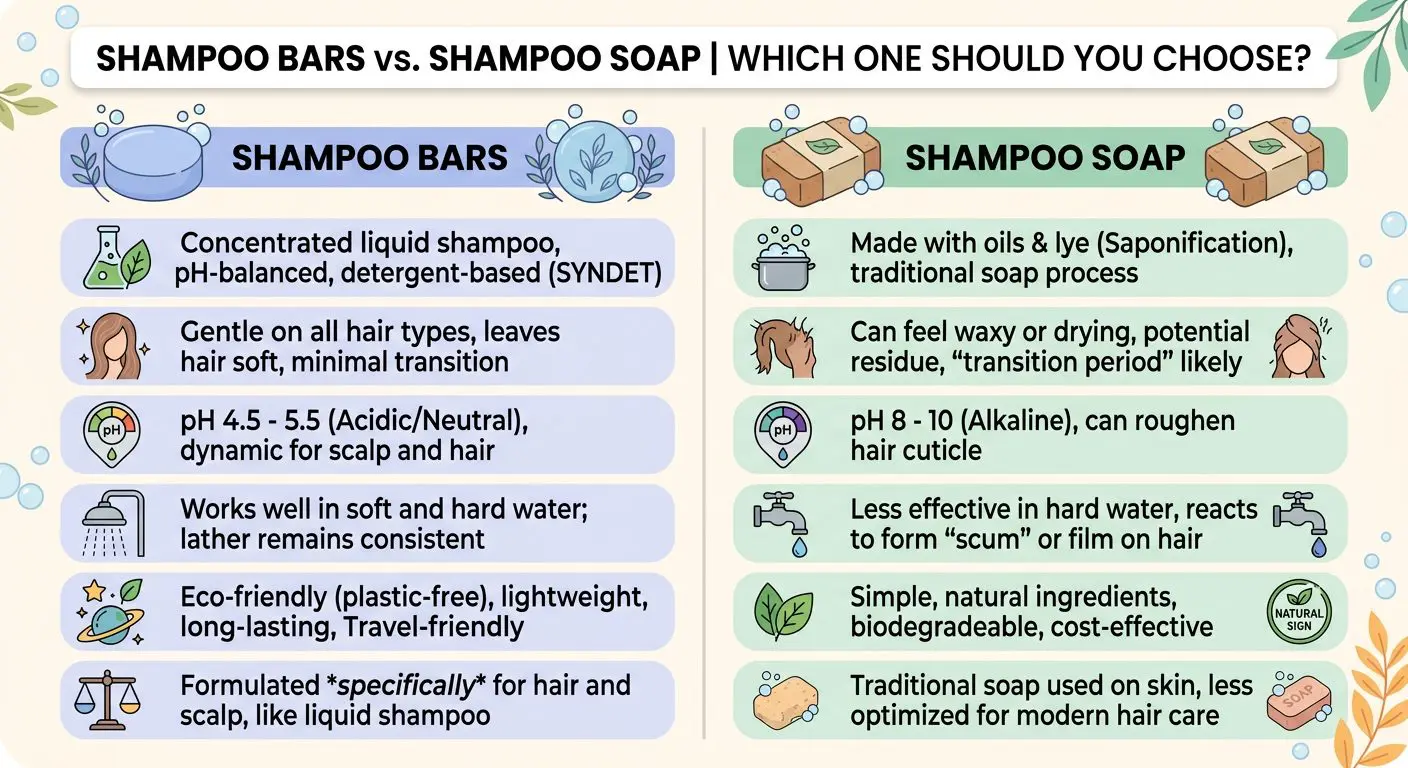
A detergent bar is liquid shampoo without the water. Its cleaning agents are synthetic surfactants, often derived from coconut or sugar and then processed in a lab. Makers add conditioning agents and acids to bring the pH down, then press or extrude the mix into a bar.
Detergent bars are not bad products. Many are gentle and work well. Their big advantage is simple: they behave like the shampoo you already know, so there is no rinse step and little adjustment.
The cost is the base. However “plant-derived” the label sounds, the main cleaning agent is a synthetic surfactant, not soap.
Side-by-Side Comparison
| Feature | Soap bar | Detergent bar |
|---|---|---|
| Cleaning agent | Saponified plant oils (real soap) | Synthetic surfactants |
| pH | Alkaline, around 9–10 | Acidic |
| Ingredient list | Short: oils, butters, scents | Longer: surfactants, conditioners, acids |
| Glycerin | Stays in (cold process) | Depends on the formula |
| Soft water | Works well on its own | Works well |
| Hard water | Works well with an ACV rinse | Works without a rinse |
| Switching from liquid shampoo | About 2–4 weeks to adjust | Little or no adjustment |
Why pH Matters (and What It Really Does)
Hair is slightly acidic, around pH 5. At that pH the cuticle, the outer layer of each hair, lies flat. A flat cuticle reflects light and slides past its neighbours. That is shine and smoothness.
Soap is alkaline. An alkaline wash lifts the cuticle. A lifted cuticle catches on the hairs next to it and scatters light. You notice it as frizz or roughness, not as dryness. The hair has not lost its moisture. Its outer layer is simply standing up.
The fix is just as simple: an acid. An apple cider vinegar rinse brings the pH back down, and the cuticle lies flat again. Shine and smoothness come back at once. This is why soap and an acid rinse belong together. It is one routine, not a repair job.
Want the full method? Read our guide to the apple cider vinegar rinse.
The Hard Water Question
Hard water carries calcium and magnesium. Soap reacts with these minerals. In hard water, that reaction can leave a thin film on the hair. That is basic chemistry, and any soap maker who denies it is not being straight with you.
The answer is the same ACV rinse. The acid dissolves the film and leaves hair soft and shiny. In soft to moderately hard water, many people need it only now and then. In very hard water, make it part of every wash.
Detergent bars do not react with minerals the same way, so they skip this step. If you know you will never do a rinse, that is a fair reason to choose one. If one extra minute in the shower is fine, soap works well in hard water too. Our hard water guide goes deeper.
How to Tell Them Apart
Read the Ingredient List
It is soap if you see:
- “Saponified” oils, or names like sodium olivate, sodium cocoate, sodium castorate
- A list of oils plus “sodium hydroxide” or “lye”
It is a detergent bar if you see:
- Surfactant names ending in -isethionate, -sulfate, -sulfoacetate or -glucoside
- Conditioning agents such as behentrimonium methosulfate or cetearyl alcohol
Test the pH
Buy pH strips at a pharmacy. Wet the bar, rub the strip on the lather and check the colour.
- pH 8–10: soap
- pH 4–7: detergent bar
Ask About the Routine
If the maker tells you about an ACV rinse and a short transition, you are almost certainly holding soap. That is not a warning sign. It is an honest maker telling you how their product works.
Which Should You Choose?
Choose a Soap Bar If:
- You want real soap and natural ingredients, with nothing synthetic in the bar
- You like an ingredient list you can read
- Your hair gets oily fast and you want a thorough, clean wash
- You are fine with a quick ACV rinse when your water is hard
Choose a Detergent Bar If:
- You never want an extra step in the shower
- You want a bar that feels exactly like your old liquid shampoo from day one
- A synthetic surfactant base does not bother you
Neither choice is wrong. It comes down to what you value more: a natural ingredient list, or skipping the rinse.
Common Myths
Myth 1: “Soap ruins your hair”
Truth: Soap lifts the cuticle. An acid rinse lays it flat again. People washed their hair with soap for centuries. Paired with a rinse, it is a complete routine.
Myth 2: “Soap dries your hair out”
Truth: What most people feel is frizz or roughness from a raised cuticle, not lost moisture. That is why the fix is an acid rinse, not more oil.
Myth 3: “Soap doesn’t work in hard water”
Truth: In hard water soap can leave a film. An ACV rinse removes it. With that step, soap works well.
Myth 4: “Detergent bars are toxic”
Truth: No. Well-made detergent bars are gentle and safe. They are simply a different product, built on synthetic surfactants instead of soap.
Myth 5: “Every solid bar needs a transition period”
Truth: The 2–4 week adjustment applies to soap, as your scalp settles after liquid shampoo. Detergent bars need little or none. Our transition guide explains what to expect.
What About Natural Answer Products?
People ask us this a lot. The answer is simple: our bars are real soap.
- Cold-process soap, pH 9–10
- Six certified-organic plant oils saponified with lye: coconut, sesame, sunflower, olive and castor oil, plus shea butter
- No synthetic surfactants, no SLS or SLES, no silicones, no synthetic fragrance
- No palm oil, no plastic packaging, vegan
We chose soap because it is the simplest honest way to clean hair: plant oils and lye, nothing else doing the work. We also tell you the trade-off. In hard water, finish with an ACV rinse. While you switch, give your scalp 2–4 weeks.
Natural Answer is our own brand, so read this section as an interested opinion. The ingredient list is on every product page, so you can check it yourself.
The Bottom Line
“Shampoo bar” tells you the shape. The ingredient list tells you the product.
Soap bars give you real soap and a short, natural ingredient list. They work best with an apple cider vinegar rinse in hard water. Detergent bars skip the rinse and feel like liquid shampoo, but they are built on synthetic surfactants.
If natural ingredients matter to you and one minute in the shower does not, choose soap. If you want zero extra steps, a detergent bar is a fair choice. Either way, now you know what you are buying.
Frequently Asked Questions
Can I use a soap bar if I have hard water?
Yes. Finish with an apple cider vinegar rinse: one tablespoon in 250 ml of water. It dissolves the mineral film and lays the cuticle flat.
Why does my hair feel frizzy after washing with soap?
Soap is alkaline, and it lifts the cuticle. A lifted cuticle reads as frizz. An acid rinse lays it flat again, and the shine comes straight back.
How long is the transition from liquid shampoo?
Usually 2–4 weeks. Your scalp is adjusting its oil production. A weekly ACV rinse shortens it. See our full transition guide.
Are detergent bars less natural than soap bars?
Their main cleaning agent is synthetic, even when it starts from a plant. Soap is made directly from oils and lye. Both can be vegan and plastic-free.
Why do some brands call their soap a “shampoo bar”?
Because “shampoo bar” describes how you use it. It is not wrong. It just does not tell you the chemistry, so always read the ingredient list.
My soap bar already works fine. Should I change anything?
No. If your hair looks and feels good, keep doing what you do. You may have soft water and need the rinse only now and then.
Curious about real soap for your hair? Our cold-process shampoo bars are made from six organic plant oils, and each product page lists every ingredient.
Last updated: October 2026