


Last updated: September 25, 2026
The Science Behind a Purple Shampoo Bar
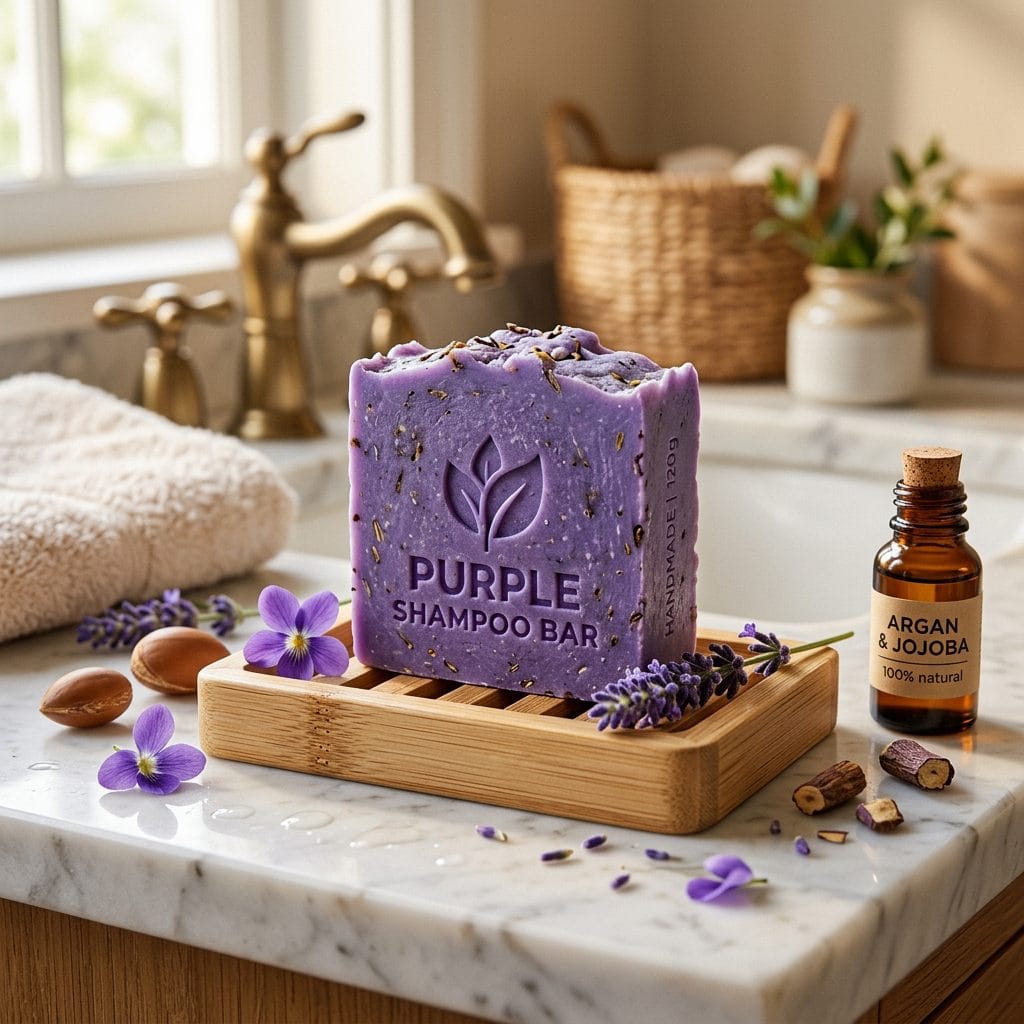
Does a purple shampoo bar work? Yes — purple shampoo bars deposit violet pigment to neutralize brassiness and yellow tones in blonde and grey hair, using the same color-wheel principle as liquid purple shampoo. Natural Answer’s purple shampoo bar is a cold-process soap (pH 9–10) that delivers this toning effect; for best results in hard water, follow with a diluted ACV rinse.
If you’ve ever watched blonde hair turn brassy after a few weeks, you’ve witnessed one of hair’s most frustrating phenomena. That warm, yellowish cast creeps in gradually—from mineral deposits in hard water, sun exposure, or simply the natural oxidation of lightened hair.
Enter purple shampoo: the color-theory hack that’s been saving blonde tones for decades. But here’s what most people don’t know—purple shampoo bars often outperform their liquid counterparts. Not despite being waterless, but because of it.
This guide breaks down exactly how purple shampoo works (spoiler: it’s basic color wheel science), why bars can be more effective than bottles, and how to avoid the common mistakes that leave people with either no results or accidentally purple hair.
How a Purple Shampoo Bar Actually Works: Color Theory
The Color Wheel Principle
Purple shampoo isn’t magic—it’s color theory in action. On the color wheel, purple and yellow sit directly opposite each other. When you combine complementary colors, they neutralize each other, creating a neutral tone.
Here’s what happens at the molecular level:
- Yellow/brass in your hair comes from underlying warm pigments (pheomelanin), mineral deposits, or oxidized color molecules
- Purple pigment in the shampoo deposits temporarily on the hair shaft
- Neutralization occurs when the purple and yellow pigments visually cancel out
- Result: Cooler, ashier tones instead of warm, brassy ones
The same principle works for other color corrections: blue shampoo cancels orange (for brunettes), and green corrects red.
Who Actually Needs Purple Shampoo?
You need purple shampoo if you have:
- Platinum or light blonde hair (natural or color-treated)
- Gray or silver hair
- Highlighted or balayaged hair with blonde sections
- White hair that’s yellowing
- Light blonde hair exposed to hard water, chlorine, or sun
You probably don’t need it if:
- You have dark brown or black hair (won’t make a visible difference)
- Your blonde is already cool-toned and not brassy
- You’re happy with warm, honey tones
The Concentration Factor
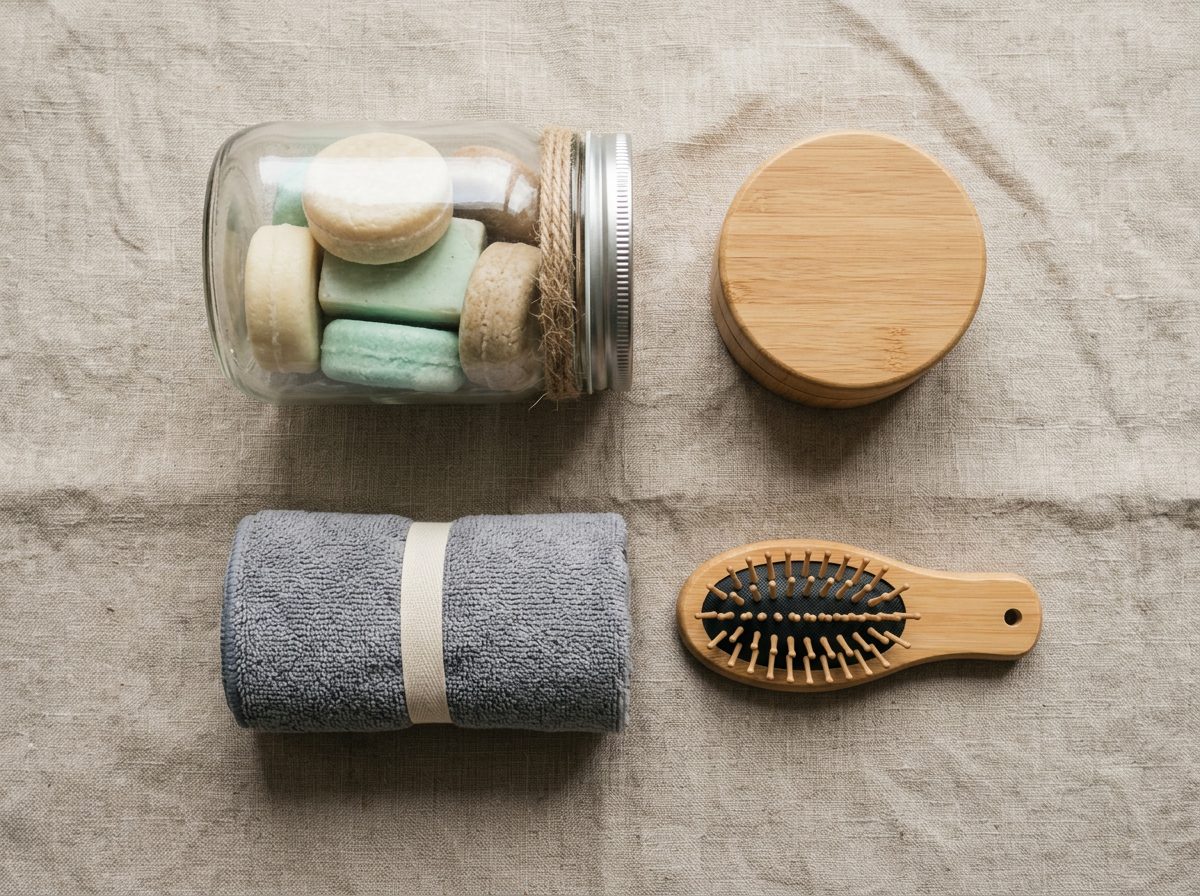
This is where purple shampoo bars have a significant advantage. Liquid purple shampoo is typically 70-85% water. The violet pigment is diluted before it ever reaches your hair.
Purple shampoo bars contain concentrated pigment without water dilution. When you create lather from the bar, you’re mixing fresh, concentrated pigment with just the right amount of water at the moment of application.
Practical difference: Most people need 3-5 minutes with liquid purple shampoo. With a well-formulated bar, 2-3 minutes often achieves the same or better results.
Does Purple Shampoo Bar Actually Work? The Honest Answer
Yes—if:
- You use a quality bar with adequate violet pigment concentration
- You apply it correctly (even distribution, appropriate contact time)
- Your hair actually needs toning (has brass/yellow present)
- You use it at the right frequency (not daily)
No—if:
- The bar has weak pigment (cheap formulations skimp on violet dye)
- You rinse too quickly (under 60 seconds = no effect)
- You apply unevenly (some sections get all the pigment, others get none)
- You use it on dark hair (won’t show visible results)
- You’re expecting it to lighten your hair (it only tones, not lifts)
What to Expect: Realistic Results
After first use:
- Subtle shift from yellow-blonde to neutral blonde
- Less obvious brass in temple and crown areas
- Hair may feel slightly drier (normal—condition afterward)
After 2-3 weeks of regular use (1-2x weekly):
- Consistent cool-toned blonde maintenance
- Significantly less brass after pool/beach exposure
- Extended time between salon toning appointments
What purple shampoo CAN’T do:
- Lighten hair (it deposits pigment, doesn’t lift color)
- Remove permanent color
- Fix extremely damaged hair
- Work on very dark hair (pigment won’t show)
Purple Shampoo Bar Application: The Right Technique
This is where most people fail with purple shampoo bars. Here’s the technique that actually works:
Step-by-Step Application
Step 1: Wet your hair thoroughly
Not damp—completely saturated. Dry or semi-dry hair absorbs pigment unevenly and leads to purple spots.
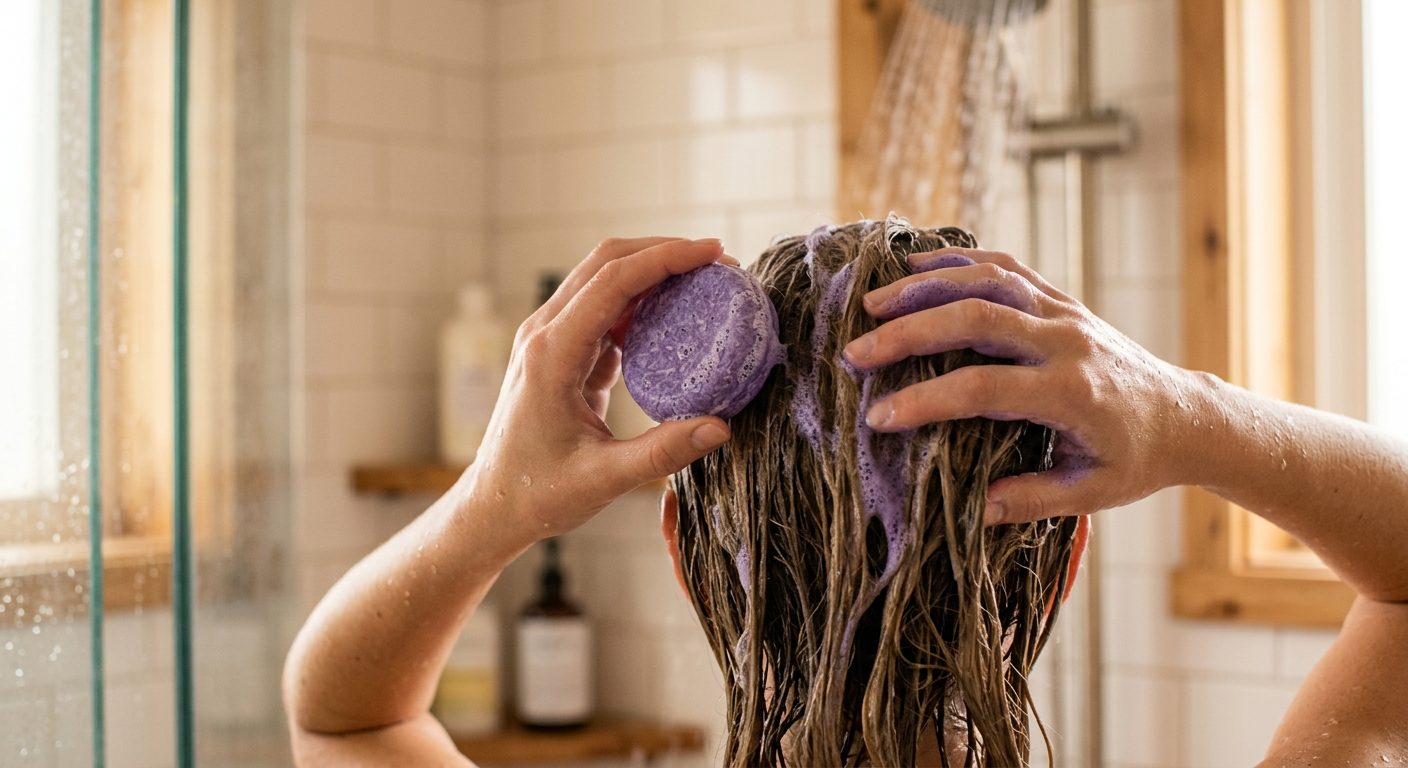
Step 2: Rub the bar directly on hair sections
Work in sections rather than randomly rubbing everywhere. Start at the back (where brass is often worst) and work forward.
Pro tip: Rub the bar between your hands first to create a purple paste, then apply this to your hair. This gives more control than rubbing directly.
Step 3: Lather and distribute evenly
Once you’ve applied product to all sections, work it into a lather using your fingers. Make sure every strand gets covered—purple lather should be visible throughout.
Step 4: Time it—seriously, set a timer
- Light brass/maintenance: 2 minutes
- Moderate brass: 3-4 minutes
- Significant brass/yellow: 5 minutes (MAX)
Do not guess. Do not skip the timer. This is the most critical step.
Step 5: Rinse thoroughly
Rinse until water runs clear—no purple residue visible. Leftover pigment = uneven toning.
Step 6: Condition (non-negotiable)
Purple shampoo can be drying. Always follow with conditioner, avoiding the roots if you have fine hair.
Common Purple Shampoo Bar Mistakes (And How to Fix Them)
Mistake #1: Not Leaving It On Long Enough
Problem: Rinsing after 30 seconds because “the lather is purple so it’s working.”
Reality: The pigment needs contact time to deposit. Purple lather just means pigment is present—it doesn’t mean it’s done working.
Fix: Set a timer for minimum 2 minutes. No exceptions.
Mistake #2: Using It on Dry Hair “For Stronger Results”
Problem: Some guides recommend applying to dry hair for more intense toning.
Reality: This leads to extremely uneven absorption. Dry, porous sections will grab too much pigment while healthier sections get nothing.
Fix: Always start with wet, saturated hair. If you need stronger toning, increase contact time—not application method.
Mistake #3: Rubbing the Bar on Only One Spot
Problem: Concentrating the bar on the top of your head (easiest to reach) and neglecting underneath.
Reality: The back and underneath sections often have the worst brass—but they get the least product.
Fix: Work in sections. Apply to back first, then sides, then top, then hairline.
Mistake #4: Using It Too Often
Problem: Daily use because “more = better.”
Reality: Daily use leads to over-toned, dull, grayish hair. Purple pigment builds up.
Fix: Maximum 2x per week. Most people need only 1x weekly for maintenance.
Mistake #5: Skipping Conditioner
Problem: Purple shampoo already takes time, so skipping conditioner saves time.
Reality: Toning shampoos are inherently drying. Without conditioner, hair becomes brittle and porous—which actually makes brass return faster.
Fix: Always condition. Use a purple conditioner 1x monthly for extra toning if desired.
What to Look for in a Quality Purple Shampoo Bar Today
Essential Ingredients
Violet Pigment (CI 60730 or similar):
The actual toning agent. Listed in the ingredients as “Violet 2,” “CI 60730,” or “Purple 1.” Without adequate pigment, the bar won’t tone effectively.
How to check: The bar itself should be deeply purple, not lavender or light violet. Pale bars = weak pigment.
Gentle Surfactants:
Purple shampoo is already somewhat drying. Combine that with harsh sulfates, and you’re stripping both brass AND moisture.
Look for: cold-process soap (saponified plant oils), Coco-Glucoside, Decyl Glucoside
Avoid: Sodium Lauryl Sulfate (SLS), Sodium Laureth Sulfate (SLES)
Moisturizing Agents:
Shea butter, coconut oil, argan oil, glycerin. These counteract the drying effect of the violet pigment.
Ingredients to Avoid
- Sulfates: Strip color and moisture—counterproductive for toning shampoo.
- Parabens: Controversial preservatives unnecessary in waterless bars.
- Synthetic fragrance: Can irritate sensitive scalps already dealing with drying effects.
- Palm oil: 90% of purple shampoo bars contain palm-derived surfactants. Some brands offer palm oil-free alternatives using cold-process soap made from coconut and other plant oils instead.
Purple Shampoo for Different Hair Scenarios
Platinum/White Blonde
Challenge: Most prone to brass, requires regular maintenance.
Protocol:
- Use 1-2x weekly
- 3-4 minute contact time
- Focus on roots and crown (most exposed to sun/minerals)
Watch for: Over-toning—platinum can shift to gray/purple if used too frequently.
Gray and Silver Hair
Challenge: Natural gray can yellow from products, hard water, and sun exposure.
Protocol:
- Use 1x weekly
- 2-3 minute contact time (gray hair is more porous, absorbs faster)
- Distribute evenly—gray hair often has varying porosity throughout
Watch for: Purple cast developing. Gray hair with over-toning looks dull and “off.”
Highlighted or Balayaged Hair
Challenge: Only specific sections need toning—not the whole head.
Protocol:
- Apply primarily to blonde sections
- Avoid brunette areas (doesn’t damage them, but wastes product)
- Use every 10-14 days
- Consider dry application to targeted sections only
Watch for: Band-like toning where highlights end and natural color begins.
Color-Treated Blonde
Challenge: Color-treated hair is more porous and can grab pigment unevenly.
Protocol:
- Start with shorter contact time (2 minutes)
- Use weekly, not more frequently
- Deep condition regularly
Watch for: Porous ends absorbing more pigment than mid-lengths—apply to ends last.
Troubleshooting Purple Shampoo Problems
“My Hair Turned Purple!”
Cause: Too much contact time, too frequent use, or very porous hair.
Fix:
- Clarifying shampoo immediately (removes surface pigment)
- If still purple: Mix vitamin C powder with shampoo, apply, leave 10-15 minutes
- Going forward: Reduce contact time to 1-2 minutes, use every 2 weeks max
“I Don’t See Any Difference”
Cause: Not enough contact time, weak pigment in the bar, or hair that doesn’t need toning.
Fix:
- Increase contact time to 5 minutes
- Try the “dry application” technique: rub bar on slightly damp (not wet) sections for more intensity
- Switch to a bar with stronger pigment concentration
- If still no change: Your hair may not have significant brass to begin with
“Results Are Patchy/Uneven”
Cause: Uneven application—some sections got more product than others.
Fix:
- Work in smaller sections
- Create purple paste in hands first, then apply
- Use a wide-tooth comb to distribute after lathering
- Flip head upside down to ensure underneath sections get coverage
“It’s Making My Hair Dry”
Cause: Purple shampoo is inherently more drying than regular shampoo.
Fix:
- Always condition after (never skip)
- Use a deep conditioning mask weekly
- Reduce frequency—only use when brass is actually visible
- Choose a bar with more moisturizing ingredients (shea butter, coconut oil)
The Environmental Angle: Why a Purple Shampoo Bar Matters
Most purple shampoo comes in plastic bottles—often non-recyclable due to pigment residue inside. In the UK alone, an estimated 2 million purple shampoo bottles end up in landfills annually.
Purple shampoo bars eliminate this entirely:
- Zero plastic packaging (glass, paper, or naked)
- Concentrated formula = longer lifespan (1 bar = 2-3 bottles)
- Lighter shipping = lower carbon footprint
If you’re switching to eco-friendly hair care, your purple shampoo shouldn’t be the exception.
Conclusion: Is a Purple Shampoo Bar Worth It?
Yes—with a learning curve.
Purple shampoo bars outperform liquids on concentration, longevity, and environmental impact. But they require technique. The first few uses might feel awkward as you figure out application. Stick with it. By the third wash, it becomes second nature.
The ideal purple shampoo bar is:
- Cold-process soap (pair it with an ACV rinse in hard water areas)
- Palm oil-free (if that matters to you)
- Adequately pigmented (deep purple, not lavender)
- Paired with moisturizing ingredients
If you have blonde, gray, or silver hair dealing with brass, a quality purple shampoo bar is one of the most effective—and most sustainable—tools in your hair care kit.