


Last updated: September 26, 2026

Switching to bar-based hair care is exciting — but also confusing. What’s the real difference between shampoo bars vs conditioner bars, and do you need both? Can you skip the conditioner? And if you live in a hard water area, does that change the answer?
This complete guide explains exactly what each bar does, when you need both, and how to build the perfect bar-based routine for your hair type and water hardness.
Quick Answer: Shampoo bars clean your hair and scalp by removing oil, dirt, and buildup. Conditioner bars add moisture, detangle, and smooth the cuticle after cleansing. Most people benefit from using both — especially in hard water areas where shampoo bars can leave hair feeling rough without conditioning.The Core Difference
What Shampoo Bars Do
- Sebum (natural scalp oil)
- Environmental dirt and pollution
- Product buildup (styling products, dry shampoo, etc.)
- Hard water mineral deposits (calcium, magnesium)
- Surfactants (cleansing agents) bind to oil and dirt
- Water rinses away the oil-dirt-surfactant mixture
- Hair is left clean but often “stripped” — cuticle is open, rough, prone to tangles
What Conditioner Bars Do
Primary function: Restore moisture, softness, and manageability after cleansing.How they work:- Cationic surfactants (positively charged) bind to negatively charged hair
- Oils and butters (shea, cocoa, coconut) add moisture
- Proteins (wheat, silk) strengthen hair structure
- Silicones OR natural alternatives (behentrimonium methosulfate) smooth the cuticle
Key Differences at a Glance
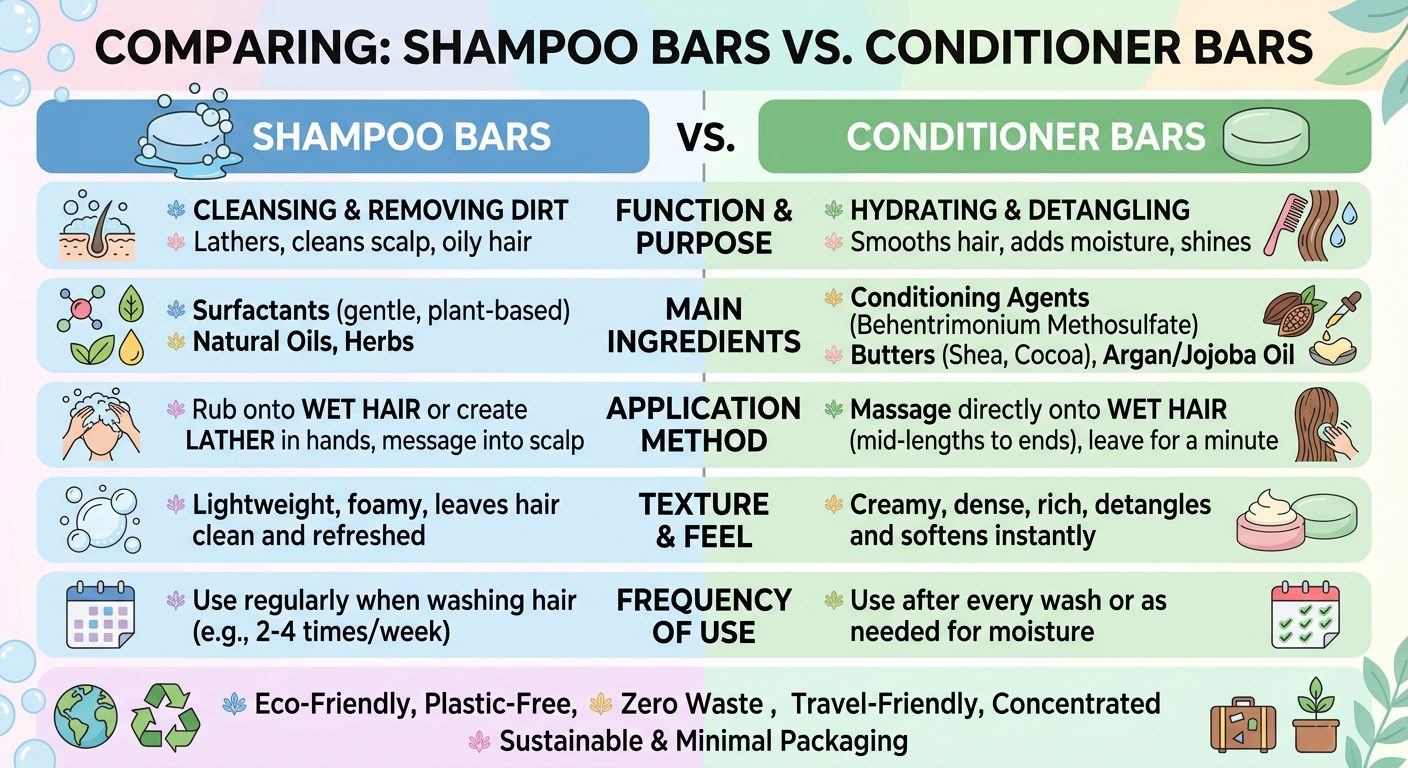
| Feature | Shampoo Bar | Conditioner Bar |
|————-|—————-|———————|
| Primary job | Clean scalp + remove oil | Add moisture + smooth cuticle |
| pH | 9-10 (alkaline cold-process soap — add ACV rinse to seal cuticle) | 4-5.5 (acidic to close cuticle) |
| Application | Scalp focus (roots) | Lengths + ends only (NOT scalp) |
| Rinse timing | Rinse immediately after lather | Leave in 1-3 minutes before rinsing |
| Main ingredients | Saponified plant oils (cold-process soap) | Conditioning agents (BTMS, behentrimonium) |
| Result | Clean, slightly rough hair | Soft, shiny, detangled hair |
| Frequency | Every wash | Every wash OR every 2-3 washes (depends on hair type) |
Do You Need Both? (Depends on Your Hair)
✅ You DEFINITELY Need Both If:
- 1. You have long hair (shoulder-length or longer)
– Longer hair = more exposure to damage, tangles, split ends
– Conditioner prevents breakage during detangling
– Without it: breakage, knots, frizz
- 2. You have dry, damaged, or color-treated hair
– Shampoo alone will make dryness worse
– Conditioner restores moisture balance
– Protects color from fading
- 3. You have curly, coily, or textured hair
– Curly hair is naturally drier (sebum doesn’t travel down curls)
– Conditioner defines curls, reduces frizz
– Essential for slip during detangling
- 4. You live in a hard water area
– Hard water minerals rough up the cuticle
– Shampoo bars (even detergent-based formulas) leave hair feeling coarse
– Conditioner smooths mineral-affected hair
- 5. You wash your hair frequently (every day or every other day)
– Frequent shampooing = more moisture stripped
– Conditioner prevents cumulative dryness
🤔 You MIGHT Skip Conditioner If:
- 1. You have very short hair (pixie cut, buzz cut)
– Short hair = less damage, tangles rare
– Scalp oil reaches ends quickly (natural conditioning)
– Exception: If hair feels rough post-shampoo, still condition
- 2. You have naturally oily hair + scalp
– Excess sebum can make conditioning feel heavy
– Try: Condition lengths/ends only, skip roots
– OR: Use conditioner every 2-3 washes instead of every wash
- 3. You have extremely fine, thin hair
– Heavy conditioners weigh down fine hair
– Solution: Use lightweight conditioner bars (avoid shea butter, use lighter oils like argan)
– OR: Condition ends only, rinse very thoroughly
- 4. You live in a soft water area + have healthy hair
– Soft water doesn’t rough up the cuticle
– Healthy hair retains moisture better
– Shampoo alone may leave hair soft enough
– Try it: Shampoo-only for 2 weeks, see how hair feels
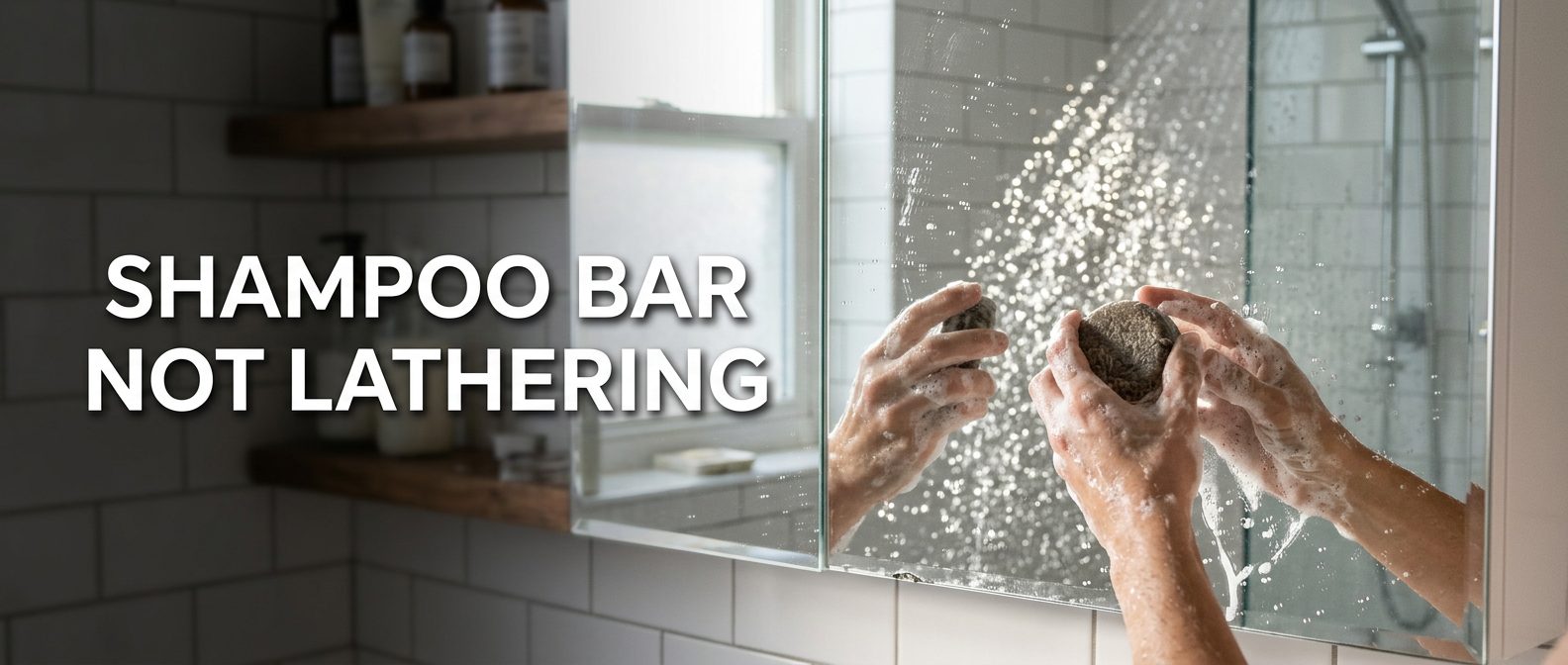
Hard Water Changes Everything
Why Hard Water Makes Conditioner Essential
Hard water (calcium + magnesium minerals) bonds to hair during shampooing. This creates:
- Rough, raised cuticle (minerals stick to hair shaft)
- Dullness (minerals block light reflection)
- Tangles (rough cuticle = friction between hair strands)
- Dryness (mineral buildup prevents moisture absorption)
Natural Answer Products’ Approach (Hard Water-Specific)
Our shampoo bars are formulated with:
- Saponified organic plant oils — real soap, nothing synthetic
- An acidic rinse afterwards (clears mineral film, closes the cuticle)
- pH 9-10 (real soap is alkaline — the acidic rinse is what smooths the cuticle)
How to Use Shampoo + Conditioner Bars Together
Step-by-Step Routine
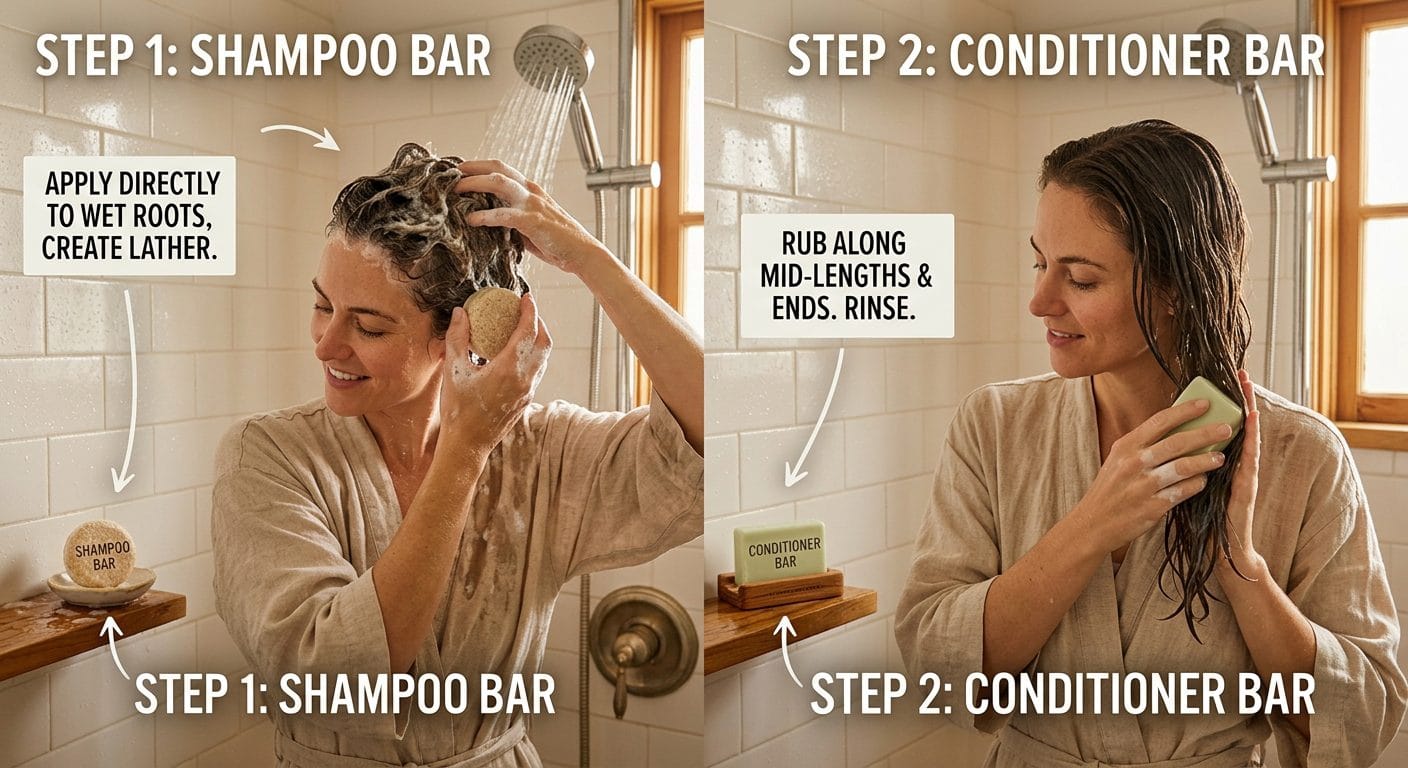
1. Wet hair thoroughly (30 seconds minimum)– Hard water? Use warm water (opens cuticle slightly for better cleansing)
2. Apply shampoo bar to scalp (NOT lengths)– Rub bar directly on scalp OR lather in hands first
– Massage scalp 1-2 minutes (roots only)
– Rinse thoroughly
3. Optional: Apple cider vinegar rinse (hard water areas)– Mix 1 tbsp ACV + 1 cup water
– Pour over hair, wait 30 seconds, rinse
– Helps remove any residual minerals
4. Apply conditioner bar to lengths + ends (AVOID scalp)– Glide bar down wet hair (mid-lengths to tips)
– OR rub between hands, apply to hair
– Focus on ends (driest part of hair)
5. Leave conditioner in 1-3 minutes– Short hair: 1 minute
– Long/damaged hair: 2-3 minutes
– Use time to wash body, shave, etc.
6. Rinse conditioner thoroughly (cold water if possible)– Cold water closes cuticle → extra shine
– Make sure ALL conditioner is rinsed out (avoid buildup)
7. Gently squeeze excess water (don’t rub with towel)– Rubbing = friction = frizz
– Pat or squeeze with microfiber towel OR old t-shirt
Can You Use a 2-in-1 Bar Instead?
What Are 2-in-1 Bars?
Some brands offer “shampoo + conditioner” bars that claim to do both jobs in one product.
How they work:- Mild cleansing surfactants (SCI, coco-betaine)
- Added conditioning agents (oils, BTMS)
- Attempt to balance cleansing + moisture in one formula
Pros of 2-in-1 Bars
✅ Convenience (one bar, one step)
✅ Travel-friendly (less luggage space)
✅ Cheaper (buy one product instead of two)
✅ Works for some hair types (short, healthy, soft water)
Cons of 2-in-1 Bars
❌ Compromise formula: Can’t clean as deeply as pure shampoo OR condition as well as pure conditioner
❌ Greasy roots: Conditioning agents on scalp can cause buildup, oiliness
❌ Not enough moisture for dry hair: Won’t satisfy long, damaged, or curly hair
❌ Hard water struggles: Minerals overpower the conditioning agents
Natural Answer’s recommendation: 2-in-1 bars work for short, healthy hair in soft water. Everyone else benefits from dedicated shampoo + conditioner bars.
Ingredient Differences: What to Look For
Shampoo Bar Ingredients
Surfactants (cleansers):- Sodium Lauryl Sulfoacetate (SLSa) — rich lather, sulfate-free
- Coco-Betaine — mild, sulfate-free
- ❌ Sodium Lauryl Sulfate (SLS) — harsh, stripping (avoid for dry hair)
- Citric acid (hard water protection)
- Glycerin (moisture retention)
- Clay (oil absorption for oily scalps)
- Essential oils (fragrance)
- Heavy oils (coconut oil, shea butter) — too conditioning for a cleanser
- Cold-process soap bars work well with an ACV rinse to clear hard-water minerals
Conditioner Bar Ingredients
Conditioning agents:- BTMS-25 or BTMS-50 (behentrimonium methosulfate) — detangles, smooths
- Cetyl alcohol — moisturizes, thickens
- Cetearyl alcohol — softens, conditions
- Shea butter (thick, heavy — best for dry/curly hair)
- Cocoa butter (rich, protective)
- Argan oil (lightweight, shiny — good for fine hair)
- Jojoba oil (mimics natural sebum)
- Hydrolyzed wheat protein
- Silk amino acids
- Keratin
- Surfactants (SCI, SLS) — those belong in shampoo, not conditioner
- Heavy waxes (if you have fine hair) — can weigh down
Cost Analysis: Is It Worth Buying Both?
Price Comparison (Average)
- Shampoo bar: €9-€13 per bar (60-80 washes)
- Conditioner bar: €10-€14 per bar (50-70 washes)
- Total investment: €19-€27 for BOTH bars
Cost Per Wash
- Shampoo bar: €0.11-€0.22 per wash
- Conditioner bar: €0.14-€0.28 per wash
- Total per wash: €0.25-€0.50
Compare to:
- Liquid shampoo + conditioner bottles: €0.30-€0.80 per wash
- Salon brands: €1.00-€2.50 per wash
Environmental Impact: Two Bars vs. Two Bottles
Plastic Saved (Per Year)
Average person uses:- 6-8 shampoo bottles/year (400ml each)
- 6-8 conditioner bottles/year (400ml each)
- Total: 12-16 plastic bottles
- 3-4 shampoo bars (lasts 12 months)
- 3-4 conditioner bars (lasts 12 months)
- Packaging: Kraft paper, compostable labels
- Plastic saved: 12-16 bottles = ~0.8kg plastic waste
Common Mistakes (And How to Fix Them)
Mistake #1: Conditioning Your Scalp
Why it’s bad: Conditioning agents (BTMS, oils) on scalp = greasy roots, buildup, limp hairFix: Apply conditioner ONLY to mid-lengths and ends. Keep it 2-3 inches away from roots.Mistake #2: Not Rinsing Conditioner Fully
Why it’s bad: Residue = greasy, flat hair + buildup over timeFix: Rinse conditioner 2x longer than you think necessary. Hair should “squeak” slightly when clean.Mistake #3: Using Too Much Conditioner
Why it’s bad: More ≠ better. Excess conditioner weighs down hair, wastes productFix:- Short hair: 3-5 swipes of bar on hair
- Long hair: 8-10 swipes
- Focus on ends (driest part)
Mistake #4: Skipping Conditioner “Because Bars Are Different”
Why it’s bad: Shampoo bars clean hair just like liquids — conditioning is STILL needed (especially in hard water)Fix: If your hair feels rough, tangled, or dry after shampooing, you need conditioner. Period.How to Choose the Right Conditioner Bar
For Fine/Thin Hair
Look for:- Lightweight oils (argan, jojoba, grapeseed)
- Minimal butters (or none)
- Protein additions (wheat, silk) for strength
- Shea butter, cocoa butter (too heavy)
- Waxes (weigh down)
For Thick/Coarse Hair
Look for:- Rich butters (shea, mango, cocoa)
- Heavier oils (coconut, avocado)
- BTMS-50 (stronger conditioning)
- “Lightweight” formulas (won’t penetrate thick strands)
For Curly/Coily Hair
Look for:- Shea butter (moisture + definition)
- Slip agents (BTMS, behentrimonium)
- Glycerin (moisture retention)
- Protein-heavy bars (can make curls crunchy if overused)
For Damaged/Color-Treated Hair
Look for:- Proteins (keratin, silk) for repair
- Argan oil, coconut oil (damage protection)
- pH 4.5-5.5 (seals cuticle, locks in color)
- Clarifying bars (strip color)
- Lemon/citrus essential oils (lighten color over time)
Hard Water Modifications
If you live in a hard water area (120+ ppm):
- 1. Use a chelating shampoo bar (contains citric acid, EDTA) — prevents mineral buildup
- 2. Apple cider vinegar rinse BEFORE conditioning — removes minerals, allows conditioner to penetrate
- 3. Leave conditioner in longer (3 minutes vs. 1 minute) — gives conditioning agents time to bond to mineral-roughened hair
- 4. Consider a water softener shower filter — removes minerals at source (best long-term solution)
- 5. Deep condition 1x/week — counteracts mineral damage
Frequently Asked Questions
Can I use liquid conditioner with a shampoo bar?
Yes! There’s no rule saying you must use bar conditioner. If you prefer liquid, that’s fine. The environmental benefit of the shampoo bar alone is significant.How long do conditioner bars last?
50-70 washes on average. Depends on:- Hair length (long hair uses more)
- How much you apply
- How well you store it (keep dry between uses)
Do conditioner bars work as well as liquid?
Yes — when formulated correctly. High-quality conditioner bars contain the same active ingredients (BTMS, oils, butters) as liquids, just without the water. The difference is application technique (glide bar on hair vs. squeeze bottle).Can I use conditioner bar without shampoo bar?
Not recommended. Conditioner bars don’t clean hair — they only add moisture. Using conditioner alone = greasy, dirty hair. Exception: “co-washing” (conditioning wash) for very dry curly hair, but that requires specific co-wash formulas, not regular conditioner.Will conditioner bars make my hair greasy?
Only if you:- Apply to scalp/roots (condition lengths/ends only)
- Don’t rinse thoroughly
- Use too much product
Can I skip conditioner if I use a “moisturizing” shampoo bar?
Depends. “Moisturizing” shampoo bars contain added oils/glycerin to reduce stripping, but they still can’t condition as deeply as a dedicated conditioner. Try it for 2 weeks — if hair feels soft, great! If not, add conditioner back.The Bottom Line
For most people: YES, you need both shampoo AND conditioner bars for healthy, manageable hair — especially in hard water areas.Exceptions: Very short hair, oily scalps, soft water + healthy hair might get away with shampoo only.The test: Try shampoo-only for 2 weeks. If your hair feels rough, tangles easily, or looks dull, you need conditioner. Simple.Natural Answer Products’ Recommendation
Our shampoo bars are true cold process soap, so in hard water finish with an acidic rinse to keep mineral film off. Conditioning is still essential for:
- Smoothing the cuticle after cleansing
- Adding moisture to lengths/ends
- Detangling long or curly hair
- Protecting color-treated or damaged hair
Related reading: the best shampoo bars for thick hair and How to use an apple cider vinegar rinse with shampoo bars.